




Introduction
NASA is planning what it calls the most complex and ambitious flight mission in its history—and it won’t even leave Earth orbit.
Artemis III, scheduled for 2027, is designed as a full-scale rehearsal for the first crewed lunar landing since Apollo 17. Instead of sending astronauts to the Moon, the mission will keep them in low Earth orbit to test two competing commercial lunar landers: SpaceX’s Starship and Blue Origin’s Blue Moon .
The architecture was finalized in September 2026. If successful, it will set the stage for Artemis IV, which aims to put astronauts on the lunar surface in 2028 .
Why Artemis III Is a Dress Rehearsal, Not a Landing
NASA originally planned for Artemis III to be the first crewed lunar landing. But repeated delays in the development of the Starship Human Landing System forced a redesign. Rather than rushing to the Moon with unproven hardware, NASA inserted an additional mission to test the landers and docking procedures in a safer environment .
The decision reflects a hard lesson from Apollo: complex orbital maneuvers are best rehearsed before committing to a lunar mission. Artemis III will expose hardware and software risks in low Earth orbit, where the crew can return quickly if something goes wrong .
How the Mission Works
Artemis III involves three launches and three spacecraft, all coordinated within a relatively short time window. NASA calls it a “space ballet” .
Step 1: The Landers Launch First
Blue Origin’s Blue Moon Mark 2 test lander will launch first on a New Glenn rocket. The spacecraft is designed to loiter in a “parking orbit” for up to 30 days, allowing mission planners to sequence the rest of the mission without pressure .
Blue Origin’s test vehicle is based on the Mark 2 crewed lander architecture and includes avionics, flight software, and attitude control systems. It will be positioned to receive the Orion spacecraft .
Step 2: Orion Launches and Docks with Blue Moon
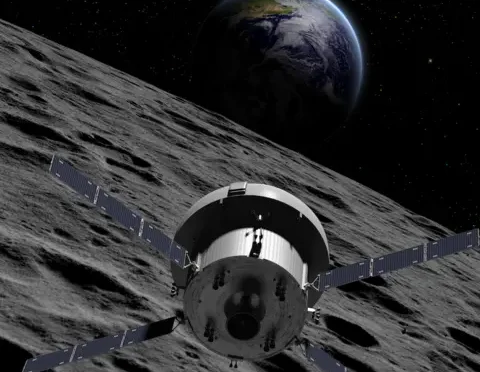
NASA’s Space Launch System rocket will launch the Orion spacecraft with a crew of up to four astronauts. Once in orbit, Orion will rendezvous and dock with the Blue Moon lander .
The docking will be a critical test. Up to two astronauts wearing orange Crew Survival System suits will open the hatch and enter the lander’s cabin, verifying the Environmental Control and Life Support System and internal functions .
Step 3: Starship Launches and Docks with Orion
After the Blue Moon test is complete, SpaceX’s Starship test vehicle will launch and rendezvous with Orion. This docking will test a very different set of challenges .
Starship is a massive vehicle—52 meters tall in its lunar configuration. Orion will dock using a system mounted on Starship’s nose cone. The test will evaluate attitude control and communications between the two spacecraft .
Step 4: Return to Earth
Once both docking tests are complete, the crew will return to Earth aboard Orion, splashing down in the Pacific Ocean .
The Two Landers: Different Designs, Different Challenges
Blue Origin’s Blue Moon Mark 2
Blue Origin’s lander is being developed under a $3.4 billion NASA contract awarded in May 2023. The Mark 2 is designed to carry astronauts from lunar orbit to the surface and back. A full-scale mockup “training cabin” became operational at NASA’s Johnson Space Center in May 2026 for crew training and testing .
Blue Origin’s path to Artemis III has been complicated by the May 2026 explosion of a New Glenn rocket during a static fire test at Cape Canaveral. The explosion destroyed the rocket and heavily damaged the launch complex . Blue Origin CEO Dave Limp said the company aims to return to flight by the end of 2026, but the cause of the anomaly remains under investigation .
SpaceX’s Starship
SpaceX’s Starship is the largest rocket ever built, standing over 120 meters tall when fully stacked. Its lunar variant requires orbital refueling—a capability that has not yet been demonstrated. In September 2026, SpaceX was preparing for Flight 14, which would be the first attempt to place Starship in Earth orbit and deploy Starlink V3 satellites .
Starship’s development has progressed through iterative test flights. Flight 12, in May 2026, was the first flight of the V3 vehicle and the first from Pad 2. The booster experienced a hard splashdown, and the upper stage lost one engine during ascent, but the vehicle achieved its planned trajectory and successfully deployed Starlink simulators .
Flight 13, in July 2026, successfully deployed 20 Starlink V3 satellites on a suborbital trajectory and demonstrated in-orbit engine relight .
The Stakes for Artemis IV
Artemis III is not just a test. It is the gate through which Artemis IV must pass. If the docking tests reveal problems with either lander, the 2028 lunar landing could slip.
NASA’s current roadmap calls for Artemis IV to send astronauts to the lunar south pole in 2028 . But that timeline depends on both landers being ready. NASA has also selected Blue Origin to provide a lander for a subsequent mission, giving the agency two independent paths to the surface .
The New Glenn explosion has raised questions about whether Blue Origin can meet the schedule. Industry experts have voiced skepticism that either company can achieve the necessary benchmarks in time . NASA’s own assessments have acknowledged the technical challenges .
What Comes After Artemis IV
NASA’s ambitions extend far beyond a single landing. The agency plans to establish an initial lunar base by 2030, with semi-permanent crew presence by 2032 .
The first phase of the Moon Base program includes 25 launches, 21 landings, and four metric tons of cargo by 2029. Blue Origin’s uncrewed Blue Moon Mark 1 lander, nicknamed Endurance, is expected to launch as early as fall 2026—the first privately funded lunar lander mission in history .
NASA Administrator Jared Isaacman has described the lunar surface as “as beautiful as it is hostile,” noting temperature swings from 250 degrees Fahrenheit in sunlight to minus-400 degrees in permanently shadowed craters .
Conclusion
Artemis III represents a new approach to lunar exploration: test everything in low Earth orbit before committing to the Moon. The mission will be the most complex orbital operation NASA has attempted, involving three launches, three spacecraft, and two commercial landers.
If it succeeds, Artemis IV will follow in 2028. If it fails, NASA will have learned critical lessons without risking a crew on the lunar surface. Either way, the era of Apollo-style single-agency missions is over. The return to the Moon will be a partnership between NASA and private industry—with all the promise and risk that entails.


