




Introduction: The Growing Role of Digital Twin Technology in America
Technology is changing how American businesses design products, manage facilities, maintain equipment, and make operational decisions. Artificial intelligence, cloud computing, connected sensors, and advanced simulation tools are helping companies understand their physical operations in ways that were difficult to achieve just a few years ago. One technology bringing these capabilities together is the digital twin.
A digital twin is a digital representation of a physical object, process, building, machine, or larger system. Depending on its design, it can use information from sensors, operating records, engineering models, and other data sources to reflect the condition of its real-world counterpart. Advanced digital twins can also simulate possible outcomes, identify unusual behavior, and help organizations evaluate decisions before making expensive physical changes.
In the United States, digital twin technology is attracting attention across manufacturing, aerospace, energy, construction, transportation, and infrastructure management. Companies are exploring ways to improve productivity, reduce equipment downtime, enhance product quality, and make complex systems easier to manage.
The National Institute of Standards and Technology (NIST) has identified digital twins as an important part of advanced manufacturing. Its research focuses on developing reliable methods, testing approaches, and standards that can help organizations build digital twins that work accurately and consistently. Readers can explore its Digital Twins for Advanced Manufacturing program for further information.
As the American economy continues to adopt connected technologies, digital twins could become an increasingly valuable tool for businesses that want to combine real-world operations with digital analysis.
What Is a Digital Twin and How Does It Work?
A digital twin is more than a conventional three-dimensional model or a static digital drawing. Its defining feature is its connection to information about a real-world asset or process. Depending on the implementation, the digital representation may receive regular updates or continuously process incoming operational data.
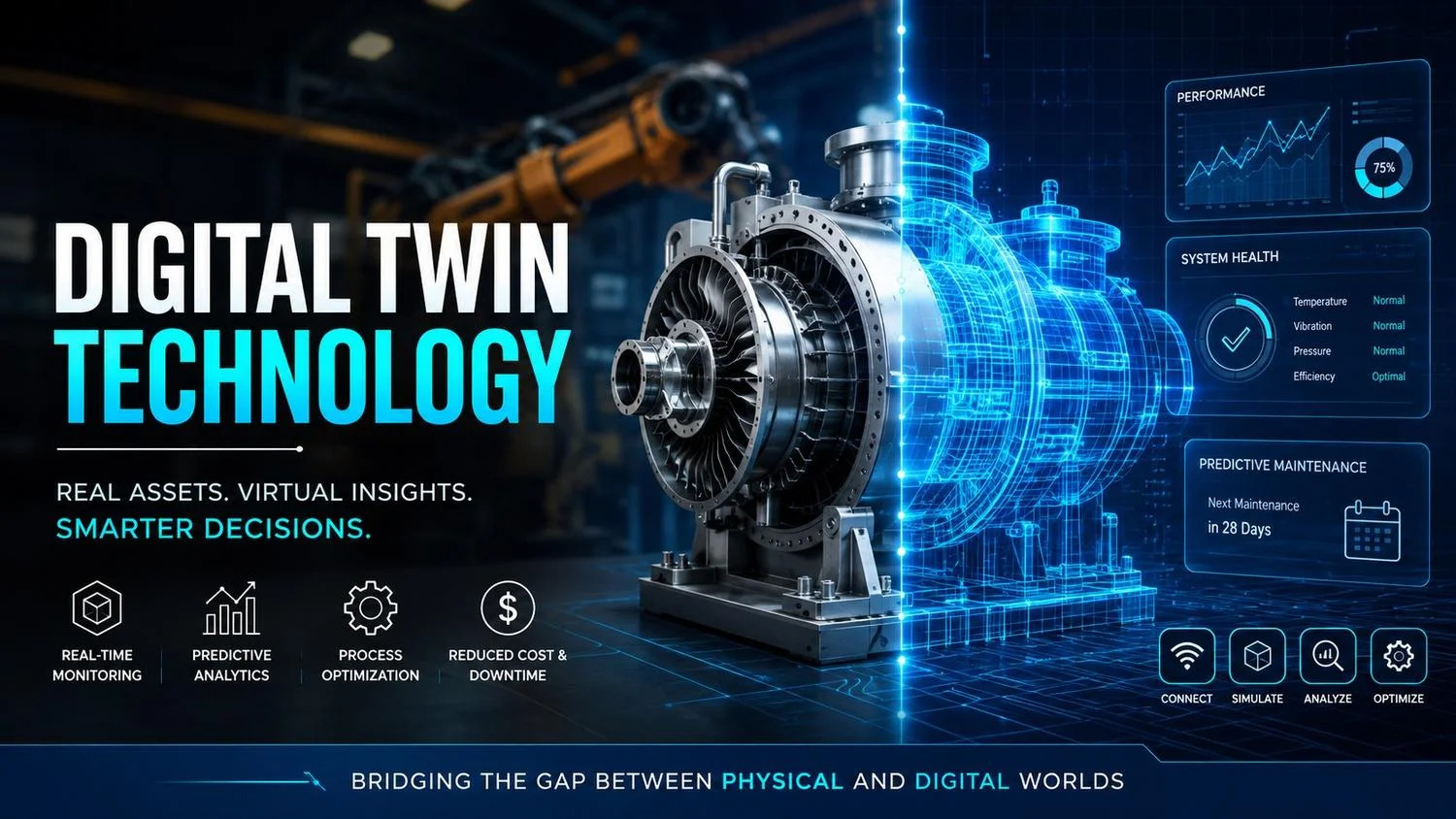
For example, imagine an American manufacturing company operating a large industrial machine. Sensors can measure temperature, vibration, pressure, speed, and other operating conditions. A digital twin can combine these measurements with engineering information and historical records to help operators understand how the machine is performing.
If vibration begins to increase beyond its normal range, the system may identify an emerging problem. More advanced analytical models might estimate how different operating conditions affect the machine and help maintenance teams decide whether an inspection is necessary.
The same general approach can be applied to an office building, aircraft component, electrical system, production line, or water treatment facility.
The Main Components of a Digital Twin
1. Physical asset or process
This is the real object or system being represented. It could be a factory machine, an aircraft engine, a commercial building, or an industrial production process.
2. Data collection systems
Sensors, connected devices, equipment controllers, and operational software collect information about the physical environment. Some applications also use maintenance records, design specifications, and historical measurements.
3. Digital model
The model represents relevant characteristics of the physical asset. It may include geometry, engineering calculations, operating rules, material properties, or simulations of how the system behaves under different conditions.
4. Data integration and computing infrastructure
The digital twin needs a way to combine information from different sources. Depending on the project, this infrastructure may include local computers, industrial networks, cloud platforms, or edge computing systems.
5. Analytics, simulation, and artificial intelligence
Analytical tools can compare current measurements with expected behavior, simulate alternative operating conditions, and help identify potential problems.
6. Visualization and decision support
Engineers, technicians, and managers use dashboards, reports, simulations, or three-dimensional interfaces to understand results and make decisions.
Not every digital twin includes all these components. A basic implementation might simply monitor a machine’s condition, while a more advanced system may simulate complex interactions across an entire facility.
Why Digital Twin Technology Matters in the USA in 2026
American companies face pressure to improve productivity, manage operating expenses, maintain aging equipment, and respond to changing customer demand. At the same time, businesses are investing in AI, automation, and digital infrastructure.
Digital twins can help connect these investments by providing a structured digital representation of physical operations.
NIST’s research highlights several potential benefits, including better production planning, improved product quality, reduced manufacturing costs, and more informed equipment maintenance. The organization is also working on the measurement science and standards needed to make digital twin systems more trustworthy and easier to integrate.
Several factors are supporting interest in the technology.
Increasing Adoption of Industrial Sensors
Connected sensors make it easier to collect information from equipment and facilities. Temperature, vibration, energy consumption, pressure, and other measurements can provide valuable insight into operating conditions.
When this information is connected to a suitable digital model, organizations can move beyond periodic inspections toward more data-informed monitoring.
Greater Availability of Artificial Intelligence
AI can help analyze large amounts of operational information and identify patterns that may be difficult to recognize manually. When integrated appropriately, AI can support anomaly detection, forecasting, and simulation-based decision-making.
However, AI predictions are only as useful as the data and models supporting them. Companies still need validation, monitoring, and expert oversight.
Growth in Cloud and Edge Computing
Cloud platforms can support large-scale data storage, collaboration, and computationally intensive simulations. Edge computing allows some processing to take place near machines and sensors, which can be important when low latency or limited network connectivity matters.
Many industrial deployments use a combination of both approaches.
Demand for More Efficient Operations
Equipment failures, production interruptions, construction delays, and inefficient energy use can create substantial financial losses. A well-designed digital twin may help companies investigate these issues, test alternatives, and prioritize improvements.
The potential benefits are significant, but actual results vary according to the asset being modeled, the quality of the implementation, and how effectively employees use the information.
Digital Twins in American Manufacturing
Manufacturing is one of the most important application areas for digital twin technology. American factories operate complex production lines involving industrial robots, machine tools, sensors, conveyors, quality-control systems, and other equipment.
A digital twin can represent an individual machine, an assembly line, or an interconnected production process.
Improving Production Planning
Before changing a production line, engineers may need to understand how the modification will affect output, material movement, staffing, and equipment utilization.
A digital twin can provide a simulated environment for evaluating these changes. Engineers may compare alternative production schedules, examine bottlenecks, or test different equipment arrangements before implementing them in a physical facility.
This can reduce the need for expensive trial-and-error changes on an active production floor.
Predictive Maintenance and Equipment Monitoring
Unexpected equipment failures can interrupt manufacturing and create repair expenses. Digital twins can combine sensor measurements with maintenance history and engineering models to support condition monitoring.
For example, a system may identify that a motor is operating at an unusual temperature or that a machine’s vibration pattern has changed. Maintenance personnel can investigate the warning and determine whether corrective action is needed.
A digital twin does not automatically prevent failures. Its value depends on the accuracy of the model, the quality of the measurements, and the maintenance team’s ability to act on the findings.
Improving Product Quality
Manufacturers can use digital models to examine how different operating conditions influence product quality. A twin of a production process might help engineers investigate why defects appear more frequently during certain shifts or under specific machine settings.
By identifying relationships between process conditions and product outcomes, companies may be able to improve consistency and reduce waste.
Supporting American Semiconductor Manufacturing
Semiconductor production involves tightly controlled processes, specialized equipment, and extremely demanding quality requirements. Small variations in manufacturing conditions can affect yield and product reliability.
Digital twins can help represent equipment behavior, production workflows, and selected process conditions. They may support simulation, process optimization, and investigations into manufacturing problems.
The US government has also supported work in this area. In December 2024, the Department of Energy announced its expected involvement through national laboratories in the planned SMART USA manufacturing institute initiative focused on digital twins for semiconductor production. Readers can review the Department of Energy announcement.
These initiatives demonstrate the importance of digital simulation and data-driven manufacturing research, although the benefits of individual implementations must be evaluated on their own merits.
Digital Twin Technology in Aerospace and Aviation
The United States has a substantial aerospace industry, including aircraft manufacturers, aviation service providers, research organizations, and space technology companies.
Aircraft and spacecraft contain complex systems that must operate reliably under demanding conditions. Engineers need to understand how components behave under different loads, temperatures, vibration levels, and environmental conditions.
Digital twins can support several stages of the aerospace lifecycle.
Aircraft Design and Engineering
Engineers can use digital representations to evaluate component designs and simulate different operating conditions. Virtual testing may help identify design weaknesses earlier, when changes can be less expensive than modifying a completed physical product.
Such models can complement physical testing, engineering analysis, and established certification procedures.
Aircraft Maintenance
Digital twins may help maintenance teams organize information about component condition, operating history, and inspection requirements. When reliable data is available, analytical tools can support the identification of unusual behavior and help prioritize further inspection.
This approach can be especially valuable when equipment maintenance requires specialized expertise or costly downtime.
Spacecraft and Mission Planning
Space missions involve complex systems, limited opportunities for physical intervention, and operating environments that are difficult to reproduce completely on Earth.
Digital models and simulations can help engineers evaluate system behavior, test mission scenarios, and investigate potential problems. Depending on the application, a digital twin may also incorporate telemetry from an operating spacecraft.
These tools can support decision-making, but they do not eliminate the need for rigorous engineering validation and mission-specific testing.
Digital Twins in Construction and Smart Buildings
Construction projects frequently involve complicated coordination between architects, engineers, contractors, equipment suppliers, and facility operators. Information can become fragmented when different teams use separate software systems.
Digital twins can help connect selected building information with operational data collected after construction.
Better Building Design and Project Coordination
A digital representation of a building can help project teams review spatial arrangements, mechanical systems, electrical infrastructure, and other design elements.
When integrated with building information modeling (BIM), a digital twin can build on design data and, where appropriate, incorporate information from the completed building.
Teams may use this information to investigate equipment placement, evaluate maintenance access, or understand how building systems interact.
Energy Efficiency and Building Operations
Commercial buildings consume energy for heating, cooling, lighting, ventilation, and other activities. Digital twins can combine information from building management systems with occupancy patterns, weather data, and equipment measurements.
Operators can then investigate energy use and evaluate potential adjustments.
For example, a facility manager might compare alternative HVAC operating schedules or examine whether particular areas consume more energy than expected.
A digital twin does not guarantee lower energy bills. Savings depend on the accuracy of the data, the building’s design, the chosen interventions, and how consistently improvements are maintained.
Infrastructure Maintenance
Digital twins may also be used to represent bridges, roads, water systems, and other infrastructure. By combining inspection records, engineering information, and sensor data where available, agencies can develop a clearer view of infrastructure conditions.
These applications could help maintenance teams prioritize inspections and plan repairs. Nevertheless, digital models should supplement rather than replace required inspections, engineering judgment, and safety procedures.
Digital Twin Technology in the Energy Industry
Energy systems contain many interconnected assets, including power plants, transmission equipment, renewable energy installations, industrial facilities, and storage systems.
Digital twins can help operators understand how these assets behave and evaluate different operating strategies.
Power Generation and Equipment Reliability
Power generation facilities rely on machinery that may operate for long periods under demanding conditions. A digital twin can help represent equipment performance and compare current measurements with expected operating behavior.
Maintenance teams may use this information to investigate unusual readings, plan servicing, and understand how operating conditions affect equipment.
Renewable Energy Systems
Wind turbines and solar installations operate under changing environmental conditions. Digital twins can help operators examine equipment performance, environmental influences, and maintenance requirements.
For a wind turbine, a model might combine operating data with information about wind conditions and component behavior. For a solar installation, analysis could examine energy output, equipment condition, and the effects of environmental factors.
The usefulness of these systems depends on the quality of available data and the suitability of the model for the particular installation.
Grid Planning and Energy Storage
Digital twins can support the simulation of electrical networks and selected energy infrastructure. Engineers may use digital models to examine how a proposed change could influence system performance or to evaluate operating scenarios.
Battery storage projects may also benefit from models that help analyze charging behavior, operating temperatures, degradation estimates, and expected energy demand.
Because electrical infrastructure is safety-critical, these tools must be carefully validated and integrated into established engineering and operational processes.
The Role of Artificial Intelligence in Digital Twin Development
AI is expanding the ways organizations can use digital twins. Traditional engineering models often depend on predefined equations, physical assumptions, and carefully specified operating conditions. AI techniques can complement these methods by learning patterns from historical and real-time data.
Anomaly Detection
AI systems may identify patterns that differ from normal operating behavior. For example, an industrial machine may develop a combination of temperature and vibration changes that suggests a need for investigation.
The system can alert an operator, who can then examine the evidence and decide whether action is necessary.
Predictive Analytics
A digital twin may use historical data, operating measurements, and simulation results to estimate possible future conditions. These estimates can help organizations plan maintenance, assess capacity, and compare operational strategies.
Predictions should be treated as estimates rather than guarantees, particularly when conditions change or the system encounters situations not represented in its training data.
Scenario Testing
AI-assisted simulation can help engineers compare alternative decisions. A manufacturing team might evaluate different production schedules, while a building operator could investigate several temperature-control strategies.
The goal is not simply to generate more data. It is to help people make better-informed decisions.
Generative AI and Natural-Language Interfaces
Emerging interfaces may allow users to ask questions about digital models using ordinary language. For example, an engineer might ask which production line experienced the most interruptions during a selected period.
Such interfaces can make complex systems easier to use, provided that the underlying data is accessible, the answers are grounded in verified information, and access permissions are respected.
Major Benefits of Digital Twin Technology for US Businesses
Digital twins can offer practical advantages when they address a clearly defined operational problem.
Reduced equipment downtime: Condition monitoring and predictive analysis may help teams identify developing problems before they lead to major interruptions.
Improved product quality: Simulation and process analysis can help manufacturers investigate defects and understand the effects of changing production conditions.
Better operational planning: Organizations can compare alternative scenarios before committing to expensive physical changes.
More informed maintenance decisions: Asset information can help maintenance teams prioritize inspections and plan repairs around operational requirements.
Greater visibility across operations: Connecting relevant data can help managers understand how equipment, processes, and facilities influence one another.
Support for product development: Engineers can evaluate design options digitally before building or modifying physical prototypes.
Potential cost savings: Better planning, fewer avoidable interruptions, and more efficient resource use may reduce costs. However, benefits must be measured against implementation and ongoing operating expenses.
For businesses in the United States, the most successful projects will generally be those that connect these capabilities to measurable goals rather than adopting digital twins simply because the technology is attracting attention.
Challenges and Limitations of Digital Twin Adoption
Despite their potential, digital twins are not simple solutions that every company can implement immediately.
High Initial Investment
Developing a digital twin may require sensors, networking equipment, software licenses, engineering work, cloud infrastructure, and specialist employees.
A complex system representing an entire industrial facility can be expensive to develop and maintain. Companies should begin by identifying a specific operational problem and estimating the expected return before expanding the project.
Data Quality Problems
Digital twins rely on accurate, relevant information. Missing measurements, inconsistent timestamps, outdated specifications, and incompatible data formats can reduce model reliability.
Organizations may need to improve data collection and management before a digital twin can provide meaningful results.
Integration With Older Equipment
Many American factories and facilities operate equipment that was installed years or decades ago. Older systems may not support modern communication protocols or continuous data collection.
Connecting them to a digital twin can require additional sensors, interface equipment, custom software, or changes to existing processes.
Cybersecurity and Privacy
A digital twin may contain sensitive information about industrial processes, building systems, equipment performance, or operational schedules. If connected to operational technology, it can also introduce new pathways that require careful security management.
NIST’s report on Security and Trust Considerations for Digital Twin Technology discusses security and trust concerns associated with these systems.
Organizations should apply appropriate access controls, network segmentation, secure data handling, software updates, monitoring, and incident-response procedures. They should also carefully assess whether a digital twin needs permission to send commands to physical equipment or should remain limited to monitoring and analysis.
Lack of Interoperability
Different vendors may use different data structures, interfaces, and modeling methods. As a result, information may not transfer easily between systems.
NIST has emphasized the importance of standards, common terminology, reliable validation, and interoperability. Its work on manufacturing digital twins highlights how standardized approaches can make solutions easier to integrate and reuse.
Skills and Workforce Training
Digital twin projects can require knowledge of engineering, data science, industrial operations, software integration, and cybersecurity.
Employees may need training to understand model limitations, interpret analytical results, and incorporate digital information into established workflows.
Model Accuracy and Validation
A digital representation is not automatically an accurate representation. Models can become outdated as equipment changes, operating conditions shift, or new data becomes available.
Companies should verify models against physical measurements, document assumptions, monitor performance, and update systems when necessary.
Digital Twin Standards and US Research Initiatives
Standards are important because digital twins often need to exchange information with software and equipment developed by different organizations.
NIST has been working on methods and technical guidance for advanced manufacturing digital twins. Its research addresses implementation requirements, data management, model validation, uncertainty, and interoperability.
One relevant framework is ISO 23247, a series of standards addressing digital twin frameworks for manufacturing. It provides a structured basis for considering how manufacturing systems and their digital representations interact.
NIST’s manufacturing digital twin standards publication explains why standardization matters for practical implementation.
In July 2026, NIST also published a workshop summary addressing digital twin research priorities, including interoperability, validation, cybersecurity, and workforce readiness. The report reflects ongoing efforts to make these systems more reliable and scalable.
For American businesses, standards and research guidance can help reduce uncertainty during implementation. They cannot eliminate every integration problem, but they provide useful starting points for designing systems that are easier to evaluate, maintain, and connect with other technologies.
How Small and Medium-Sized US Businesses Can Get Started
Digital twin technology is not limited to major corporations. Smaller manufacturers and service providers may also benefit from targeted implementations, provided that the scope remains manageable.
Step 1: Identify a Specific Business Problem
Begin with an issue that can be measured, such as recurring equipment failures, excessive energy consumption, production bottlenecks, or difficulty coordinating maintenance.
A clearly defined problem makes it easier to decide whether a digital twin is the right solution.
Step 2: Choose a Suitable Asset
Rather than modeling an entire facility, start with one machine, production cell, building system, or operational process.
A smaller pilot project can help the organization learn what data and technical resources are required.
Step 3: Review Available Data
Determine whether the necessary sensor readings, maintenance records, engineering specifications, and operational data already exist.
Identify missing information and assess whether additional sensors or software integration will be necessary.
Step 4: Establish Measurable Goals
Set practical targets before implementation. These might include reducing unplanned downtime, improving production consistency, shortening troubleshooting time, or identifying energy inefficiencies.
Record the baseline so that results can be compared fairly after deployment.
Step 5: Test and Validate the Model
Compare the digital twin’s results with actual measurements and observed outcomes. Document limitations and investigate significant differences.
Do not rely on predictions until the system has been evaluated under conditions relevant to its intended use.
Step 6: Measure Results Before Expanding
After the pilot runs for an appropriate period, evaluate its performance, total cost, employee adoption, and maintenance requirements.
Expand only when the evidence supports doing so. A focused digital twin that solves a real problem may deliver more value than a complicated platform with no clear operational purpose.
The Future of Digital Twin Technology in the USA
Digital twins are likely to continue evolving as sensor technology, AI, computing infrastructure, and simulation tools improve. Their future will depend on whether organizations can turn increasingly detailed digital representations into reliable operational improvements.
More Connected Industrial Systems
Future projects may connect equipment-level twins with production-line, facility, and supply-chain models. This could help organizations investigate how changes in one part of an operation affect the wider system.
Achieving this requires consistent data definitions, compatible software, and careful coordination between teams.
Better Integration With AI
AI could help automate selected analysis tasks, identify unusual behavior, and assist with scenario evaluation. However, companies will still need controls that distinguish reliable conclusions from uncertain predictions.
Greater Use in Infrastructure Planning
As infrastructure operators seek better ways to manage assets, digital twins may help combine engineering information, inspection records, and selected sensor data.
Applications could include transportation networks, commercial buildings, water infrastructure, and energy systems. Their adoption will depend on funding, data availability, technical readiness, and regulatory requirements.
More Accessible Tools for Smaller Organizations
Cloud services, modular software, and standardized interfaces may make some digital twin capabilities easier to deploy without building every component from scratch.
Even so, smaller organizations will need to consider subscription costs, data ownership, cybersecurity, vendor dependence, and the expertise required to maintain their systems.
Stronger Emphasis on Trust and Verification
As digital twins become more influential in operational decisions, companies will need clearer evidence that their models are fit for purpose. Testing, validation, uncertainty analysis, and security reviews will remain important areas of development.
The long-term opportunity is not simply to create digital copies of physical assets. It is to make those representations sufficiently accurate, secure, and useful to improve real-world decisions.
Conclusion
Digital twin technology is becoming an important part of the broader digital transformation taking place across the United States. By connecting physical assets with digital models, operational data, and analytical tools, organizations can gain a better understanding of how their equipment, facilities, and processes behave.
Manufacturing companies may use digital twins to investigate production bottlenecks and improve maintenance planning. Aerospace engineers can use digital representations to support design and simulation. Building operators may analyze energy use, while infrastructure teams can explore ways to improve asset monitoring and maintenance.
Artificial intelligence, connected sensors, cloud computing, and simulation tools are expanding what digital twins can do. At the same time, implementation costs, cybersecurity risks, data quality, interoperability, and model validation remain significant considerations.
For American businesses considering this technology in 2026, a practical approach is to start with a specific problem, establish measurable goals, test the model carefully, and expand only when results justify the investment.
Digital twins are not a replacement for engineering expertise or real-world testing. Used responsibly, however, they can provide an additional layer of insight that helps organizations plan more effectively, understand complex systems, and make better-informed decisions.
Frequently Asked Questions (FAQs)
1. What is digital twin technology?
Digital twin technology creates a digital representation of a physical object, process, or system. Depending on the application, it can use sensor data, engineering models, and operational records to monitor conditions, simulate scenarios, and support decision-making.
2. How is digital twin technology used in the USA?
In the United States, digital twins are being developed and used across areas such as manufacturing, aerospace, construction, energy, infrastructure, and building management. Specific applications vary according to the industry’s requirements and the organization’s technical capabilities.
3. What is the difference between a digital twin and a 3D model?
A conventional 3D model usually represents an object’s geometry or design. A digital twin adds a relationship with information about a real-world asset or process. Some digital twins update from operational data and support analysis or simulation, while a static 3D model generally does not.
4. Can digital twins use artificial intelligence?
Yes. AI can support anomaly detection, predictive analysis, pattern recognition, and scenario evaluation. The quality of these capabilities depends on the available data, model design, validation, and appropriate human oversight.
5. Which industries benefit most from digital twin technology?
Manufacturing, aerospace, construction, energy, transportation, and infrastructure management are important application areas. The greatest benefit usually occurs when the technology addresses a specific problem involving equipment reliability, product quality, system planning, or operational efficiency.
6. Are digital twins expensive to implement?
Costs vary considerably. A small pilot involving a single machine may be more manageable than a digital twin representing an entire factory or infrastructure network. Companies should consider software, sensors, integration, data management, cybersecurity, employee training, and ongoing maintenance.
7. Are digital twins secure?
They can be designed with strong security controls, but they are not automatically secure. Organizations should evaluate access permissions, network connections, data sensitivity, software vulnerabilities, and the potential consequences of unauthorized access.
8. What is the role of NIST in digital twin technology?
NIST conducts research and develops technical guidance related to digital twin implementation, manufacturing standards, measurement science, model validation, and interoperability. Its work supports efforts to make digital twins more reliable and practical for American industry.
9. Can small businesses use digital twin technology?
Yes. Small businesses can begin with a limited project focused on a specific machine, process, or facility system. A pilot with clear goals and measurable results can help determine whether a broader investment makes sense.
10. What is the future of digital twin technology in 2026 and beyond?
Potential developments include stronger AI integration, better interoperability, improved simulation capabilities, and wider use in manufacturing and infrastructure. Adoption will depend on cost, technical readiness, cybersecurity, data quality, and demonstrated business value.


