


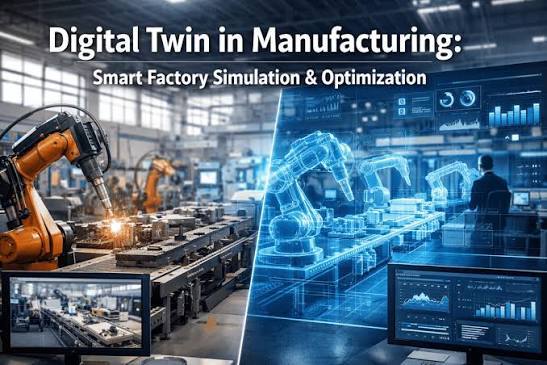


Introduction: The Growing Importance of Digital Twin Technology in America
Technology is changing the way American companies design products, operate factories, maintain infrastructure, and plan for the future. One of the most promising developments is digital twin technology, which allows organizations to create virtual representations of real-world objects, machines, buildings, and entire systems.
A digital twin is more than a traditional 3D model. It can combine real-world measurements, sensor data, engineering simulations, and artificial intelligence to help users understand how a physical asset is performing. Depending on its design, the virtual model can also help predict equipment failures, test potential improvements, and evaluate different operating conditions before changes are made in the real world.
In the United States, digital twins are attracting attention across manufacturing, aerospace, energy, transportation, construction, and other industries. Organizations are looking for better ways to manage complex operations, reduce unnecessary downtime, improve product quality, and make informed investment decisions.
The National Institute of Standards and Technology (NIST) is actively researching digital twins for advanced manufacturing. Its work focuses on making these systems more reliable, measurable, interoperable, and easier to implement. In July 2026, NIST also published a report summarizing industry and research discussions about the future of digital twins in manufacturing.
As businesses face increasing pressure to improve productivity and use resources efficiently, digital twin technology is becoming an important area of industrial innovation. However, its success depends on accurate data, realistic models, cybersecurity, and careful implementation.
What Is Digital Twin Technology?
Digital twin technology creates a digital representation of a physical object, process, or system. The model can use information from the real world to reflect how the corresponding physical asset behaves.
For example, a manufacturing company might create a digital twin of a production machine. Sensors could provide information about temperature, vibration, operating speed, and energy consumption. The virtual model could use that information to help engineers understand the machine’s condition and identify unusual patterns.
A digital twin can represent several types of assets, including:
- Industrial machines and production equipment
- Commercial buildings and HVAC systems
- Aircraft engines and aerospace components
- Electric power networks and energy infrastructure
- Bridges, roads, and transportation systems
- Water treatment facilities
- Warehouses and supply chain operations
The sophistication of a digital twin varies. Some models update periodically using operational data, while others synchronize with physical systems frequently or continuously.
A digital twin does not automatically control the physical asset. Monitoring, simulation, forecasting, and automated control are separate capabilities that must be designed and validated for the intended application.
How Does a Digital Twin Work?
A digital twin typically combines several technology components.
1. Physical asset: The real machine, building, vehicle, or infrastructure system being represented.
2. Sensors and data collection: Devices and software gather measurements such as temperature, pressure, movement, energy use, or equipment status.
3. Data integration: Information from sensors, business applications, engineering files, and operational systems is collected and organized.
4. Digital model: Engineers develop a virtual representation of the physical asset or process using mathematical models, simulations, 3D representations, or combinations of these approaches.
5. Analytics and artificial intelligence: Analytical tools may identify patterns, estimate future performance, or detect conditions that require attention.
6. Visualization and decision-making: Operators and engineers use dashboards, simulations, and reports to evaluate conditions and choose appropriate actions.
When these components work together effectively, a digital twin can help organizations move beyond simply recording what happened. It can also help them investigate why something happened and evaluate what might happen under different conditions.
Why Digital Twin Technology Matters in the USA in 2026
The United States has a large and diverse industrial economy. Manufacturers, utilities, transportation operators, technology companies, and public agencies manage assets that can be expensive to repair or replace.
Digital twins offer a way to study complex systems without repeatedly experimenting on the physical equipment itself.
For example, a factory might use a digital model to test a revised production schedule before changing its actual production line. An energy operator could evaluate different operating conditions in a model before modifying a system. A construction team could use a digital representation of a building to improve coordination between design and operations.
Several technological developments are supporting this approach:
- Artificial intelligence: AI can help analyze large volumes of operational data and identify patterns.
- Industrial Internet of Things: Connected sensors can provide measurements from machines and facilities.
- Cloud computing: Cloud platforms can provide storage and computing resources for complex models.
- High-performance computing: Advanced computing can support detailed simulations and engineering analysis.
- Advanced visualization: Interactive 3D environments can make complicated systems easier to understand.
These technologies do not guarantee that every digital twin will deliver financial savings. The value depends on whether the model addresses a real operational problem and whether the information it produces improves decisions.
1. Digital Twins in American Manufacturing
Manufacturing is one of the most important applications of digital twin technology.
American factories operate complex production lines containing industrial robots, conveyor systems, machine tools, sensors, and quality-control equipment. Even a small disruption can affect production schedules, delivery commitments, and operating costs.
Digital twins allow manufacturers to create virtual representations of individual machines, production lines, and entire facilities.
Improving Production Efficiency
A digital twin of a production line can help engineers evaluate how materials move through different stages of manufacturing.
Suppose a factory produces electronic components. One station may process items faster than the next station can handle them. This creates a bottleneck that reduces overall production efficiency.
By simulating the production line, engineers can compare different equipment configurations, staffing arrangements, and operating schedules before making physical changes.
The results can help teams identify potential improvements while reducing the need for expensive trial-and-error experimentation.
Predictive Maintenance
Traditional maintenance schedules often depend on operating hours, calendar dates, or visible equipment problems. Although these approaches remain useful, they may not identify every developing issue.
A digital twin can combine equipment data with engineering models and historical maintenance records to help identify unusual operating conditions.
For example, increasing vibration and temperature readings might indicate that a motor requires inspection. The system could alert maintenance personnel before the problem causes a larger disruption.
Such predictions are not always correct, and they should not replace required inspections or safety procedures. Their usefulness depends on sensor quality, historical data, and the reliability of the analytical model.
Improving Product Quality
Manufacturers can also use digital twins to investigate why defects occur.
A model may help engineers examine the relationship between production speed, material conditions, machine temperature, and product quality. This can support more systematic troubleshooting.
NIST identifies increased production, improved product quality, and lower manufacturing costs among the potential benefits of digital twins. Its research also highlights the need for dependable standards and testing methods.
Source: https://www.nist.gov/programs-projects/digital-twins-advanced-manufacturing
2. Digital Twin Technology in the American Energy Sector
Energy infrastructure is another important area for digital twin development.
The United States depends on extensive networks of power plants, transmission lines, substations, renewable energy facilities, batteries, and distribution equipment. Operators must manage these systems while balancing demand, reliability, maintenance, and changing energy conditions.
Digital twins can provide a virtual environment for examining how different parts of an energy system behave.
Power Grid Planning and Operations
A digital twin of an electrical network can combine engineering information, equipment records, and operational measurements.
Engineers may use such a model to investigate possible equipment failures, study changes in electricity demand, or evaluate proposed infrastructure upgrades.
For example, a utility considering a new industrial connection could model different operating scenarios to understand potential effects on equipment loading and network performance.
The model can support planning, but its results must be checked against accurate network information and appropriate engineering methods.
Renewable Energy Management
Solar and wind installations operate under changing environmental conditions. Their output can vary with sunlight, wind speed, weather, and equipment availability.
A digital twin may help operators compare expected output with actual performance and identify equipment that is not functioning as expected.
At a wind farm, for instance, a model could help engineers study turbine performance and plan maintenance. At a solar facility, it could support investigations into inverter performance, energy production, or equipment degradation.
Water Treatment and Energy Efficiency
Digital twin technology can also support essential public services.
In May 2026, Oak Ridge National Laboratory reported on research involving a digital twin for water purification. The system connects a virtual model with a real-world pilot operation and uses information about operating conditions and energy prices to help improve performance.
The project illustrates how digital twins can support both infrastructure management and resource efficiency.
Source: https://www.ornl.gov/news/digital-twin-innovation-cuts-energy-costs-water-purification
This type of application is particularly relevant to utilities and municipalities that need to balance service reliability, operating costs, and environmental requirements.
3. Aerospace and Aviation Applications
The aerospace industry depends on highly engineered systems that must meet strict performance and safety requirements.
Aircraft, spacecraft, propulsion systems, and their supporting equipment contain many interacting components. Understanding how those components behave under different conditions can require extensive testing and simulation.
Digital twins can help engineers connect design information with operational data and engineering analysis.
Aircraft Maintenance
An aircraft-related digital twin may combine information about components, usage, maintenance history, and operating conditions.
Engineers can use this information to study performance trends and support maintenance planning. Depending on the system, a digital twin may help identify components that deserve closer inspection.
However, aviation maintenance remains subject to approved procedures and regulatory requirements. A digital model cannot independently authorize an aircraft to return to service.
Spacecraft and Mission Planning
Space missions involve conditions that are difficult or impossible to reproduce completely on Earth. Digital models can help teams simulate thermal conditions, component behavior, power requirements, and other mission factors.
When linked with relevant operational information, a digital twin can help engineers investigate unexpected behavior and compare possible responses.
These capabilities are valuable because physical repairs in space may be difficult, costly, or impossible.
4. Digital Twins in Construction and Smart Buildings
Construction projects frequently involve architects, engineers, contractors, equipment suppliers, and building operators.
Problems can arise when different teams use inconsistent drawings, outdated information, or disconnected software systems. Digital twins can help improve coordination by connecting information about a building with its real operating conditions.
Better Building Management
A building digital twin may include information about heating, ventilation, air conditioning, lighting, occupancy, electrical systems, and maintenance requirements.
Facility managers can use this information to understand how the building operates and identify areas that may require attention.
For example, if a particular zone consumes more energy than expected, the model may help staff investigate equipment settings, operating schedules, or environmental conditions.
Planning Before Construction
Digital models can also support project planning before construction begins.
Teams can examine equipment placement, service access, potential spatial conflicts, and alternative layouts. Identifying a problem during design may be easier and less expensive than correcting it after installation.
The exact benefits depend on the quality of the underlying design information and how well the digital model is maintained once construction is complete.
5. Digital Twins for Smart Cities and Transportation
American cities manage complex systems that include roads, public transportation, water networks, public buildings, and emergency services.
Digital twin technology can help city planners examine these systems together instead of treating every infrastructure asset as an isolated project.
Traffic and Transportation Planning
A transportation digital twin may combine road layouts, traffic counts, signal timing, and other relevant information.
Planners could use a simulation to evaluate changes to an intersection, compare traffic-management strategies, or estimate how a proposed development might affect nearby roads.
These simulations can help teams investigate alternatives before implementing changes. However, their results depend on the accuracy of traffic assumptions, data coverage, and the way human behavior is represented.
Infrastructure Maintenance
Digital representations of bridges, tunnels, roads, and public buildings can help agencies organize inspection records and maintenance information.
When combined with appropriate sensor measurements and engineering assessments, these models can support decisions about which assets need further investigation.
They should complement—not replace—required structural inspections and professional engineering judgment.
Emergency Preparedness
Digital twins may also support emergency planning by allowing officials to examine scenarios involving flooding, infrastructure disruption, or changes in demand.
The goal is not to predict every event perfectly. Instead, the model can help decision-makers understand dependencies, test response options, and identify weaknesses before an emergency occurs.
6. Healthcare and Medical Research
Healthcare is another potential application, although the meaning of a digital twin varies considerably in this field.
A hospital might create a digital representation of its facilities, equipment, patient-flow processes, or supply operations. Researchers may also develop models of biological systems for specific scientific purposes.
Hospital Operations
A hospital operations model could represent patient movement, bed availability, diagnostic equipment, staffing, and appointment schedules.
Administrators might use simulations to examine how changes to scheduling or resource allocation affect waiting times and operational capacity.
Such models can support planning, but their predictions may be affected by unexpected demand, incomplete information, and changing clinical requirements.
Research and Personalized Medicine
Researchers are investigating ways to use computational models to better understand biological processes and treatment responses.
In some contexts, a digital model may combine patient-specific information with biological or physiological simulations. However, this field is technically challenging, and capabilities vary widely by application.
A virtual representation of a biological system should not automatically be treated as a complete digital copy of a person or as a substitute for clinical trials and medical judgment.
Privacy, consent, data quality, and scientific validation are especially important when digital models use sensitive health information.
7. The Role of Artificial Intelligence in Digital Twins
Artificial intelligence can make some digital twins more useful by helping interpret large amounts of data and identify relationships that may be difficult to detect manually.
A conventional simulation may calculate how a system should behave under specified assumptions. An AI-enabled digital twin may additionally analyze operational history, identify anomalies, or estimate likely outcomes.
Potential applications include:
- Detecting unusual machine behavior
- Estimating equipment maintenance needs
- Comparing actual and expected energy consumption
- Supporting production scheduling
- Analyzing operational bottlenecks
- Helping engineers investigate performance changes
AI does not automatically make a digital twin accurate. A model trained on incomplete or unrepresentative data may produce misleading results.
Organizations should test predictions against real measurements, document assumptions, and ensure that important decisions receive appropriate human review.
For safety-critical operations, AI-generated recommendations should be subject to clearly defined approval and control procedures.
8. Major Benefits of Digital Twin Technology
Digital twins can create value when they solve a specific operational problem and provide information that people can act on.
Reduced Equipment Downtime
By combining operational data with equipment models, companies may identify developing problems earlier and plan maintenance more effectively.
More Informed Decision-Making
Engineers can compare different scenarios in a virtual environment before committing money or resources to a physical change.
Better Product Development
Design teams can use simulations to examine performance and evaluate alternatives earlier in the development process.
Improved Resource Management
Models of buildings, factories, and utilities can help organizations investigate energy consumption, operating schedules, and equipment performance.
Greater Operational Visibility
A digital twin can bring together information that might otherwise remain spread across separate systems.
Support for Long-Term Planning
Organizations can use models to examine future demand, equipment upgrades, infrastructure expansion, and alternative operating strategies.
These benefits are possibilities rather than guaranteed outcomes. A digital twin that is expensive to maintain, poorly calibrated, or disconnected from real business decisions may deliver limited value.
9. Challenges Facing Digital Twin Adoption in the USA
Despite its potential, digital twin technology is not easy to implement at scale.
Data Quality and Availability
A digital twin can only be as useful as the information and assumptions supporting it.
Missing sensor readings, outdated engineering records, inconsistent measurements, and incorrect equipment information can weaken the model.
Companies need processes for checking data quality and keeping the virtual representation aligned with the physical system.
High Initial Costs
Developing a digital twin may require sensors, software, engineering expertise, data integration, computing resources, and employee training.
Smaller businesses may struggle to justify a large project without a clearly defined financial or operational benefit.
Starting with a limited, measurable use case can help organizations understand the costs before expanding the system.
Interoperability Problems
Industrial equipment and software are often supplied by different vendors. Their systems may use different data formats, communication methods, and terminology.
If these systems cannot exchange information reliably, creating a connected digital twin becomes more complicated.
NIST has identified interoperability and standards development as important areas for advancing digital twin adoption.
Its July 2026 report also discusses verification, validation, uncertainty measurement, cybersecurity, and workforce readiness as ongoing challenges.
Cybersecurity Risks
A digital twin may contain sensitive information about industrial processes, facility layouts, equipment behavior, or critical infrastructure.
If connected to operational systems, it may also become part of a larger cybersecurity risk environment.
Organizations should apply appropriate access controls, encryption, network segmentation, monitoring, and incident-response procedures. Connections between virtual models and physical controls require particular care.
NIST’s report on security and trust considerations for digital twins provides additional background:
Skills and Workforce Readiness
Digital twin projects often require cooperation among software developers, engineers, data specialists, cybersecurity teams, and operational employees.
Businesses may need to train existing workers or recruit people with experience in modeling, simulation, industrial systems, and data analysis.
Successful implementation depends not only on technology but also on whether employees understand how to use the results.
10. Important Digital Twin Trends to Watch in 2026
Several developments are shaping digital twin research and adoption in the United States.
More standardized systems: Organizations are working toward common frameworks that make digital twins easier to develop, validate, and connect across platforms.
AI-assisted analysis: Machine learning and other analytical methods are being integrated into selected digital twin applications to support forecasting and anomaly detection.
Infrastructure resilience: Utilities and infrastructure operators are exploring virtual models to evaluate system behavior and support modernization planning.
More realistic engineering simulations: Improvements in computing and modeling tools can help teams study complex systems with greater detail, provided that the models are properly validated.
Integration across the asset lifecycle: Businesses are increasingly interested in connecting design, manufacturing, operation, maintenance, and end-of-life information instead of maintaining separate models for each stage.
Greater attention to cybersecurity: As digital twins become more connected, organizations need stronger methods for protecting data, controlling access, and validating system behavior.
A recent example of US research activity appeared on October 8, 2026, when Princeton Plasma Physics Laboratory announced its participation in a national effort to develop a digital twin platform for commercial fusion energy, involving Commonwealth Fusion Systems, national laboratories, industry participants, and university researchers.
This illustrates how digital twin approaches are being explored in technically demanding areas beyond conventional manufacturing.
11. How American Businesses Can Get Started With Digital Twins
Companies interested in adopting digital twin technology should begin with a specific business problem rather than trying to create a virtual model of every asset at once.
Step 1: Identify a Measurable Problem
Choose a challenge such as unexpected equipment downtime, high energy consumption, production bottlenecks, or limited visibility into asset performance.
Step 2: Review Available Data
Determine whether useful sensor measurements, engineering drawings, maintenance records, and operational data are available.
Step 3: Choose a Suitable Pilot Project
Select one machine, production line, building system, or other manageable asset. A focused pilot makes it easier to evaluate performance and costs.
Step 4: Define Success Metrics
Establish measurable indicators, such as downtime, maintenance response time, energy use, production output, or forecast accuracy.
Step 5: Build and Validate the Model
Work with qualified specialists to develop the digital representation and compare its results with observed real-world behavior.
Step 6: Protect the System
Assess cybersecurity, access permissions, data privacy, vendor dependencies, and the risks of connecting the model to operational controls.
Step 7: Evaluate Before Expanding
Compare the pilot’s results with its costs. Expand only when evidence shows that the approach is useful and can be maintained reliably.
This process helps companies avoid investing in impressive-looking models that do not solve meaningful business problems.
12. The Future of Digital Twin Technology in America
Digital twins are likely to remain an important area of engineering research and industrial digital transformation. Their long-term value will depend on the ability to connect reliable data, useful models, practical analytics, and human expertise.
Manufacturing companies may use them to test production changes. Utilities may use them to study infrastructure performance. Researchers may use them to explore complex scientific systems. Building managers may use them to investigate energy consumption and maintenance needs.
However, widespread adoption will require more than better software. Organizations need trustworthy data, appropriate standards, validated models, cybersecurity safeguards, and employees who understand the technology.
The most successful digital twin projects will not necessarily be the largest or most complicated. They will be the ones that help people answer important questions and make better decisions.
For American businesses, digital twin technology represents an opportunity to improve how physical assets are designed, operated, and maintained. By approaching implementation carefully and measuring actual results, organizations can explore these benefits while managing technical and financial risks.
Frequently Asked Questions (FAQs)
1. What is digital twin technology?
Digital twin technology creates a virtual representation of a real-world object, process, or system. Depending on its design, it can use real-world data, simulations, and analytics to help users understand performance and evaluate possible changes.
2. How is digital twin technology used in the USA?
In the United States, digital twins are being developed or used across manufacturing, energy, aerospace, construction, infrastructure, water treatment, and research. Applications vary by industry and organization.
3. What is the difference between a digital twin and a 3D model?
A 3D model usually represents an object’s shape and structure. A digital twin may also incorporate operational data, simulation, and analytical capabilities to help represent how the physical asset behaves over time.
4. How does AI improve digital twins?
AI can help analyze operational data, identify unusual patterns, and estimate potential outcomes. Its effectiveness depends on the quality of the data, the model’s design, and appropriate validation.
5. Can digital twins reduce manufacturing costs?
They may help reduce certain costs by supporting better maintenance, production planning, and product development. The actual savings depend on the application, implementation costs, and measurable operational improvements.
6. Are digital twins used in the energy industry?
Yes. Digital twin applications can support energy infrastructure modeling, equipment monitoring, renewable energy operations, grid planning, and water treatment. Specific capabilities vary across projects.
7. What are the biggest challenges of digital twin technology?
Common challenges include data quality, high implementation costs, interoperability, cybersecurity, model validation, and the availability of skilled workers.
8. Are digital twins secure?
They can be designed with strong security controls, but they are not automatically secure. Organizations need suitable access controls, network protection, monitoring, data governance, and risk management.
9. Can small businesses use digital twin technology?
Yes. Small businesses can explore focused digital twin applications, particularly when they have a clear operational problem and sufficient data. Starting with a limited pilot can help control costs.
10. What is the future of digital twins in the United States?
Future development may include more standardized models, improved AI-assisted analysis, better integration with industrial systems, and broader use in infrastructure, manufacturing, and scientific research. Adoption will depend on demonstrated value, technical reliability, and implementation costs.
Conclusion
Digital twin technology is helping American organizations explore new ways to understand physical systems, test alternatives, and improve operations. Its applications range from factory equipment and energy networks to buildings, transportation systems, and scientific research.
As the technology develops, standards, data quality, cybersecurity, and validation will remain essential. Businesses should approach digital twins as practical decision-support tools rather than automatic solutions to every operational challenge.
For organizations willing to begin with a clear objective and evaluate results carefully, digital twin technology offers a promising path toward more informed engineering, more efficient operations, and better long-term planning.


