


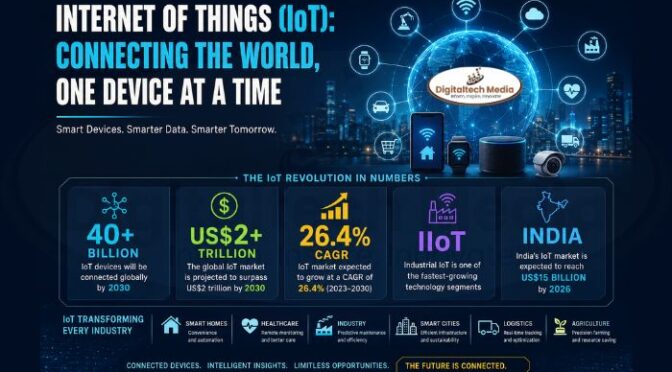


The Internet of Things (IoT) has become one of the fastest-growing technologies in the United States, transforming the way businesses operate, cities function, and consumers interact with everyday devices. From smart home assistants and connected vehicles to industrial sensors and advanced healthcare systems, IoT is creating a world where billions of devices communicate seamlessly through the internet.
In 2026, IoT is no longer just a futuristic concept—it has become a critical component of America’s digital infrastructure. Businesses across healthcare, manufacturing, agriculture, logistics, retail, finance, and energy sectors are investing heavily in connected technologies to improve efficiency, reduce operational costs, and deliver better customer experiences.
The rapid expansion of 5G networks, artificial intelligence (AI), cloud computing, and edge computing has accelerated IoT adoption across the country. These technologies work together to enable real-time communication, intelligent automation, predictive analytics, and faster decision-making.
As organizations continue embracing digital transformation, IoT is expected to play an even greater role in shaping the future of the American economy.
What Is the Internet of Things (IoT)?
The Internet of Things (IoT) refers to a network of physical devices connected to the internet that can collect, transmit, and analyze data without requiring constant human intervention.
These devices include sensors, cameras, wearable gadgets, home appliances, industrial machines, medical equipment, connected vehicles, and many other smart technologies.
Unlike traditional devices that operate independently, IoT devices communicate with each other through cloud platforms and software applications.
For example:
- A smartwatch monitors heart rate and sends health data to a smartphone.
- A smart thermostat automatically adjusts room temperature based on occupancy.
- Industrial sensors detect equipment problems before machinery fails.
- Connected vehicles exchange traffic information with nearby cars.
- Smart refrigerators monitor food inventory and notify users when supplies run low.
This interconnected ecosystem improves efficiency while enabling automation across nearly every industry.
How Does IoT Work?
Although IoT systems appear simple from the user’s perspective, they rely on several advanced technologies working together.
Smart Devices
IoT begins with connected devices equipped with sensors capable of collecting information such as temperature, movement, pressure, location, humidity, or energy consumption.
Internet Connectivity
Devices transmit collected information through Wi-Fi, 5G, Bluetooth, satellite networks, or other communication technologies.
Cloud Computing
The collected information is stored and processed within cloud platforms where powerful computing resources analyze the data.
Artificial Intelligence
Machine learning algorithms examine the information, identify patterns, and make intelligent decisions automatically.
User Interface
Finally, users access insights through mobile applications, web dashboards, or enterprise management systems.
This entire process occurs within seconds, allowing businesses and consumers to respond to changing conditions almost instantly.
Why IoT Is Growing Rapidly in the United States
Several technological and economic factors are accelerating IoT adoption across America.
Expansion of 5G Networks
High-speed 5G connectivity enables billions of devices to communicate simultaneously with minimal delay.
This supports applications such as autonomous vehicles, remote healthcare, industrial automation, and smart cities.
Artificial Intelligence Integration
AI allows connected devices to make intelligent decisions rather than simply collecting information.
Examples include predictive maintenance, fraud detection, personalized shopping recommendations, and automated manufacturing.
Cloud Computing Growth
Cloud platforms provide scalable infrastructure for storing and processing massive amounts of IoT data.
Businesses no longer need expensive local servers to manage connected devices.
Digital Transformation
Organizations across every industry are modernizing operations using connected technologies that improve efficiency and reduce operational costs.
Key Components of an IoT Ecosystem
Every successful IoT solution depends on several essential components working together.
Sensors
Sensors collect information from physical environments.
Examples include:
- Temperature sensors
- Motion detectors
- Pressure sensors
- GPS tracking devices
- Air quality monitors
- Humidity sensors
Connectivity
Reliable communication networks ensure data moves efficiently between devices.
Common technologies include:
- Wi-Fi
- 5G
- Bluetooth
- Ethernet
- Zigbee
- LPWAN
- Satellite communication
Cloud Infrastructure
Cloud computing stores, analyzes, and processes billions of connected data points every day.
Businesses use cloud platforms to monitor devices remotely while managing software updates and analytics.
Artificial Intelligence
AI converts raw data into valuable insights.
Instead of simply reporting information, intelligent IoT systems can predict failures, optimize energy usage, detect fraud, or automate business processes.
Types of IoT Devices
IoT technology appears in many different forms across industries.
Consumer IoT
Devices designed for everyday consumers include:
- Smart speakers
- Smart televisions
- Wearable fitness trackers
- Smart doorbells
- Connected lighting
- Home security cameras
Industrial IoT (IIoT)
Manufacturing facilities deploy connected sensors to monitor machinery, automate production lines, and reduce downtime.
Healthcare IoT
Hospitals use connected devices to monitor patient health, manage medical equipment, and improve treatment outcomes.
Smart City IoT
Municipal governments deploy sensors for traffic management, public safety, environmental monitoring, and energy efficiency.
Agricultural IoT
Farmers use connected technologies to improve irrigation, monitor livestock, optimize fertilizer usage, and increase crop production.
Major Benefits of IoT Technology
IoT provides significant advantages for businesses, governments, and consumers.
Increased Efficiency
Automation reduces manual work while improving productivity.
Businesses monitor equipment continuously without requiring employees to inspect every machine physically.
Cost Savings
Predictive maintenance helps organizations detect equipment issues before expensive breakdowns occur.
This significantly reduces repair costs and production downtime.
Better Decision-Making
Real-time data enables managers to make informed decisions based on current business conditions rather than outdated reports.
Improved Customer Experience
Retailers use IoT to personalize shopping experiences, optimize inventory, and reduce checkout times.
Enhanced Safety
Connected sensors improve workplace safety by detecting hazardous conditions before accidents occur.
IoT and Artificial Intelligence
Artificial Intelligence has transformed IoT from a simple monitoring system into an intelligent decision-making platform.
AI-powered IoT applications include:
- Predictive maintenance
- Smart traffic control
- Energy optimization
- Voice assistants
- Fraud detection
- Smart healthcare monitoring
- Automated quality inspection
Rather than simply collecting information, AI enables IoT systems to understand data and respond automatically.
IoT and Cloud Computing
Cloud computing plays a central role in every modern IoT deployment.
Businesses rely on cloud platforms because they provide:
- Unlimited scalability
- Secure data storage
- Real-time analytics
- AI integration
- Software updates
- Device management
- Business intelligence
Without cloud computing, managing millions of connected devices would be nearly impossible.
Smart Homes: How IoT Is Transforming Everyday Living in America
One of the most visible applications of the Internet of Things is the rise of smart homes. Across the United States, homeowners are adopting connected devices that make daily life more convenient, energy-efficient, and secure. From voice-controlled lighting to intelligent security systems, IoT is redefining modern living.
Smart home devices communicate with one another through a centralized network, allowing users to control multiple appliances from a smartphone or voice assistant. A homeowner can lock doors remotely, adjust room temperature before arriving home, monitor security cameras in real time, or receive alerts if unusual activity is detected.
Popular smart home technologies include:
- Smart thermostats
- Smart lighting systems
- Connected door locks
- Smart security cameras
- Video doorbells
- Voice assistants
- Smart refrigerators
- Smart washing machines
- Connected smoke detectors
- Home energy management systems
Beyond convenience, smart homes also help reduce electricity consumption. Intelligent thermostats automatically adjust temperatures based on occupancy, while smart lighting turns off when rooms are empty. These small improvements can significantly reduce energy bills over time.
As broadband internet and 5G connectivity continue expanding across the United States, experts expect smart home adoption to accelerate even further.
IoT in Healthcare: Improving Patient Care and Medical Innovation
Healthcare has become one of the fastest-growing sectors for IoT adoption. Connected medical devices allow healthcare providers to monitor patients more effectively while reducing unnecessary hospital visits.
Wearable health devices continuously collect data such as heart rate, blood oxygen levels, blood pressure, sleep quality, and physical activity. This information is securely transmitted to healthcare professionals, enabling early detection of potential medical issues.
Major healthcare applications include:
Remote Patient Monitoring
Patients with chronic conditions can be monitored from home, reducing hospital admissions while improving long-term care.
Connected Medical Equipment
Hospitals use IoT-enabled devices to monitor ventilators, infusion pumps, diagnostic equipment, and patient beds.
Smart Emergency Services
Connected ambulances transmit patient information to hospitals before arrival, allowing emergency teams to prepare treatment immediately.
Medication Management
Smart pill dispensers remind patients to take medications and notify caregivers if doses are missed.
IoT technology helps improve healthcare efficiency while enabling more personalized patient care.
Industrial IoT Is Revolutionizing American Manufacturing
Manufacturing companies throughout the United States are embracing Industrial Internet of Things (IIoT) solutions to increase productivity and reduce operational costs.
Factories now deploy thousands of connected sensors that monitor machinery, production lines, inventory levels, and environmental conditions in real time.
Benefits include:
Predictive Maintenance
Instead of repairing equipment after failures occur, IoT sensors detect early warning signs, allowing maintenance teams to fix issues before costly breakdowns happen.
Automated Quality Control
Computer vision systems inspect products during manufacturing, identifying defects much faster than manual inspections.
Real-Time Production Monitoring
Managers monitor production performance through centralized dashboards, enabling faster decision-making.
Energy Optimization
Smart sensors reduce unnecessary energy consumption by monitoring equipment efficiency.
Industrial IoT has become a key component of Industry 4.0, helping manufacturers remain competitive in global markets.
Retail and E-Commerce Are Becoming Smarter
Retailers across America are using IoT to enhance customer experiences and optimize business operations.
Connected technologies enable:
- Smart inventory management
- Automated checkout systems
- Personalized shopping experiences
- Digital price tags
- Warehouse automation
- Supply chain visibility
Retailers can automatically reorder products when inventory runs low, reducing stock shortages while improving customer satisfaction.
Large distribution centers also rely on IoT-enabled robots that transport inventory efficiently throughout warehouses.
IoT Is Transforming Logistics and Supply Chain Management
Modern supply chains depend heavily on connected devices.
GPS trackers, temperature sensors, and smart logistics platforms provide real-time visibility throughout the shipping process.
Companies benefit from:
- Live shipment tracking
- Fleet management
- Route optimization
- Fuel efficiency improvements
- Cold chain monitoring
- Reduced delivery delays
These capabilities improve customer satisfaction while reducing transportation costs.
Smart Agriculture Supports American Farmers
Agriculture is becoming increasingly data-driven through IoT technology.
Farmers use connected sensors to monitor:
- Soil moisture
- Weather conditions
- Crop growth
- Livestock health
- Irrigation systems
- Equipment performance
Rather than relying solely on manual inspections, farmers receive real-time information through mobile applications.
This enables better decision-making while improving crop yields and reducing water consumption.
Precision agriculture has become an important strategy for increasing food production sustainably.
Smart Cities Powered by IoT
Many cities across the United States are deploying IoT technologies to improve public services and urban infrastructure.
Applications include:
Intelligent Traffic Systems
Connected traffic lights reduce congestion by adjusting signal timing according to traffic conditions.
Public Safety
Smart surveillance cameras assist emergency responders by detecting unusual activity in real time.
Environmental Monitoring
Air quality, noise levels, weather conditions, and water systems are continuously monitored through connected sensors.
Smart Parking
Drivers receive real-time information about available parking spaces, reducing congestion and fuel consumption.
Waste Management
Garbage bins equipped with sensors notify sanitation departments when collection is required.
These technologies improve efficiency while enhancing residents’ quality of life.
Cybersecurity Challenges in the IoT Era
Although IoT creates enormous opportunities, it also increases cybersecurity risks.
Every connected device represents a potential entry point for cybercriminals.
Organizations must implement strong security measures, including:
- End-to-end encryption
- Multi-factor authentication
- Regular firmware updates
- Zero Trust security architecture
- AI-powered threat detection
- Network segmentation
- Continuous monitoring
Consumers should also change default passwords, install software updates, and purchase devices from trusted manufacturers.
Strong cybersecurity remains essential for maintaining trust in connected technologies.
Challenges Facing IoT Adoption
Despite rapid growth, several obstacles remain.
Data Privacy
Organizations must ensure customer information is collected and stored responsibly.
Device Compatibility
Many connected devices use different communication standards, making interoperability challenging.
Infrastructure Costs
Large-scale IoT deployments require significant investment in networking, cloud computing, and cybersecurity.
Skills Gap
Demand for IoT engineers, AI specialists, and cybersecurity professionals continues exceeding available talent.
Addressing these challenges will support broader adoption across industries.
The Future of IoT in the United States
The future of IoT looks extremely promising.
Industry experts expect rapid growth in:
- AI-powered IoT platforms
- Connected healthcare
- Autonomous transportation
- Smart factories
- Precision agriculture
- Smart energy grids
- Home automation
- Industrial robotics
- Edge computing
- Smart city infrastructure
As 5G coverage expands and AI capabilities improve, IoT systems will become faster, smarter, and more autonomous.
Frequently Asked Questions (FAQs)
What is the Internet of Things (IoT)?
IoT is a network of internet-connected devices that collect, share, and analyze data to automate tasks and improve efficiency.
How does IoT work?
IoT devices use sensors, internet connectivity, cloud computing, and AI to collect and process real-time information.
Which industries use IoT the most?
Healthcare, manufacturing, retail, logistics, agriculture, transportation, and smart city development are among the biggest adopters.
Is IoT secure?
IoT can be secure when organizations implement encryption, strong authentication, regular updates, and cybersecurity best practices.
Why is IoT important?
IoT improves automation, reduces costs, increases efficiency, supports data-driven decisions, and enables smarter digital services.
Conclusion
The Internet of Things (IoT) has become one of the most influential technologies driving digital transformation across the United States. From smart homes and connected healthcare to industrial automation and intelligent transportation, IoT is helping businesses operate more efficiently while improving everyday life for millions of Americans.
Combined with artificial intelligence, cloud computing, edge computing, and 5G connectivity, IoT is creating a highly connected ecosystem where devices communicate, analyze data, and make intelligent decisions in real time.
Although challenges related to cybersecurity, privacy, and infrastructure remain, continued investment in connected technologies positions the United States to remain a global leader in IoT innovation. Organizations that embrace IoT today will be better prepared for the increasingly connected future.


