


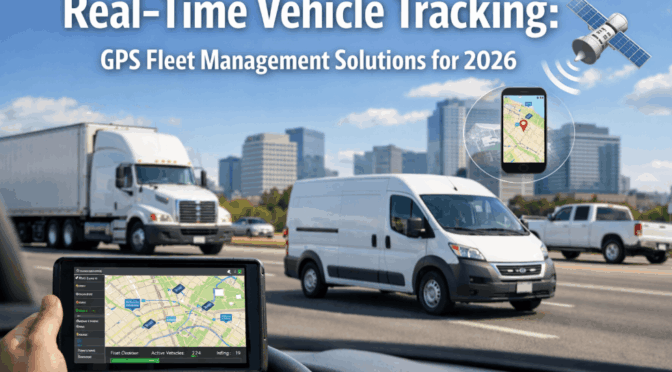


The transportation and logistics industry in the United States is undergoing a major digital transformation. Businesses that operate delivery vans, commercial trucks, service vehicles, trailers, and other mobile assets increasingly depend on location technology to manage their operations.
At the center of this transformation is GPS fleet tracking.
GPS fleet tracking has evolved far beyond simply showing the location of a vehicle on a map. Modern systems combine satellite positioning with artificial intelligence, cloud computing, Internet of Things devices, telematics, 5G connectivity, and advanced analytics.
These technologies allow companies to understand where their vehicles are, how efficiently they are operating, which routes drivers are taking, when maintenance may be required, and how transportation costs can be reduced.
For American businesses, these capabilities have become increasingly important as e-commerce, same-day delivery, supply-chain complexity, and customer expectations continue to grow.
A logistics company may have dozens, hundreds, or even thousands of vehicles operating across different states. Without accurate location information, managing such a fleet can become difficult and expensive. GPS tracking provides centralized visibility, allowing fleet managers to monitor operations from a single digital platform.
The technology is being used by trucking companies, courier services, construction businesses, utility providers, healthcare organizations, food delivery companies, field service businesses, and many other industries.
This article explores how GPS fleet tracking works, how artificial intelligence is changing fleet management, how businesses can reduce operating costs, the role of IoT and cloud technology, major challenges, and what the future may look like.
What Is GPS Fleet Tracking?
GPS fleet tracking is a technology that allows businesses to monitor the real-time location and operational status of vehicles and other mobile assets.
A GPS tracking device installed in a vehicle receives signals from satellites orbiting Earth. The device calculates its location and sends that information to a cloud-based platform through a communication network.
Fleet managers can then access the information through a computer, smartphone, or tablet.
Depending on the system, a fleet tracking platform can provide information about:
- Vehicle location
- Speed
- Direction
- Route history
- Distance traveled
- Idle time
- Fuel consumption
- Engine information
- Driver behavior
- Maintenance schedules
- Geofence activity
- Estimated arrival times
This information helps businesses make better transportation decisions.
How GPS Fleet Tracking Works
A modern GPS fleet tracking system generally includes several components.
GPS Satellites
GPS satellites continuously transmit positioning signals. A vehicle’s tracking device receives these signals and calculates its geographic location.
Tracking Hardware
A GPS tracking device is installed inside the vehicle. Depending on the model, it may connect to the vehicle’s electrical system or diagnostic port.
Cellular or Satellite Network
The device transmits location and vehicle information to a remote server through cellular networks. In extremely remote environments, satellite communication can provide an alternative.
Cloud Platform
The tracking platform receives and processes information from vehicles across the fleet.
Management Dashboard
Fleet managers use a web dashboard or mobile application to monitor vehicles and analyze operational data.
The system continuously updates, allowing businesses to maintain real-time visibility.
Why GPS Fleet Tracking Is Important for American Businesses
Transportation costs represent a significant expense for many businesses. Fuel, maintenance, labor, insurance, vehicle depreciation, and unexpected delays can all affect profitability.
GPS tracking provides information that can help organizations identify inefficiencies.
For example, a fleet manager may discover that certain vehicles spend too much time idling or that drivers regularly take longer routes.
The business can then adjust its operations.
GPS technology can help companies:
- Reduce unnecessary mileage
- Improve route planning
- Reduce idle time
- Monitor vehicle utilization
- Improve delivery visibility
- Identify maintenance requirements
- Improve driver safety
- Protect valuable vehicles
- Improve customer communication
The result can be a more efficient and data-driven transportation operation.
Real-Time Vehicle Tracking
One of the most important features of modern fleet management software is real-time tracking.
Fleet managers can open a digital map and see the current location of vehicles.
This information is especially useful for delivery companies.
Suppose a customer wants to know when a package will arrive. Instead of providing a broad delivery window, a company can use vehicle location and route information to provide a more accurate estimated arrival time.
Dispatchers can also identify which vehicle is closest to a new service request.
This can reduce unnecessary travel and improve response times.
AI-Powered Route Optimization
Artificial Intelligence is transforming GPS fleet management.
Traditional route planning often relies on fixed schedules and historical information. AI-powered systems can analyze much larger amounts of data and adjust recommendations dynamically.
An intelligent route optimization system can consider:
- Traffic conditions
- Road closures
- Weather
- Delivery deadlines
- Vehicle capacity
- Driver availability
- Historical travel times
- Customer locations
- Vehicle restrictions
The system can then recommend efficient routes.
For large fleets, even small improvements in route efficiency can produce significant savings over time.
GPS Fleet Tracking and Fuel Savings
Fuel is one of the largest operating costs for many commercial fleets.
GPS tracking can help companies identify behaviors and operational patterns that increase fuel consumption.
Excessive Idling
A vehicle that remains running while stationary consumes fuel without producing useful mileage.
GPS systems can identify excessive idling and provide reports to fleet managers.
Unnecessary Mileage
Route analysis can reveal inefficient journeys and repeated detours.
Aggressive Driving
Rapid acceleration and excessive speeds can increase fuel consumption.
Route Optimization
More efficient routes reduce total travel distance and time.
By combining these insights, companies can create more efficient fleet operations.
Driver Safety and GPS Technology
GPS fleet tracking is also used to improve road safety.
Modern systems can monitor driving patterns such as:
- Speeding
- Hard braking
- Rapid acceleration
- Sharp cornering
- Excessive idling
- Unauthorized vehicle use
Fleet managers can use this information to identify training opportunities.
Rather than relying entirely on manual observation, businesses can use objective operational data to understand driving behavior.
A safer driving culture can potentially reduce accidents, vehicle wear, insurance-related expenses, and downtime.
GPS Tracking and Predictive Maintenance
Vehicle maintenance is another area where GPS and telematics technology provide significant benefits.
Unexpected vehicle breakdowns can disrupt deliveries and create expensive repair bills.
Modern tracking platforms can combine GPS data with vehicle information to help businesses monitor maintenance requirements.
For example, fleet software may track:
- Mileage
- Engine hours
- Service intervals
- Vehicle usage
- Diagnostic information
- Battery status
Businesses can use this information to schedule maintenance before a minor issue becomes a major operational problem.
This approach is commonly known as predictive or preventive maintenance.
GPS and IoT in Fleet Management
The Internet of Things is expanding the capabilities of GPS tracking.
IoT devices can collect information from vehicles and equipment continuously.
For example, sensors can monitor:
- Temperature
- Fuel levels
- Tire pressure
- Engine conditions
- Cargo conditions
- Door status
- Battery levels
This information can be combined with GPS location data.
For refrigerated transportation, for example, a business may need to know not only where a truck is but also whether the cargo is being maintained at the correct temperature.
This combination of location and sensor information provides a much more complete picture of fleet operations.
GPS Tracking for Last-Mile Delivery
The growth of online shopping has increased demand for efficient last-mile delivery.
The final stage of delivery can be one of the most expensive parts of the logistics process because vehicles may need to make many individual stops within urban or suburban areas.
GPS technology helps companies optimize last-mile operations.
Businesses can use tracking systems to:
- Optimize delivery routes
- Monitor delivery progress
- Provide customer updates
- Reduce unnecessary mileage
- Identify delays
- Improve dispatching
Customers increasingly expect accurate delivery information, making real-time tracking an important part of the modern logistics experience.
GPS Fleet Tracking for Small Businesses
GPS tracking is not limited to large corporations.
Small and medium-sized businesses can also use fleet technology.
Examples include:
- Plumbing companies
- Electrical contractors
- HVAC businesses
- Landscaping companies
- Local delivery companies
- Cleaning services
- Construction contractors
- Medical transportation providers
A small business with a few service vehicles can use GPS tracking to understand where employees are working and assign new jobs more efficiently.
Cloud-based platforms have also made fleet management software more accessible to smaller organizations.
GPS and Geofencing
Geofencing allows businesses to create virtual boundaries around specific geographic areas.
For example, a company can create a geofence around:
- A warehouse
- Construction site
- Customer location
- Delivery zone
- Office
- Restricted area
When a vehicle enters or leaves the defined area, the system can generate an automatic notification.
This can be useful for:
- Delivery confirmation
- Employee scheduling
- Equipment security
- Unauthorized vehicle movement
- Job-site monitoring
Geofencing adds another layer of automation to GPS fleet management.
GPS Fleet Tracking and Cloud Computing
Cloud computing has transformed how businesses access GPS information.
Older tracking systems often required specialized local software. Modern platforms generally provide web-based dashboards that can be accessed from almost anywhere with an internet connection.
Cloud systems make it easier to:
- Store large amounts of historical data
- Generate reports
- Manage multiple vehicles
- Share information with authorized employees
- Integrate GPS data with other business software
- Access fleet information remotely
Cloud computing also enables businesses to combine GPS information with accounting, customer service, logistics, and enterprise management systems.
GPS Fleet Tracking and Customer Experience
Modern customers want transparency.
When a package, technician, delivery vehicle, or service provider is on the way, customers often want to know when they can expect arrival.
GPS tracking enables businesses to provide more accurate updates.
For example, a customer may receive information such as:
Driver is approximately 20 minutes away.
Instead of waiting for an entire day, customers can plan their schedules around a more precise delivery window.
This can improve customer satisfaction while reducing the number of calls to customer service departments.
GPS Fleet Tracking for Construction Companies
The construction industry depends heavily on vehicles and expensive mobile equipment. Excavators, bulldozers, cranes, loaders, generators, trailers, and other machinery frequently move between construction sites.
Managing these assets without accurate location information can be difficult.
GPS fleet tracking provides construction companies with better visibility into equipment and workforce operations.
Managers can monitor where machinery is located, how long it has been operating, and whether equipment has moved outside an authorized area.
Equipment Utilization
Construction companies can analyze how frequently individual machines are being used. If expensive equipment remains inactive for long periods, managers can move it to another project or reduce unnecessary rental costs.
Job-Site Monitoring
Geofencing can create digital boundaries around construction sites. Managers can receive alerts when equipment enters or leaves a designated area.
Theft Protection
Construction equipment can be extremely valuable. GPS tracking provides an additional security layer by allowing companies to identify the location of missing or stolen machinery.
Maintenance Management
Tracking engine hours and mileage helps companies schedule servicing based on actual equipment usage.
These capabilities can improve asset utilization while reducing unnecessary operational expenses.
GPS Tracking in Agriculture and Farming
Modern American agriculture is becoming increasingly connected.
Farmers use GPS technology for precision farming, automated machinery, crop monitoring, field mapping, and equipment management.
GPS-enabled tractors and agricultural machinery can follow highly accurate routes across fields, reducing overlap and improving the efficiency of planting, spraying, and harvesting.
Fleet tracking can also help agricultural businesses monitor:
- Tractor locations
- Equipment usage
- Fuel consumption
- Field operations
- Operating hours
- Maintenance schedules
When GPS is combined with agricultural sensors and cloud platforms, farmers can create detailed digital records of field activities.
This can support better planning and resource management.
GPS for Emergency Services
Emergency organizations need accurate location information because response time can directly affect outcomes.
Ambulance services, fire departments, utility crews, and disaster-response organizations can use GPS tracking to coordinate mobile resources.
A dispatch center can identify nearby vehicles and assign the most appropriate unit to an incident.
GPS can also provide navigation support when road conditions change.
During major emergencies, centralized location information can help command teams understand where vehicles and response teams are operating.
Applications include:
- Ambulance tracking
- Fire vehicle monitoring
- Search-and-rescue coordination
- Disaster response
- Utility restoration
- Emergency logistics
Location intelligence therefore plays an important role in modern emergency management.
GPS Asset and Trailer Tracking
Fleet management is not limited to vehicles.
Companies also need to track trailers, shipping containers, generators, mobile equipment, and other valuable assets.
Portable GPS trackers can provide visibility into assets that may not have a traditional vehicle connection.
For logistics companies, trailer tracking can help answer important questions:
- Where is the trailer?
- How long has it been at a location?
- Has it moved unexpectedly?
- When did it arrive?
- When did it leave?
- Is it being utilized efficiently?
This information can help reduce idle assets and improve fleet utilization.
GPS Tracking for Cold-Chain Logistics
Some products require controlled temperatures during transportation.
Pharmaceuticals, medical supplies, fresh food, and other temperature-sensitive products may need continuous monitoring.
GPS tracking can be combined with temperature sensors to create a connected cold-chain monitoring system.
The platform can show both:
Where the shipment is located
and
Whether the shipment is being stored at the required temperature.
If temperature levels move outside an acceptable range, an automated alert can notify logistics personnel.
This combination of location and environmental monitoring can improve supply-chain visibility.
GPS Fleet Tracking and Cybersecurity
As GPS systems become connected to cloud platforms, mobile applications, IoT devices, and business networks, cybersecurity becomes increasingly important.
Location data can reveal sensitive information about company operations.
Businesses should therefore implement strong security controls.
Data Encryption
Location information should be protected while being transmitted and stored.
Secure Authentication
Fleet management accounts should use strong passwords and multi-factor authentication where available.
Role-Based Permissions
Employees should only have access to information necessary for their jobs.
Software Updates
Tracking devices and fleet software should be updated regularly to address security vulnerabilities.
Monitoring
Companies should monitor systems for unusual login attempts or suspicious activity.
Security should be considered an essential part of GPS fleet management rather than an optional feature.
GPS Tracking and Employee Privacy
GPS technology can improve fleet efficiency, but businesses must also consider employee privacy.
Companies should clearly communicate how tracking technology is being used.
A responsible GPS tracking policy should explain:
- Which vehicles are tracked
- What information is collected
- When tracking is active
- Who can access the data
- How long information is stored
- Why the information is collected
Organizations should also follow applicable privacy and employment requirements.
Transparency can help employees understand that fleet tracking is primarily intended to improve safety, efficiency, asset security, and customer service.
Challenges of GPS Fleet Tracking
Despite its advantages, GPS fleet tracking has several limitations.
Connectivity Problems
Remote areas may have limited cellular coverage, which can delay the transmission of tracking information.
GPS Signal Interference
Tunnels, underground garages, dense buildings, and certain geographic environments can affect positioning accuracy.
Hardware Costs
Businesses must purchase tracking devices and may also pay recurring software or connectivity fees.
Data Overload
Large fleets can generate enormous quantities of location and telematics information. Without effective analytics, managers may struggle to identify the most important insights.
Employee Resistance
Workers may have concerns about tracking and monitoring.
Cybersecurity
Connected devices create additional security considerations.
Successful implementation therefore requires both appropriate technology and clear management policies.
How AI Will Change GPS Fleet Tracking
Artificial Intelligence is expected to become one of the most important technologies in future fleet management.
Traditional GPS platforms primarily report what has already happened.
AI-powered systems can increasingly predict what is likely to happen next.
For example, AI could identify patterns suggesting:
- A vehicle may require maintenance
- A route may experience congestion
- A delivery could be delayed
- A driver may be exhibiting risky behavior
- A vehicle may be underutilized
- Fuel consumption is higher than expected
Instead of simply presenting data, future fleet platforms will increasingly provide recommendations.
This shift from tracking to prediction could significantly improve fleet management.
The Future of GPS Fleet Tracking in the USA
GPS fleet tracking is likely to become more intelligent and deeply integrated with other technologies over the next several years.
AI-Powered Fleet Management
AI will automatically analyze vehicle and operational data and recommend improvements.
5G Connectivity
Faster networks can support more connected vehicles and near-real-time communication.
Electric Fleet Management
GPS platforms will increasingly monitor EV charging, battery levels, charging locations, and energy consumption.
Autonomous Vehicles
Self-driving commercial vehicles will require highly reliable location and fleet monitoring systems.
Connected Infrastructure
Vehicles may increasingly exchange information with traffic signals, roads, warehouses, and other infrastructure.
Predictive Logistics
AI will forecast delays, demand, maintenance requirements, and transportation conditions.
Advanced Asset Tracking
Smaller, more energy-efficient tracking devices will make it easier to monitor trailers, containers, equipment, and other assets.
These developments could transform fleet management from a monitoring function into an intelligent, automated business operation.
GPS Fleet Tracking and Sustainable Transportation
Environmental sustainability is becoming increasingly important for American businesses.
GPS technology can help companies reduce unnecessary fuel consumption and vehicle mileage.
For example, businesses can use route optimization to reduce the distance traveled by delivery vehicles.
They can also identify excessive idling and inefficient driving behavior.
For electric fleets, GPS systems can help optimize charging routes and vehicle utilization.
Over time, these improvements can support lower energy consumption and more sustainable transportation operations.
Frequently Asked Questions
What is GPS fleet tracking?
GPS fleet tracking is a technology that allows businesses to monitor the location, movement, and operational information of vehicles and mobile assets.
How does GPS fleet tracking work?
A GPS device receives satellite signals, determines the vehicle’s location, and transmits information through cellular or other communication networks to a cloud-based platform.
Can GPS tracking reduce fleet costs?
Yes. Businesses can potentially reduce fuel consumption, unnecessary mileage, idle time, maintenance expenses, and inefficient vehicle usage through better operational visibility.
Is GPS fleet tracking useful for small businesses?
Yes. Small businesses such as contractors, delivery companies, HVAC providers, electricians, and service companies can use GPS tracking to manage vehicles and improve dispatching.
Can GPS tracking monitor driver behavior?
Many modern systems can identify events such as speeding, harsh braking, rapid acceleration, excessive idling, and unauthorized vehicle use.
What is GPS geofencing?
Geofencing creates virtual geographic boundaries. A GPS platform can generate alerts when a vehicle or asset enters or leaves a specified area.
Can GPS track trailers and equipment?
Yes. Dedicated asset and trailer tracking devices can provide location information for equipment that does not have a conventional vehicle connection.
Does GPS fleet tracking work everywhere?
GPS positioning has broad geographic coverage, but real-time transmission can depend on cellular or satellite connectivity. Remote areas may require alternative communication technologies.
How does AI improve fleet management?
AI can analyze historical and real-time data to predict maintenance needs, identify inefficient routes, detect unusual behavior, and recommend operational improvements.
Is GPS fleet tracking secure?
It can be secure when businesses use encryption, strong authentication, access controls, software updates, and appropriate cybersecurity practices.
Conclusion
GPS fleet tracking has evolved from a simple vehicle-location technology into a sophisticated digital platform for modern transportation and logistics.
Across the United States, businesses are using GPS tracking to improve fleet visibility, optimize routes, reduce fuel consumption, monitor driver behavior, protect valuable assets, and provide customers with better delivery information.
The technology is also expanding beyond traditional trucking. Construction companies use GPS to monitor heavy machinery, farmers use location technology for precision agriculture, emergency organizations use it to coordinate response vehicles, and logistics companies combine GPS with temperature sensors to monitor sensitive shipments.
The integration of Artificial Intelligence, IoT, cloud computing, 5G, telematics, and electric vehicle technology is creating a new generation of intelligent fleet management systems.
The biggest change may be the transition from reactive management to predictive management.
Traditional fleet tracking tells businesses where their vehicles are.
Modern systems can increasingly explain why something is happening and what may happen next.
AI can identify inefficient routes, predict maintenance requirements, recognize unusual driving patterns, and help managers make faster operational decisions.
However, organizations must also address cybersecurity, employee privacy, connectivity limitations, hardware costs, and responsible data management.
Looking ahead, GPS fleet tracking will likely become even more deeply integrated into connected transportation networks. As electric and autonomous vehicles become more common and logistics operations become increasingly automated, accurate location intelligence will remain a critical component of the transportation ecosystem.
For American businesses looking to improve efficiency and compete in a data-driven economy, GPS fleet tracking is no longer simply a vehicle-monitoring tool. It is becoming an important part of modern logistics intelligence.


