


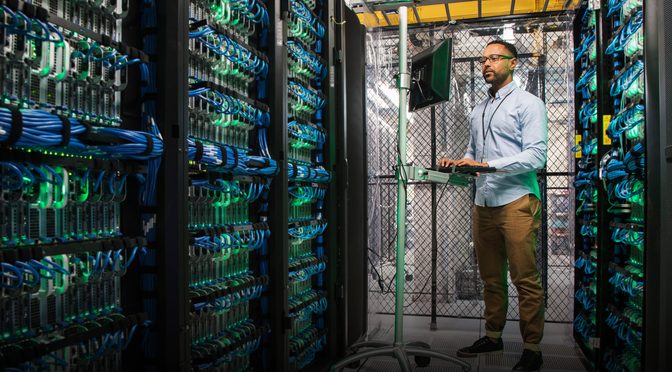


Data centers have become one of the most important parts of the modern digital economy. Every time people stream a video, use an online banking application, store files in the cloud, interact with an AI service, shop online, or use a business application, data centers are often working behind the scenes to process and store the information.
In the United States, the importance of data centers has grown significantly as companies increasingly depend on cloud computing, artificial intelligence, online services, digital platforms, and large-scale data processing.
The rapid development of generative AI has added another major source of demand. AI systems require substantial computing resources, and the infrastructure supporting those systems needs powerful processors, large amounts of memory, high-speed networking, storage, electricity, and advanced cooling systems.
As a result, data centers are becoming much more than large buildings filled with servers. They are evolving into sophisticated infrastructure facilities designed to support some of the world’s most demanding computing workloads.
This article explores the data center industry in the USA, explains how data centers work, why AI is increasing demand, the role of cloud computing, major challenges, energy requirements, cybersecurity considerations, and the future of American digital infrastructure.
What Is a Data Center?
A data center is a facility designed to house computing equipment and supporting infrastructure.
A typical data center can contain:
- Computer servers
- Storage systems
- Networking equipment
- Backup power systems
- Cooling equipment
- Security systems
- Monitoring technology
- Fire protection systems
- Fiber-optic connections
The primary purpose is to provide reliable computing and storage infrastructure.
Companies can operate their own data centers, rent space in specialized facilities, or use cloud providers that operate large networks of data centers.
Why Data Centers Matter
Modern businesses depend heavily on digital systems.
A company may use data centers to operate its website, host applications, store customer information, process transactions, run analytics, or support employees.
Large technology companies may operate extensive infrastructure to provide services to millions or even billions of users.
Cloud computing has made this infrastructure even more important.
Instead of purchasing physical servers themselves, businesses can obtain computing resources from cloud platforms. Those cloud platforms rely on large data center facilities to provide the underlying infrastructure.
Data Centers and Cloud Computing
Cloud computing and data centers are closely connected.
Cloud providers operate physical infrastructure that customers access through internet-based services.
A business using cloud storage, virtual machines, databases, or software services may never physically see the data center where its information is processed.
However, behind the cloud interface are physical servers, storage devices, networking systems, power equipment, and cooling infrastructure.
This is one reason the expansion of cloud computing has contributed to increasing demand for data center capacity.
The Impact of Artificial Intelligence
Artificial intelligence is changing the data center industry.
Traditional computing workloads can often run on general-purpose processors. Many AI workloads, however, require specialized hardware capable of performing large numbers of calculations simultaneously.
AI data centers can therefore require:
- High-performance processors
- AI accelerators
- Large memory systems
- High-speed networking
- Advanced cooling
- High-capacity power infrastructure
- Specialized storage
The computing requirements of AI can be significantly different from those of traditional business applications.
As organizations develop and deploy larger AI models, data center infrastructure must evolve accordingly.
Why AI Data Centers Need More Power
Power consumption is one of the most important considerations for modern data center development.
AI systems can require large numbers of high-performance processors operating simultaneously.
Those processors consume electricity and generate heat.
The facility must therefore provide enough electricity not only to run computing equipment but also to support cooling, networking, lighting, security, and other infrastructure.
This creates a close relationship between data center development and energy infrastructure.
Data Center Cooling Technology
Servers generate heat during operation.
If heat is not removed efficiently, equipment can become too hot and performance can suffer.
Traditional data centers often use air-based cooling systems.
However, high-density AI computing can create greater cooling requirements.
This has increased interest in advanced cooling technologies, including liquid cooling.
Liquid cooling can transfer heat more efficiently than traditional air-based methods in certain high-density computing environments.
As AI infrastructure expands, cooling technology is becoming an increasingly important part of data center design.
Data Center Power Infrastructure
Reliable electricity is essential for data center operations.
A major facility may require substantial electrical capacity to operate its servers and cooling equipment.
Data centers also need backup power systems to help maintain operations during electrical disruptions.
These systems can include:
- Batteries
- Uninterruptible power systems
- Backup generators
- Redundant electrical connections
- Power management equipment
Reliability is particularly important for services that operate continuously.
An outage affecting a major digital service can potentially impact thousands or millions of users.
Renewable Energy and Data Centers
Energy consumption has also increased discussion about sustainability in the data center industry.
Technology companies and data center operators are exploring different ways to support their electricity requirements while reducing environmental impact.
Strategies can include:
- Renewable energy procurement
- Solar power
- Wind energy
- Improved energy efficiency
- Advanced cooling systems
- More efficient processors
- Better facility design
The specific energy strategy can vary between facilities and companies.
As data center demand increases, energy efficiency is likely to remain an important consideration.
Where Are Data Centers Located?
Data centers can be found in many regions across the United States.
Location decisions can depend on factors such as:
- Electricity availability
- Network connectivity
- Land availability
- Climate
- Fiber infrastructure
- Construction costs
- Access to skilled workers
- Regulatory considerations
- Proximity to customers
Large technology markets can attract data center investment because they provide strong connectivity and access to customers.
However, other regions may also become attractive when companies seek additional land, power availability, or geographic diversity.
The Importance of Fiber-Optic Networks
Data centers need high-speed connections to communicate with other systems.
Fiber-optic networks can provide high bandwidth and low latency for transferring large quantities of information.
Large cloud and technology companies may connect multiple facilities through extensive network infrastructure.
This connectivity allows applications and data to operate across different locations.
For AI systems, high-speed networking can also be important because large computing clusters may need to exchange enormous amounts of data between processors.
Data Centers and Cybersecurity
Data centers contain valuable digital infrastructure, making cybersecurity a critical consideration.
Security can involve both physical and digital protection.
Physical security may include:
- Restricted access
- Security cameras
- Perimeter controls
- Visitor management
- Security personnel
Digital security can include:
- Network monitoring
- Access controls
- Encryption
- Authentication
- Intrusion detection
- Endpoint security
- Security logging
Protecting a data center requires multiple layers because a security incident can potentially affect important applications and services.
Physical Security
Data centers are often designed with controlled access.
Employees and contractors may require authorization to enter specific areas.
Sensitive equipment can be located in restricted rooms or cages.
Security systems can monitor activity around the facility.
Physical protection is important because cybersecurity does not eliminate the possibility of physical threats.
Data Center Redundancy
Reliability is another major feature of data center design.
Important systems can be duplicated so that a single equipment failure does not necessarily stop operations.
For example, a facility may use redundant:
- Power systems
- Network connections
- Cooling equipment
- Servers
- Storage systems
The exact redundancy design depends on the requirements of the facility and the services it supports.
Data Centers and Business Continuity
Businesses increasingly depend on continuous access to digital applications.
If a major system becomes unavailable, companies can potentially experience operational disruptions.
Data centers can support business continuity through backup systems, geographically separated infrastructure, data replication, and disaster recovery technologies.
Organizations may maintain multiple environments so that workloads can continue operating if one facility experiences a major problem.
The Growth of Edge Data Centers
Not every computing task needs to be processed in a huge centralized facility.
Edge computing moves certain processing resources closer to users or devices.
Edge data centers can help reduce the physical distance between computing resources and the systems generating data.
This can be useful for applications that require fast response times.
Potential applications include:
- Industrial automation
- Connected vehicles
- Smart infrastructure
- Telecommunications
- Real-time analytics
- Gaming
- Video processing
Edge infrastructure can work alongside large centralized cloud data centers.
Data Centers and 5G Networks
The expansion of high-speed mobile networks is also creating new opportunities for distributed computing.
5G can connect large numbers of devices and support applications requiring relatively low latency.
Edge computing infrastructure can complement these networks by placing computing resources closer to users and connected devices.
This can become increasingly important as more applications rely on real-time data processing.
Data Center Construction in the USA
Building a large data center is a major infrastructure project.
Construction can involve:
- Site selection
- Land preparation
- Power planning
- Network connectivity
- Building construction
- Cooling installation
- Server infrastructure
- Security systems
- Testing
- Operational deployment
Large facilities can take significant time and investment to develop.
The availability of suitable power and network infrastructure can strongly influence construction decisions.
The Economic Impact of Data Centers
Data center development can create economic activity in several ways.
Construction projects can create temporary demand for workers and contractors.
Once operational, facilities require employees and service providers for areas such as:
- Engineering
- Security
- Maintenance
- Electrical systems
- Cooling
- Networking
- Facility management
Data center development can also increase demand for supporting infrastructure.
However, communities evaluating large projects may also consider factors such as electricity use, land requirements, water consumption, environmental impact, and infrastructure capacity.
Water and Cooling Considerations
Some data center cooling systems can use water as part of their heat-management processes.
Water requirements can therefore become an important consideration when evaluating new facilities.
Operators may investigate cooling systems designed to improve efficiency and reduce water usage depending on the local environment and facility design.
The balance between computing performance, energy efficiency, water consumption, and operating cost is becoming increasingly important.
The Challenge of Data Center Demand
One of the biggest challenges facing the US data center industry is the rapid growth in computing demand.
AI applications can require significantly more computing resources than many traditional workloads.
Cloud services continue to expand, while businesses are also producing and storing increasing amounts of digital information.
This creates pressure on:
- Electricity infrastructure
- Data center construction
- Semiconductor supply
- Networking equipment
- Cooling systems
- Skilled labor
- Real estate
Meeting this demand requires coordination between technology companies, infrastructure providers, utilities, local communities, and policymakers.
Data Center Efficiency
Efficiency is becoming increasingly important as computing workloads grow.
Operators can improve efficiency through:
- More efficient processors
- Better server utilization
- Improved cooling
- Advanced power management
- Efficient building design
- Renewable energy integration
- Automated infrastructure monitoring
One common measure used in the industry is Power Usage Effectiveness, or PUE, which compares total facility energy use with the energy consumed by computing equipment.
Improving efficiency can help reduce the amount of supporting energy required for computing operations.
AI and the Future of Data Center Design
AI may fundamentally influence how future data centers are built.
Traditional facilities were designed around general-purpose computing workloads.
AI infrastructure can require higher power densities and different networking and cooling requirements.
Future AI-focused facilities may therefore feature:
- Higher-density computing environments
- Advanced liquid cooling
- Specialized AI processors
- High-speed interconnects
- Large-scale memory systems
- More sophisticated power management
The physical architecture of data centers may continue evolving as AI workloads become more demanding.
Data Center Automation
Automation can help operators manage increasingly complex facilities.
Modern data centers can use monitoring systems to track:
- Temperature
- Power consumption
- Equipment performance
- Network activity
- Cooling efficiency
- Hardware health
Automated systems can identify abnormal conditions and help operators respond before they develop into larger problems.
Automation can therefore contribute to reliability and operational efficiency.
The Future of Data Centers in the USA
The US data center industry is likely to continue evolving as digital services expand.
Several major trends may shape the future.
AI-Focused Infrastructure
AI is likely to remain one of the major drivers of data center demand.
Advanced Cooling
Higher computing densities may encourage greater adoption of liquid and other advanced cooling technologies.
More Efficient Hardware
Improvements in semiconductor technology can help increase computing performance while managing energy consumption.
Renewable Energy
Companies may continue exploring renewable energy and other approaches to support growing electricity demand.
Edge Computing
Distributed data center infrastructure may expand for applications requiring lower latency.
Automated Operations
AI and automation may increasingly assist with data center monitoring, maintenance, and resource management.
What Data Centers Mean for Consumers
Most consumers never see the data centers supporting their digital services.
However, these facilities directly affect the services people use every day.
Data centers support:
- Online shopping
- Streaming services
- Social media
- Cloud storage
- Online banking
- AI applications
- Video calls
- Gaming
- Business software
- Search engines
As data center infrastructure improves, digital services can become more scalable and capable.
Final Thoughts
Data centers have become a fundamental part of the US technology ecosystem.
Cloud computing, artificial intelligence, online services, connected devices, and digital businesses all depend on physical computing infrastructure operating behind the scenes.
The rapid growth of AI is changing the industry’s requirements. Modern AI workloads can demand powerful processors, high-speed networking, large-scale storage, advanced cooling, and significant electricity capacity.
At the same time, data center operators must consider cybersecurity, physical security, sustainability, reliability, water use, and infrastructure availability.
The future of data centers in the United States will likely involve a combination of larger high-performance facilities, specialized AI infrastructure, edge computing, advanced cooling, improved energy efficiency, and increasingly automated operations.
As more aspects of everyday life move into the digital environment, the importance of the infrastructure supporting those services will continue to grow.
Data centers may remain largely invisible to consumers, but they will continue to serve as one of the most important foundations of America’s digital future.
Frequently Asked Questions
What is a data center?
A data center is a facility that houses servers, storage systems, networking equipment, power systems, cooling infrastructure, and other technologies used to operate digital services.
Why are data centers important in the USA?
Data centers support cloud computing, AI, websites, online services, business applications, digital communications, and many other parts of the American digital economy.
Why does AI require large data centers?
AI workloads can require substantial computing power, memory, networking, and storage. Large data centers can provide the infrastructure required to run these workloads at scale.
How do data centers stay cool?
Data centers can use air-based cooling or advanced technologies such as liquid cooling to remove heat generated by computing equipment.
Do data centers use a lot of electricity?
Data centers consume electricity to operate computing equipment, networking systems, cooling systems, and other facility infrastructure. Energy efficiency is therefore an important consideration in data center design.
What is an edge data center?
An edge data center places computing resources closer to users or connected devices, potentially reducing latency for applications that require fast data processing.


