


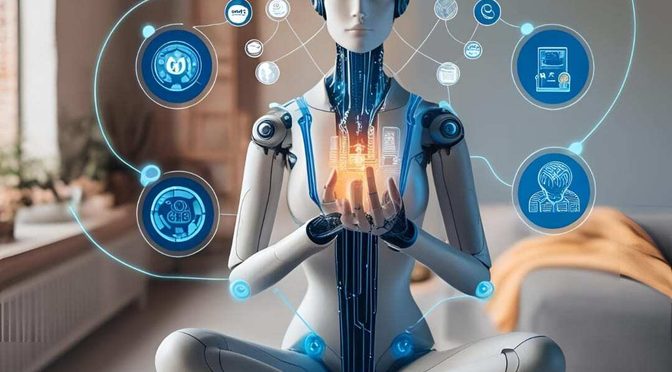


Artificial intelligence has moved from being a futuristic concept to becoming a normal part of everyday life.
A few years ago, many people associated AI mainly with science-fiction movies, research laboratories or highly advanced technology companies. Today, artificial intelligence can be found in smartphones, search engines, online shopping platforms, banking applications, navigation services, customer support systems, smart home devices and workplace software.
In many cases, people use AI without even realizing it.
When a smartphone automatically organizes photographs, when a streaming service recommends a movie, when an email application identifies suspicious messages, or when an online store suggests products based on previous activity, artificial intelligence may be involved behind the scenes.
The rapid development of machine learning, cloud computing, data processing and generative AI has made these systems increasingly capable.
However, AI is not just about chatbots or image generators.
It is a much broader field involving technologies that allow computers to analyze information, recognize patterns, make predictions, understand language and assist with complex tasks.
What Is Artificial Intelligence?
Artificial intelligence, commonly called AI, refers to computer systems designed to perform tasks that traditionally require some form of human intelligence.
These tasks can include:
- Understanding language
- Recognizing images
- Identifying patterns
- Making predictions
- Generating content
- Analyzing large datasets
- Recommending information
- Automating repetitive tasks
- Supporting decision-making
AI does not necessarily work like a human brain.
Instead, modern AI systems generally use algorithms, statistical methods and large amounts of data to identify patterns and produce outputs.
How Does AI Work?
Modern artificial intelligence can involve several technologies.
Some of the most important include:
- Machine learning
- Deep learning
- Natural language processing
- Computer vision
- Generative AI
- Neural networks
- Predictive analytics
Machine learning allows systems to learn patterns from data.
For example, an email system can analyze characteristics of previously identified spam messages and use those patterns to help classify future messages.
Deep learning uses neural-network architectures capable of processing complex relationships in large datasets.
Natural language processing allows computers to work with human language.
Computer vision allows machines to analyze images and video.
These technologies can work independently or together.
AI in Smartphones
One of the easiest places to see artificial intelligence is the smartphone.
Modern phones contain numerous AI-powered features.
Examples include:
- Face recognition
- Voice assistants
- Camera optimization
- Photo organization
- Predictive text
- Translation
- Spam detection
- Battery optimization
- Personalized recommendations
A smartphone camera may automatically recognize a scene and adjust settings.
It can identify faces, objects and lighting conditions.
Photo applications can search collections using descriptions such as people, places or objects.
These capabilities rely on increasingly sophisticated machine-learning models.
AI-Powered Smartphone Cameras
Computational photography has become a major area of smartphone innovation.
Instead of relying entirely on traditional optical hardware, smartphones can use software algorithms to improve images.
AI can help with:
- Low-light photography
- Portrait effects
- Noise reduction
- Image sharpening
- Object recognition
- HDR processing
- Automatic scene detection
A modern phone can capture multiple frames and computationally combine information from them to produce a final image.
This demonstrates how AI and traditional hardware can work together.
AI in Search Engines
Search engines have traditionally relied on keyword matching and ranking algorithms.
Modern search systems increasingly use AI to understand the meaning behind queries.
For example, users do not always search using perfectly structured sentences.
They may type:
“best laptop for editing under budget”
or ask a conversational question.
AI systems can analyze the intent behind such queries and provide more relevant results.
Search technology is therefore becoming increasingly focused on understanding context rather than simply matching individual words.
AI and Online Recommendations
Recommendation systems are another major example of AI in everyday life.
Streaming platforms, online stores and social networks can recommend content based on patterns in user behavior.
The system may analyze:
- Previous interactions
- Search history
- Viewing behavior
- Product interests
- Time spent on content
- Similar users’ activity
The goal is to predict what information or content may be relevant.
This technology is widely used because modern internet platforms contain enormous amounts of information.
Without recommendation systems, discovering useful content could become much more difficult.
AI in Online Shopping
E-commerce companies use AI across many parts of the shopping experience.
AI can help with:
- Product recommendations
- Search results
- Fraud detection
- Inventory forecasting
- Customer support
- Demand prediction
- Personalized marketing
For example, if a customer repeatedly searches for a particular category of products, a shopping platform may recommend related products.
Businesses can also use AI to forecast demand and manage inventory.
AI in Customer Service
AI-powered customer service has become increasingly common.
Businesses may use chatbots to answer routine questions.
A chatbot can potentially provide information about:
- Order status
- Delivery information
- Account procedures
- Product details
- Frequently asked questions
- Appointment scheduling
This allows human customer-service agents to focus on more complicated issues.
However, AI customer service works best when customers can easily reach a human agent when necessary.
Generative AI
One of the most significant recent developments in artificial intelligence is generative AI.
Generative AI systems can create new content based on user instructions.
Depending on the system, generated content may include:
- Text
- Images
- Audio
- Video
- Computer code
- Summaries
- Presentations
Generative AI has changed how many people approach writing, research, brainstorming and creative work.
Instead of simply retrieving information, these systems can generate new responses based on learned patterns.
AI in Education
Education is another area where AI can have a significant impact.
AI-powered tools can assist students with:
- Explanations
- Practice questions
- Language learning
- Writing feedback
- Study planning
- Research organization
- Personalized learning
A student struggling with a mathematical concept can ask an AI system to explain it using simpler language.
Similarly, language-learning applications can use AI to provide conversational practice.
Personalized Learning With AI
Traditional education often uses the same material for an entire class.
AI can potentially help create more personalized learning experiences.
For example, if a student consistently struggles with a particular concept, an AI system can identify the pattern and provide additional exercises.
If another student understands the concept quickly, the system may provide more advanced material.
This approach is often described as adaptive or personalized learning.
AI in Healthcare
Artificial intelligence is also being explored and used across healthcare.
Potential applications include:
- Medical image analysis
- Administrative automation
- Clinical decision support
- Patient communication
- Drug discovery
- Research
- Predictive analysis
AI can process large datasets much faster than humans in certain situations.
However, healthcare is a high-stakes field.
AI-generated information should therefore be appropriately validated and used within professional and regulatory frameworks.
AI in Medical Imaging
Medical imaging produces enormous amounts of visual information.
AI models can be trained to recognize patterns in images.
Researchers and healthcare organizations are exploring AI applications involving:
- X-rays
- CT scans
- MRI images
- Ultrasound
- Pathology images
AI can potentially help identify areas that require closer attention.
However, an AI system should not automatically be treated as a replacement for qualified medical professionals.
AI in Banking and Finance
Financial institutions use technology to analyze large quantities of transactions.
AI and machine learning can help with:
- Fraud detection
- Transaction monitoring
- Risk analysis
- Customer service
- Credit-related analysis
- Financial forecasting
Fraud detection is a particularly important application.
A system can look for unusual transaction patterns that may indicate suspicious activity.
AI and Fraud Detection
Imagine a customer normally makes transactions from one geographic region.
Suddenly, a transaction appears with an unusual combination of location, device and spending behavior.
A machine-learning system can identify that the activity differs from previous patterns.
This does not automatically mean fraud occurred, but it can trigger additional verification.
AI in Transportation
Transportation systems are increasingly dependent on intelligent software.
AI can be used for:
- Traffic prediction
- Route optimization
- Fleet management
- Demand forecasting
- Public transportation planning
- Driver-assistance technologies
Navigation systems can analyze traffic information and suggest alternative routes.
Fleet operators can analyze vehicle data to improve scheduling.
AI in Smart Homes
Smart homes are becoming increasingly connected.
AI can help devices understand usage patterns.
For example, a smart-home system may learn:
- When people are usually at home
- Preferred temperature settings
- Lighting preferences
- Energy consumption patterns
AI can then automate certain functions.
This can make connected homes more convenient and potentially improve energy efficiency.
AI and Energy Management
Energy systems generate large amounts of data.
AI can analyze consumption patterns and identify opportunities for optimization.
Homes and businesses can use intelligent systems to monitor:
- Electricity consumption
- Heating and cooling
- Solar generation
- Battery storage
- Peak usage
In larger energy networks, AI can also help forecast demand.
AI in Manufacturing
Manufacturing companies are using AI to improve production processes.
Potential applications include:
- Predictive maintenance
- Quality inspection
- Production optimization
- Robotics
- Supply-chain forecasting
- Inventory management
Computer vision systems can inspect products on production lines.
Instead of manually checking every item, an AI-powered camera system can identify certain visual defects.
Predictive Maintenance
One important industrial AI application is predictive maintenance.
Traditional maintenance may follow a fixed schedule.
Predictive maintenance uses equipment data to estimate when a machine may require attention.
Sensors can monitor:
- Temperature
- Vibration
- Pressure
- Energy consumption
- Operating hours
AI can analyze these measurements and identify unusual patterns.
The objective is to reduce unexpected equipment failures.
AI in Cybersecurity
Cybersecurity is another major area of AI development.
Security systems can analyze huge amounts of network and system activity.
AI may help identify:
- Suspicious behavior
- Unusual login activity
- Malware patterns
- Network anomalies
- Potential attacks
Cybersecurity teams can use these systems to prioritize alerts.
However, attackers can also use AI to develop new techniques, making cybersecurity an ongoing technological competition.
AI in Software Development
AI tools are increasingly being used by software developers.
They can assist with:
- Code generation
- Code explanation
- Debugging
- Documentation
- Testing
- Refactoring
- Software planning
AI can help developers complete repetitive tasks more quickly.
However, generated code still requires human review.
A program that appears correct can contain security vulnerabilities, logic errors or compatibility problems.
AI and Workplace Productivity
Many organizations are exploring AI to automate repetitive office tasks.
Examples include:
- Summarizing documents
- Drafting emails
- Organizing information
- Meeting transcription
- Data analysis
- Report generation
- Document classification
The potential benefit is not necessarily eliminating human work.
In many cases, the objective is to allow employees to spend more time on tasks that require judgment, communication and creativity.
AI in Content Creation
Content creators are also using AI tools.
AI can assist with:
- Topic research
- Outlining
- Editing
- Translation
- Image creation
- Video production
- Audio generation
However, high-quality content still requires human oversight.
AI-generated content can contain factual errors, repetitive language or information that lacks context.
Human editing remains important.
AI and Language Translation
Language translation has improved significantly through machine learning.
Modern translation systems can process entire sentences while considering context.
AI translation can be useful for:
- Travel
- Business communication
- Education
- Customer support
- International content
Real-time translation is also becoming increasingly practical as speech recognition and language models improve.
AI Voice Assistants
Voice assistants allow users to interact with computers using natural language.
They can perform tasks such as:
- Setting reminders
- Playing music
- Answering questions
- Controlling smart devices
- Sending messages
Modern voice AI is moving toward more conversational interactions.
Instead of requiring exact commands, users can communicate more naturally.
AI in Agriculture
Agriculture is increasingly becoming data-driven.
AI can analyze:
- Weather information
- Soil conditions
- Crop images
- Satellite imagery
- Irrigation data
- Equipment information
Farmers can use these insights to improve resource management.
Computer vision can also help identify certain crop conditions.
AI in Retail Stores
Physical retail businesses can use AI as well.
Potential applications include:
- Inventory monitoring
- Demand forecasting
- Customer analytics
- Automated checkout
- Personalized offers
- Store optimization
Computer vision and sensor technologies can provide retailers with additional information about how products and spaces are used.
AI in Media and Entertainment
Entertainment companies use AI for various tasks.
AI can help analyze audience preferences and recommend content.
It can also assist with:
- Subtitles
- Dubbing
- Content tagging
- Visual effects
- Audio processing
- Content discovery
Generative AI is also creating new possibilities for creative workflows.
AI in Scientific Research
Scientists work with enormous datasets.
AI can help researchers identify patterns within complex information.
Applications include:
- Drug discovery
- Climate modeling
- Astronomy
- Materials science
- Biology
- Physics
The ability to analyze large datasets can help researchers investigate questions that would otherwise require enormous amounts of manual effort.
AI and Climate Technology
Climate and environmental research can generate massive quantities of data.
AI can assist with:
- Weather modeling
- Climate analysis
- Energy forecasting
- Environmental monitoring
- Satellite-image analysis
Researchers can use machine learning to identify patterns across large datasets.
Benefits of Artificial Intelligence
AI offers several potential benefits.
Automation
AI can automate repetitive processes.
Speed
Computers can process large datasets rapidly.
Personalization
AI systems can tailor recommendations and experiences.
Pattern Recognition
Machine learning can identify relationships in data.
Productivity
AI tools can assist workers with routine tasks.
Accessibility
AI can provide tools such as speech recognition, translation and assistive interfaces.
Limitations of Artificial Intelligence
AI also has important limitations.
A system can produce incorrect information.
It can misunderstand context.
It can reflect problems present in training data.
AI systems may also require substantial computing resources.
Therefore, AI should not automatically be treated as an infallible source of truth.
Human judgment remains important, particularly in high-stakes situations.
AI and Data Privacy
Many AI systems depend on data.
This creates important privacy questions.
Users should understand:
- What information is collected
- Why it is collected
- How it is stored
- Who can access it
- How long it is retained
Businesses should establish appropriate data-protection practices when implementing AI systems.
AI and the Future of Jobs
Artificial intelligence is expected to change many types of work.
Some tasks may become automated.
Other jobs may change rather than disappear.
Workers may increasingly need to collaborate with AI systems.
Skills such as:
- Critical thinking
- Communication
- Problem-solving
- Creativity
- Domain knowledge
can remain important even as automation increases.
Human-AI Collaboration
One possible future is not humans versus AI, but humans working alongside AI.
A professional can use AI to process information quickly and then apply human judgment.
For example, an analyst could ask an AI system to identify patterns in a large dataset and then evaluate the findings.
A writer could use AI for brainstorming while remaining responsible for the final content.
This combination can potentially improve productivity while retaining human oversight.
What Is the Future of Artificial Intelligence?
AI development is likely to continue across many industries.
Future systems may become better at:
- Understanding context
- Processing multiple types of information
- Working across applications
- Personalizing experiences
- Automating complex workflows
- Supporting professional tasks
AI may become less visible as a separate technology and more integrated into ordinary software.
Instead of opening a dedicated AI application, users may simply encounter AI-powered functionality inside tools they already use.
AI Agents and Automated Workflows
One emerging direction is AI agents.
An AI agent can potentially perform multiple steps to accomplish a task instead of simply generating a single response.
For example, an AI system could potentially:
- Understand a request.
- Gather relevant information.
- Analyze the information.
- Complete a workflow.
- Produce a result.
This could change how people interact with business software.
The Importance of Responsible AI
As AI becomes more powerful, responsible development becomes increasingly important.
Organizations need to consider:
- Accuracy
- Privacy
- Security
- Transparency
- Bias
- Human oversight
- Appropriate use
The goal should be to use AI where it provides genuine value while recognizing its limitations.
Frequently Asked Questions About Artificial Intelligence
What is artificial intelligence?
Artificial intelligence is a field of computing focused on creating systems capable of performing tasks involving capabilities such as pattern recognition, language processing, prediction and content generation.
Where is AI used in everyday life?
AI is used in smartphones, search engines, streaming platforms, online shopping, banking, navigation, smart homes, customer service and many other applications.
Is AI the same as machine learning?
No. Machine learning is one important approach within artificial intelligence. AI is the broader field.
What is generative AI?
Generative AI refers to systems capable of producing content such as text, images, audio, video or code based on learned patterns and user instructions.
Can AI replace human workers?
AI can automate certain tasks, but the impact varies significantly by occupation and task. Many workflows are likely to involve a combination of automation and human oversight.
Is AI always accurate?
No. AI systems can generate incorrect or misleading information. Important outputs should be reviewed appropriately.
How is AI used in healthcare?
AI is being used and researched for applications including medical imaging, research, administrative tasks and decision-support systems.
How does AI help businesses?
Businesses can use AI for automation, customer service, forecasting, fraud detection, data analysis, personalization and productivity.
Does AI require the internet?
Not always. Some AI models can operate locally on computers or mobile devices, while other systems rely on cloud computing.
What is the future of AI?
AI is likely to become increasingly integrated into software, business processes, consumer devices, research and other technologies.
Conclusion
Artificial intelligence is no longer a technology limited to research laboratories or futuristic concepts.
It is already integrated into many aspects of modern life.
Smartphones use AI to improve photography and recognize information. Search engines use machine learning to understand queries. Shopping platforms use recommendation systems to personalize experiences. Banks use AI to detect unusual transactions. Businesses use intelligent software to automate repetitive work. Healthcare organizations are exploring AI for medical research and image analysis.
Generative AI has expanded these possibilities even further by allowing computers to produce text, images, audio, video and software code.
At the same time, AI has limitations.
It can make mistakes, misunderstand context and produce unreliable results. Privacy, security and responsible data use are also important considerations.
The future of AI will therefore depend not only on how powerful the technology becomes, but also on how responsibly it is designed and used.
The most significant change may be the increasing collaboration between people and intelligent software.
Instead of replacing every human task, AI can increasingly act as a tool that helps people analyze information, automate repetitive work, explore ideas and make better use of their time.
As computing power, data availability and AI research continue to advance, artificial intelligence is likely to become even more deeply integrated into everyday technology.


