


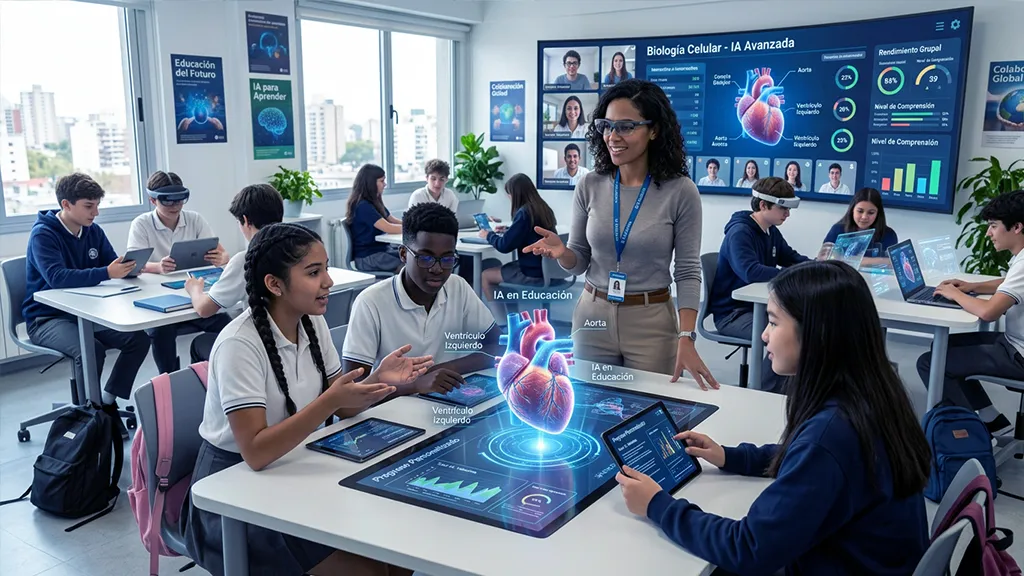


Introduction: Artificial Intelligence Is Changing American Education
Education has always evolved alongside technology. Printed textbooks, classroom computers, online courses, and digital learning platforms have each changed how students access information and how teachers deliver lessons. In 2026, artificial intelligence is becoming another important part of this transformation.
Across the United States, educators, school administrators, universities, technology developers, and families are exploring how AI can support teaching and learning. These tools can help students practice difficult subjects, generate explanations, organize study materials, and receive feedback. Teachers can also use AI to prepare lesson materials, develop classroom activities, and reduce some repetitive administrative tasks.
However, the growing availability of AI does not mean that every educational problem can be solved with software. Schools still need qualified teachers, effective curricula, meaningful assessments, reliable technology, and supportive learning environments.
The US Department of Education has encouraged responsible AI adoption while emphasizing the importance of educational outcomes, teacher involvement, accessibility, and student privacy. In August 2026, the department also released guidance encouraging schools to judge educational technology by its instructional value and evidence of effectiveness rather than simply by how engaging a digital product appears. Source: US Department of Education.
This shift is important because schools need to determine whether a tool genuinely improves learning rather than merely introducing another screen into the classroom.
This article explores the development of AI in American education, its practical applications, potential benefits, challenges, and the trends likely to influence schools and universities beyond 2026.
1. What Is AI in Education?
Artificial intelligence in education refers to computer systems that perform tasks commonly associated with human reasoning, language understanding, pattern recognition, prediction, or decision support.
Educational AI includes a wide range of technologies. Some systems provide conversational tutoring, while others analyze student performance, recommend learning materials, assist with accessibility, or help teachers organize information.
For example, a student studying algebra might use an AI-powered learning tool to request another explanation of a difficult equation. A language learner might practice conversation with a digital assistant. A teacher might use AI to generate different versions of a reading exercise for students working at different levels.
These applications differ considerably in their capabilities and limitations.
Common Types of Educational AI
Intelligent tutoring systems: These systems guide students through exercises, provide feedback, and help them work through specific problems.
Generative AI assistants: These tools can explain concepts, summarize material, brainstorm ideas, and help users develop drafts or study plans.
Adaptive learning platforms: These systems adjust the sequence, difficulty, or presentation of learning activities according to selected information about a student’s progress.
Automated feedback tools: Depending on the subject and design, these tools can help identify errors, provide practice suggestions, or support the review of assignments.
Accessibility technologies: AI-supported speech recognition, transcription, translation, and text-to-speech features can help some students interact with educational content in different ways.
Administrative assistants: Educational institutions may use AI to organize information, draft communications, answer routine questions, or support selected scheduling and reporting activities.
The most important distinction is that AI is a tool, not a complete educational system. Its effectiveness depends on the quality of the content, the suitability of the application, the needs of the student, and the involvement of educators.
2. Why AI in Education Is Gaining Attention in the USA
American schools and universities face many different challenges. Teachers work with students who have different backgrounds, abilities, interests, and learning needs. Universities must support large student populations, while institutions also manage advising, enrollment, financial aid, and administrative responsibilities.
AI is attracting interest because it may help address specific parts of these challenges.
Demand for More Personalized Learning
In a traditional classroom, a teacher may need to explain a concept to dozens of students at once. Some students understand the material immediately, while others need additional examples or more time to practice.
AI-supported tools can provide additional explanations and exercises outside normal classroom instruction. This may allow students to revisit difficult material at their own pace.
However, personalization is only useful when the explanations are accurate and the suggested activities support the curriculum.
Growing Interest in AI Skills
AI is also becoming a subject that students need to understand. Students entering higher education and the workforce may encounter AI in office software, research tools, engineering systems, healthcare applications, and other professional environments.
Learning how AI works, where it can fail, and how to evaluate its output can help prepare students for a technology-driven economy.
Opportunities to Support Teachers
Teachers spend time planning lessons, preparing assessments, communicating with families, reviewing assignments, and managing classroom information.
AI may help with selected repetitive tasks, giving teachers more time for direct instruction and individual support. Yet teachers must still verify generated materials, check for errors, and make professional decisions about what students need.
The central opportunity is not to remove the human element from education. It is to use technology where it can provide practical support.
3. AI Tutors and Personalized Student Learning
One of the most promising applications of educational AI is tutoring support.
A conventional digital worksheet provides the same questions to every student. An AI tutoring system may instead respond to a student’s answer, explain a mistake, and offer a different example.
Learning at an Individual Pace
Students often need different amounts of practice to understand the same subject. An AI tutor can offer additional explanations without requiring a student to wait until the next classroom session.
For example, a student learning fractions could ask for a visual explanation, work through several practice questions, and request a simpler example after making a mistake.
This can make independent study more flexible.
Step-by-Step Problem Solving
A useful tutor should help students understand the process behind an answer rather than simply reveal the final result.
In mathematics, this may mean explaining why a particular operation is necessary. In science, it may involve describing how evidence supports a conclusion. In writing, it could mean helping a student identify an unclear argument.
Teachers and families should encourage students to use AI to develop understanding rather than rely on it to complete every assignment.
The Importance of Accuracy
AI systems can produce incorrect explanations or confidently present information that is incomplete. Students who lack background knowledge may find it difficult to identify these mistakes.
Educational AI should therefore be tested against reliable subject material, and students should be encouraged to verify important information through textbooks, teachers, and trustworthy sources.
AI tutoring is most useful when it complements instruction and encourages active thinking.
4. How Teachers Can Use AI in American Classrooms
Teachers are central to successful education technology adoption. They understand the curriculum, know their students, and can identify whether an activity is appropriate for a particular age group or learning objective.
AI may help educators with planning and preparation, but the teacher should remain responsible for instructional decisions.
Lesson Planning and Classroom Activities
Teachers can use suitable AI tools to brainstorm lesson structures, develop practice questions, generate discussion prompts, and prepare examples.
For instance, a science teacher introducing the water cycle might request several age-appropriate examples, a vocabulary exercise, and questions for a classroom discussion.
The teacher must still verify scientific accuracy and align the material with learning standards.
Differentiated Instruction
A classroom may include students who need extra practice, students who are ready for more advanced work, and students who benefit from different formats.
AI can help educators prepare alternative explanations, reading passages, or practice activities based on the same learning objective.
This may reduce some preparation time, although reviewing and adapting the materials remains necessary.
Administrative Support
AI can assist with drafting routine communications, organizing meeting notes, developing rubrics, and summarizing non-sensitive information.
Schools should be especially careful when handling student records, disability information, grades, disciplinary matters, or other confidential material.
Teachers should use only approved systems and follow their institution’s data-handling policies.
Protecting the Teacher’s Role
Teaching requires empathy, classroom management, encouragement, subject expertise, and an understanding of students’ circumstances.
AI cannot reliably replace the full range of these responsibilities. Schools should evaluate technology according to whether it supports teachers and improves student outcomes, not simply whether it automates a task.
5. AI in American Colleges and Universities
Higher education is another major area for educational AI. Colleges and universities serve students with different academic backgrounds, schedules, financial circumstances, and career goals.
AI tools may support coursework, research, student services, and career planning. Their appropriate use depends on institutional policies and the academic task.
Research and Study Assistance
Students may use AI to brainstorm research questions, organize notes, explain unfamiliar terminology, or identify areas that require further reading.
These tools can help students begin exploring a topic, but AI-generated references and factual claims must be checked carefully.
Students should consult original research, credible publications, library resources, and course materials rather than cite an AI response as though it were a verified academic source.
Academic Writing
Writing assistants can help students identify unclear sentences, improve organization, and review grammar.
There is a meaningful difference between using feedback to improve one’s own work and submitting generated material without understanding or acknowledging it.
Universities may have different policies concerning AI assistance. Students should follow their instructor’s rules and disclose AI use when required.
Student Advising
AI assistants can potentially help students locate information about course requirements, academic calendars, degree pathways, campus resources, and application procedures.
The US Department of Education has identified college and career pathway exploration, advising, and navigation as potential areas for responsible AI use. Source: Department of Education guidance on AI in schools.
However, students should confirm important information with official university departments, especially when decisions affect graduation requirements, tuition, financial aid, or enrollment deadlines.
Research Administration
Universities may also use AI to assist with document organization, data analysis, and selected administrative workflows.
Research involving sensitive information, human participants, or confidential material requires additional care. Institutions must ensure that AI use is compatible with research ethics, data protection, and applicable requirements.
6. AI and Special Education: Accessibility and Inclusion
AI has the potential to improve access to educational materials for some students with disabilities and different learning needs.
The benefits depend on the design of the tool, the student’s requirements, the quality of implementation, and compatibility with existing accessibility accommodations.
Speech-to-Text and Text-to-Speech
Speech-to-text systems can convert spoken language into written text, while text-to-speech tools read digital material aloud.
These features may assist students who benefit from listening to content, using dictation, or accessing text through alternative formats.
Accuracy can vary depending on accents, background noise, language, and the complexity of the material. Students may still need tools and support tailored to their individual needs.
Translation and Language Support
Some AI tools can help explain vocabulary, translate selected text, or provide additional language practice.
These features may be useful for multilingual learners and students developing proficiency in English.
However, automatic translation can miss context, idioms, or subject-specific meanings. Teachers should verify critical educational material before using it in formal instruction.
Adapting Digital Content
AI may help educators develop alternative formats, simplify selected passages, or create additional examples.
Such adaptations should preserve the intended learning objective and avoid lowering expectations without a valid educational reason.
Accessibility should be built into the overall learning experience rather than treated as an optional feature added at the end.
7. AI in K–12 Education: Elementary, Middle, and High Schools
The use of AI in K–12 schools requires particular attention because children have different levels of reading ability, judgment, independence, and digital literacy.
A tool suitable for a university student may not be appropriate for a young child.
Elementary School Applications
For younger learners, carefully selected tools may provide reading practice, vocabulary activities, basic mathematics exercises, or teacher-guided educational games.
The priority should be age-appropriate learning, clear instructions, limited unnecessary data collection, and meaningful adult supervision.
Technology should not replace essential activities such as conversation, reading physical books, creative play, and direct interaction with teachers.
Middle School Learning
Middle school students are developing stronger independent study habits and learning to evaluate information.
AI can support writing practice, science explanations, mathematics exercises, and guided research projects.
Teachers can also use these activities to introduce questions about misinformation, source verification, privacy, and the limitations of automated systems.
High School and Career Preparation
High school students may benefit from AI literacy lessons, introductory programming activities, career exploration, and project-based learning.
Students can examine how AI systems are used in industries such as manufacturing, healthcare, finance, transportation, and scientific research.
This helps connect classroom learning with possible career pathways while encouraging students to consider ethical questions and real-world consequences.
School Policies Matter
Schools should communicate clearly about when AI tools are permitted, what information students may enter, and how AI-assisted work should be acknowledged.
Consistent policies help students understand expectations and reduce confusion between acceptable learning support and academic misconduct.
8. AI Literacy: Preparing Students for the Future Workforce
AI literacy means understanding the basic capabilities, limitations, uses, and risks of artificial intelligence.
It does not require every student to become a software engineer. Instead, students should develop the skills needed to use AI thoughtfully and recognize when its output requires verification.
Understanding How AI Works
Students can learn that AI systems identify patterns in data and generate outputs based on the information and methods used to develop them.
They should understand that a fluent answer is not necessarily a correct answer and that AI systems can reflect limitations or biases in their training data and design.
Critical Thinking and Verification
Students should learn to compare AI-generated claims with reliable sources, identify missing evidence, and question conclusions that seem unreasonable.
For research assignments, this could include checking whether a cited article exists, confirming the publication date, and reading the original source.
These skills are valuable even when students are not directly using AI because digital information increasingly includes automatically generated content.
Practical Skills for Different Careers
AI literacy can be integrated into subjects such as business, writing, science, mathematics, arts, and computer science.
A business student might study how AI supports forecasting. A science student might examine its role in analyzing data. A media student might investigate synthetic images and misinformation.
The goal is to help students understand both the capabilities and the limitations of the technology they may encounter in their future work.
9. AI and Academic Integrity: Finding the Right Balance
One of the biggest concerns surrounding AI in education is academic integrity.
Students can use generative AI to produce essays, summaries, code, and answers to questions. This creates challenges for educators who need to determine whether assignments accurately reflect students’ knowledge and skills.
Why Traditional Assignments May Need Rethinking
If an assignment can be completed entirely by copying a prompt into an AI tool, it may not provide enough evidence of independent understanding.
Teachers can respond by including classroom writing, oral explanations, supervised exercises, project milestones, and assignments that require students to connect ideas to course discussions or personal observations.
These approaches can help educators evaluate the learning process as well as the final result.
Teaching Responsible AI Use
A blanket prohibition may not prepare students for workplaces where AI tools are used for some tasks. On the other hand, unrestricted use can undermine learning when students outsource the thinking they are expected to develop.
Schools and universities can define permitted uses according to the assignment.
For example, an instructor might allow AI for brainstorming but prohibit generated prose in a particular essay. Another assignment might explicitly ask students to compare an AI answer with verified sources and explain the differences.
The Limitations of AI Detectors
AI-detection tools can produce false positives and false negatives. Their results should not be treated as definitive proof of misconduct.
Educators should use a fair process, examine the broader evidence, and give students an opportunity to explain their work.
The goal is to preserve academic standards while adapting assessment methods to a changing technological environment.
10. Student Privacy, Cybersecurity, and Responsible AI
Educational AI can involve sensitive information. Depending on the system, that information may include student names, learning histories, assignment content, disability accommodations, behavioral records, or other personal details.
Schools must understand what information a product collects, how it is processed, whether it is shared with third parties, and how long it is retained.
Protecting Student Data
Before adopting an AI platform, an institution should examine its privacy documentation, security practices, access controls, and data-retention policies.
Schools should avoid entering identifiable student information into unapproved public tools.
They should also make sure that teachers, students, and families understand the relevant rules.
Understanding Federal Privacy Requirements
US schools may have obligations under laws such as the Family Educational Rights and Privacy Act (FERPA) and, where applicable, the Children’s Online Privacy Protection Act (COPPA).
The precise requirements depend on the situation, the data involved, and how the service operates. Schools should seek appropriate legal and privacy guidance rather than assume that every educational application complies automatically.
Preventing Misinformation and Manipulation
AI systems can generate misleading content, fabricated references, or persuasive explanations that omit important facts.
Students need to learn how to identify unreliable claims, compare sources, and avoid sharing sensitive information with unfamiliar systems.
Institutions should also prepare for cybersecurity threats, including phishing attempts that imitate school officials, fake learning platforms, and compromised accounts.
Transparency and Accountability
Students and families should receive understandable information about how AI is being used in education.
When a system influences consequential decisions, such as access to services or student evaluation, institutions should examine whether the process is appropriate, explainable, and subject to meaningful human review.
Responsible adoption requires clear accountability rather than assuming that a technology provider alone can make every decision.
11. The Role of US Education Technology Companies
The American education technology market includes software developers, learning-platform providers, digital publishers, tutoring services, accessibility companies, and AI infrastructure providers.
These businesses develop tools for different audiences, from elementary school students to university researchers and adult learners.
Learning Management Platforms
Learning management systems help educators distribute materials, collect assignments, communicate with students, and organize course information.
AI features may be integrated into these platforms to assist with content development, learning summaries, or selected administrative tasks.
The usefulness of these features depends on how well they fit existing teaching workflows.
Digital Tutoring Companies
Online tutoring services can combine human instruction with digital practice tools and automated feedback.
AI may help students practice between sessions or give tutors additional information about areas that need attention.
Human tutors remain important for explaining complex concepts, motivating students, and recognizing when a learner needs a different approach.
Education Software Startups
Startups may focus on specific problems, such as reading support, language learning, exam preparation, classroom administration, or college advising.
Their success depends on delivering reliable educational value, protecting user data, meeting school requirements, and providing sufficient support for teachers and students.
Schools should assess products based on evidence, usability, accessibility, cost, and compatibility with existing systems rather than marketing claims alone.
12. Challenges Facing AI in American Education
Although AI can provide useful support, adopting it across schools and universities is not straightforward.
Unequal Access to Technology
Some students have reliable broadband, modern devices, and quiet places to study. Others face limited internet access, shared devices, or other barriers.
If AI-based learning becomes essential without addressing these differences, existing educational inequalities may become more difficult to overcome.
Schools should consider access, affordability, device availability, and offline alternatives when designing technology programs.
Teacher Training
Educators need practical training to understand what AI tools can do, where they can fail, and how to use them appropriately.
Training should cover instructional design, privacy, bias, accessibility, academic integrity, and methods for evaluating student learning.
Simply giving teachers access to software is not the same as preparing them to use it effectively.
Accuracy and Reliability
Generative AI can produce mistakes, outdated explanations, and fabricated citations.
Schools need review procedures, reliable learning materials, and ways for students to question incorrect outputs.
High-stakes educational decisions should not depend on unverified AI-generated information.
Cost and Long-Term Sustainability
AI products may involve subscription fees, implementation costs, integration work, staff training, and ongoing support.
Schools should consider the total cost of ownership rather than focusing only on an introductory price.
A technology program should also have a clear plan for measuring whether its benefits justify the expense.
Overdependence on Automation
Students need opportunities to practice memory, reasoning, writing, problem-solving, and independent judgment.
If technology completes too much of the learning process, students may miss opportunities to develop these skills.
The most effective educational use of AI should strengthen student capability rather than make independent effort unnecessary.
13. How Schools Can Evaluate AI Tools in 2026
Selecting an AI tool should begin with a clear educational problem.
A school should not purchase technology simply because AI is popular. It should identify the need, evaluate the available evidence, and decide how success will be measured.
Step 1: Define the Learning Objective
Determine whether the goal is to improve reading practice, support mathematics instruction, reduce administrative work, or provide another specific benefit.
A clearly defined objective makes it easier to judge whether the technology is appropriate.
Step 2: Examine Evidence of Effectiveness
Schools should look for credible evidence that a tool improves the intended outcome.
Useful measures might include student progress, assignment quality, teacher workload, accessibility, or the time required to complete a particular task.
Engagement alone is not enough to demonstrate learning improvement.
Step 3: Review Privacy and Security
Administrators should examine data collection, retention, access controls, security practices, and third-party sharing.
They should confirm that the product is appropriate for the students and information involved.
Step 4: Involve Teachers, Students, and Families
Educators can assess classroom suitability, while families can raise concerns about privacy, access, and age appropriateness.
Clear communication helps establish expectations and creates opportunities to identify problems early.
Step 5: Run a Limited Pilot
A small pilot can help a school identify practical challenges before adopting a tool more widely.
The pilot should include a defined evaluation period, clear success measures, and a process for collecting feedback.
Step 6: Review and Adjust
After implementation, schools should examine whether the technology is delivering measurable benefits.
If it does not improve the intended outcome or creates unacceptable risks, administrators should change the implementation or discontinue the tool.
This evidence-based approach is consistent with the US Department of Education’s August 2026 emphasis on instructional purpose, educator judgment, transparency, and student outcomes.
14. What Is Next for AI in Education in the USA?
The future of educational AI will likely involve more integration with learning platforms, improved accessibility features, AI literacy programs, and tools that help educators manage selected classroom tasks.
Several trends deserve attention.
More personalized practice: Learning platforms may provide increasingly tailored exercises and explanations based on student progress, subject to the quality of their models and educational design.
AI literacy in school curricula: Students may receive more structured instruction on AI capabilities, verification, privacy, and responsible use.
Better teacher-support tools: AI may become more closely integrated into lesson planning, learning-material preparation, and administrative workflows.
Expanded accessibility options: Speech, translation, transcription, and alternative content formats may help more students interact with digital learning materials.
More evidence-based procurement: Schools may demand stronger evidence of learning outcomes, transparent data practices, and clear implementation plans from technology providers.
New approaches to assessment: Teachers may increasingly combine written work with oral explanations, classroom activities, supervised assessments, and project-based learning.
Closer attention to student protection: Privacy, cybersecurity, age-appropriate design, and transparency will remain central to responsible implementation.
These developments will not occur uniformly. Schools have different budgets, technical capabilities, policies, and student needs. Some institutions may adopt new tools quickly, while others will proceed more cautiously.
The strongest results are likely to come from thoughtful implementation rather than technology adoption alone.
Conclusion: AI Can Support the Future of American Education
AI in education in the USA is creating new possibilities for tutoring, personalized learning, classroom preparation, accessibility, college advising, and workforce development.
When used appropriately, AI can provide additional practice, help teachers prepare materials, and make certain educational tasks more efficient. It can also help students learn about a technology that is increasingly relevant across professional fields.
However, AI introduces risks involving accuracy, privacy, academic integrity, unequal access, and overreliance on automation. Schools must address these challenges through clear policies, teacher training, appropriate safeguards, and ongoing evaluation.
The most important measure of educational technology is whether it helps students learn. A tool that produces impressive demonstrations but fails to improve understanding may not justify its cost or complexity.
As American schools and universities continue exploring AI beyond 2026, the goal should be to combine technological innovation with strong teaching, critical thinking, accessibility, and human judgment.
AI should not define the purpose of education. It should help educators and students achieve that purpose more effectively.
Frequently Asked Questions (FAQs)
1. What is AI in education in the USA?
AI in education refers to using artificial intelligence to support teaching, learning, assessment, accessibility, tutoring, and selected administrative activities in American schools, colleges, and universities.
2. How are American schools using AI in 2026?
Potential applications include personalized practice, tutoring assistance, lesson preparation, writing feedback, accessibility tools, student advising, and administrative support. Adoption varies by institution and local policy.
3. Can AI replace teachers in American classrooms?
AI can support certain educational tasks, but it cannot reliably replace the full responsibilities of teachers, including relationship-building, classroom leadership, professional judgment, and understanding students’ needs.
4. What are the benefits of AI tutors?
AI tutors can provide additional explanations, practice questions, and immediate feedback. Their usefulness depends on accuracy, instructional quality, and how effectively they support independent learning.
5. Is AI safe for school students?
AI tools can be useful when selected and managed appropriately. Schools and families should review age suitability, privacy, security, content accuracy, and the rules governing student use.
6. How can teachers use AI responsibly?
Teachers can use approved tools to brainstorm lesson ideas, prepare exercises, and support selected administrative tasks. They should verify generated content, protect student information, and follow school policies.
7. Does AI make students more likely to cheat?
AI can make it easier to submit work that does not reflect a student’s own understanding. Schools can address this through clear policies, appropriate assessment design, student education, and fair review procedures.
8. What is AI literacy?
AI literacy is the ability to understand AI’s basic capabilities and limitations, use it responsibly, verify its outputs, and recognize potential risks such as misinformation and bias.
9. Can AI help students with disabilities?
Some AI-supported features, including speech-to-text, text-to-speech, transcription, and content adaptation, can improve access for certain students. The right tool depends on individual needs and accessibility requirements.
10. What is the future of AI in American education?
Likely developments include more personalized practice, better teacher-support tools, expanded AI literacy, accessibility improvements, and stronger emphasis on privacy, evidence, and responsible use.


