


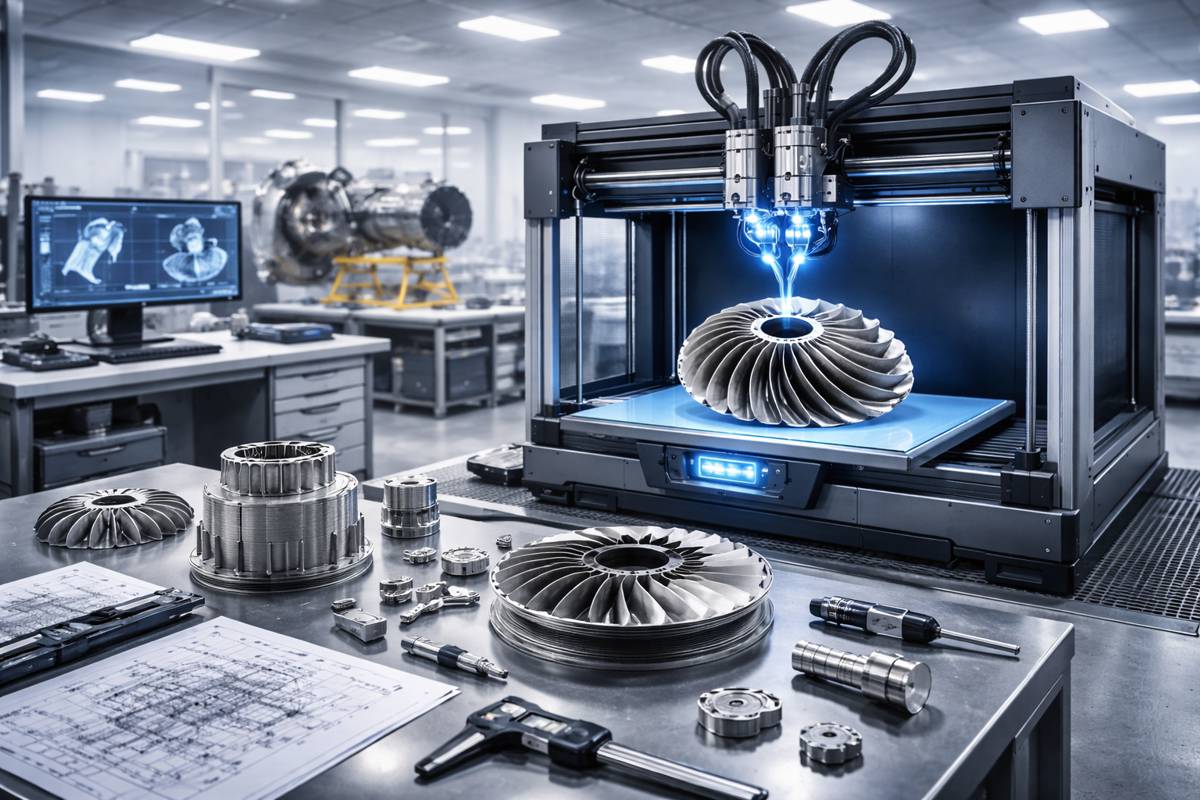


Introduction: The Growing Importance of 3D Printing in America
Technology continues to transform how products are designed, developed, and manufactured across the United States. One of the most interesting developments is the growth of 3D printing, a technology that allows manufacturers to create physical objects directly from digital designs. What once served mainly as a tool for making experimental models has become an increasingly important part of modern industrial production.
In 2026, 3D printing is attracting attention across American manufacturing, aerospace engineering, healthcare, automotive development, construction, and product design. Businesses are exploring how additive manufacturing can help them produce complex components, reduce development time, customize products, and respond more quickly to changing customer requirements.
The technology is also becoming relevant to discussions about domestic manufacturing and supply chain resilience. When a company can manufacture selected components closer to its customers, it may be able to reduce shipping requirements, shorten certain production timelines, and maintain better control over replacement-part availability.
According to the National Institute of Standards and Technology (NIST), additive manufacturing builds products layer by layer from digital designs. Depending on the process, manufacturers can work with polymers, metals, ceramics, and other specialized materials. The technology can support intricate designs that are difficult to create using conventional manufacturing methods.
However, 3D printing is not a universal replacement for traditional manufacturing. Its value depends on the product, materials, production volume, required accuracy, and overall cost. Understanding where it offers genuine advantages is essential for businesses considering investment in this technology.
1. What Is 3D Printing and How Does It Work?
3D printing, commonly called additive manufacturing, is a production process that creates three-dimensional objects by adding material in successive layers rather than removing material from a solid block.
The process generally begins with a digital model created using computer-aided design software. Specialized software then prepares the model for printing, dividing it into layers and generating instructions for the machine.
The printer follows these instructions to build the object. Depending on the technology, it may melt plastic filament, solidify liquid resin, fuse metal powder, or deposit another suitable material.
After printing, a component may require additional work, including support removal, surface finishing, heat treatment, machining, or inspection. Industrial applications often involve several of these steps before a part is ready for use.
Common Types of 3D Printing
Fused filament fabrication (FFF): This process melts and deposits thermoplastic material through a nozzle. It is widely used for prototypes, educational projects, product housings, and selected functional components.
Stereolithography (SLA): This technique uses light to solidify liquid resin. It is useful when detailed features and smooth surfaces are important, including in product design, dental applications, and specialized models.
Selective laser sintering (SLS): This method uses a laser to fuse powdered material into a solid structure. It can produce complex parts without requiring the same support structures used by some other methods.
Metal powder bed fusion: Industrial machines use energy sources such as lasers or electron beams to fuse metal powder layer by layer. Applications may include aerospace components, industrial tooling, and selected medical implants.
Binder jetting: A binding agent joins particles of powder to create a component or intermediate structure. Depending on the material and application, additional processing may be required to achieve the desired strength and properties.
Each method has different costs, material limitations, production speeds, and quality requirements. Selecting the right process is therefore an important part of successful additive manufacturing.
2. Why 3D Printing Matters for the US Manufacturing Industry
The United States has a broad manufacturing base that includes aerospace, medical equipment, automotive products, electronics, industrial machinery, and consumer goods. These sectors often require specialized parts, short development cycles, and dependable quality.
3D printing offers manufacturers another way to address these needs.
Faster Product Development
Traditional manufacturing may require specialized molds, cutting tools, or production fixtures before a new component can be made. These requirements can increase the time and expense involved in early product development.
With 3D printing, engineers can produce a prototype directly from a digital model. They can then test its dimensions, fit, appearance, and selected functional characteristics before making further design changes.
This approach can make design iteration more convenient, particularly when a product is still being developed.
Greater Design Flexibility
Some components contain internal channels, complex curves, lightweight lattice structures, or shapes that are difficult to manufacture using conventional methods.
Additive manufacturing can make certain designs more practical by building features directly into the component. In some cases, multiple parts can be combined into a single printed structure, reducing assembly requirements.
However, a design must still meet strength, durability, inspection, and maintenance requirements. A shape that is easy to print is not automatically the best engineering solution.
Reduced Material Waste in Suitable Applications
Traditional machining often removes material from a larger block to create the final component. Additive manufacturing generally builds material where it is needed, which can reduce waste for some geometries.
The overall environmental and financial benefit depends on material production, printer energy use, failed builds, post-processing, and the recovery or disposal of unused material.
For manufacturers working with expensive metals or complex low-volume parts, these factors can make additive manufacturing worth evaluating.
The US Department of Commerce’s manufacturing resources describe additive manufacturing as a method for creating complex parts using digital model data and materials such as metals, polymers, and ceramics. See Manufacturing.gov’s additive manufacturing overview.
3. Aerospace and Space Exploration: A Major Application Area
Aerospace is one of the most prominent fields for industrial 3D printing because aircraft and spacecraft often use components with demanding weight, strength, and performance requirements.
Reducing component weight can be valuable in aviation and space systems, where every kilogram may influence payload, fuel consumption, or mission design. Additive manufacturing can help engineers develop selected lightweight structures and complex internal geometries.
Aircraft Component Development
Aerospace manufacturers can use 3D printing to develop prototypes, specialized tooling, cabin components, brackets, ducts, and other parts suitable for the technology.
Some applications focus on consolidating several traditionally manufactured components into one integrated design. Fewer separate parts may simplify assembly, although qualification and maintenance requirements must still be considered.
Rocket and Spacecraft Manufacturing
Space companies face their own production challenges. Rocket engines, fluid systems, and spacecraft structures can contain complex shapes that are difficult or expensive to produce through conventional methods.
Metal additive manufacturing can support selected engine components and other specialized hardware. It can also help engineers experiment with designs before committing to larger production programs.
The technology does not eliminate the need for rigorous testing. Aerospace components must meet demanding performance and reliability requirements, and production processes must be validated for their intended use.
The Role of American Innovation
US research organizations, aerospace businesses, universities, and manufacturing suppliers continue to investigate new materials, machine capabilities, and inspection methods.
Organizations such as America Makes bring together industry, academia, government, and workforce organizations to advance additive manufacturing research and adoption.
As aerospace programs seek efficient ways to develop complex parts, additive manufacturing is likely to remain an important tool for selected applications.
4. Healthcare and Medical 3D Printing
Healthcare is another area where 3D printing offers practical benefits, especially when products need to be adapted to individual patients or specific clinical requirements.
Medical professionals may use printed anatomical models, customized surgical guides, dental devices, prosthetic components, and selected implants. The exact application depends on the material, manufacturing process, regulatory requirements, and clinical purpose.
Personalized Medical Devices
People do not all have the same anatomy, mobility needs, or treatment requirements. A standardized product may not always provide the best fit.
3D printing can help manufacturers create certain devices that reflect an individual’s measurements. For example, digital scans may help inform the design of a customized external prosthetic component or an orthopedic aid.
Personalization can improve fit and usability when the design and manufacturing process are properly validated.
Surgical Planning and Medical Education
Printed anatomical models can help clinicians examine complex structures before a procedure. A model based on medical imaging may provide a physical reference for discussing anatomy, planning an approach, or explaining a condition to a patient.
These models do not replace clinical judgment or medical imaging. Instead, they offer another way to understand selected anatomical features.
Dental Applications
Dental laboratories use digital workflows and 3D printing for certain models, guides, temporary devices, and other products. The suitability of a printed item depends on the material’s approved use and the device’s intended purpose.
Medical and dental manufacturers must consider biocompatibility, dimensional accuracy, sterilization where applicable, and regulatory obligations. A consumer-grade printer and ordinary printing material should never be assumed suitable for clinical use.
What Comes Next?
Research into bioprinting and tissue engineering continues to explore whether biological materials can be arranged into structures that support future medical applications. These fields are scientifically promising, but complex, fully functional printed organs are not routine clinical products.
The near-term value of medical 3D printing remains strongest in carefully defined applications where customization, digital planning, and specialized production can address a real clinical need.
5. Automotive Manufacturing and Electric Vehicles
The US automotive sector is continually developing new vehicle platforms, production processes, and electric vehicle technologies. 3D printing can support this work without replacing every traditional manufacturing method.
Prototypes and Design Testing
Automotive engineers can print dashboard components, interior features, brackets, air ducts, housings, and other prototype parts.
These prototypes help teams evaluate shape, fit, and assembly before expensive production tooling is created. Depending on the material and testing requirements, some printed components can also support functional evaluation.
Specialized Tools for Factory Workers
One practical industrial use is producing custom jigs, fixtures, alignment guides, and assembly aids. These tools can be designed around a particular workstation or manufacturing task.
Because they may be made in smaller quantities, 3D-printed tools can sometimes offer cost or lead-time advantages compared with conventional alternatives.
Electric Vehicle Development
Electric vehicles contain numerous electrical, thermal, and structural systems. Additive manufacturing can help engineers explore specialized housings, cooling channels, lightweight structures, and prototype battery-related components.
Nevertheless, battery systems require strict attention to thermal management, electrical insulation, fire safety, and durability. Printing a component does not remove these engineering challenges.
Spare Parts for Older Vehicles
Manufacturers and specialist repair businesses sometimes struggle to source components for older or low-volume vehicles. Digital part files and on-demand manufacturing could provide another option for suitable non-safety-critical parts.
The original design, material properties, intellectual property rights, and legal requirements still matter. Critical vehicle components should only be produced through appropriate engineering and quality-control processes.
6. 3D Printing for Construction and Housing
The construction industry is exploring large-scale 3D printing as one possible way to automate selected building processes.
In construction printing, a specialized machine deposits material—often a formulated cement-based mixture—in successive layers to form portions of a structure. The method differs from the desktop and industrial printers used for small components.
Potential Advantages
Construction 3D printing may offer several benefits in suitable projects:
- Automated placement of selected building materials.
- Greater flexibility for some curved or unusual architectural shapes.
- Potentially reduced formwork requirements for certain designs.
- Faster execution of specific wall or structural elements.
- Opportunities to standardize digital design and construction workflows.
These advantages are not guaranteed. Site preparation, foundations, reinforcement, roofing, plumbing, electrical systems, windows, inspections, and finishing work may still require conventional methods.
Challenges in the US Housing Market
A printed wall is only one part of a complete building. Construction businesses must account for local building codes, weather conditions, material performance, structural design, labor, insurance, and financing.
Standards and approval pathways are especially important because construction products must perform safely over many years.
The National Institute of Standards and Technology has documented industry discussions around standardization for additive construction, including material testing, structural integrity, and safety.
For this reason, 3D-printed construction should be viewed as an emerging method for selected projects rather than an immediate solution to every housing challenge in America.
7. Small Businesses and Startups: New Opportunities
3D printing is not limited to large industrial corporations. It can also create opportunities for entrepreneurs, design studios, engineering services, and small manufacturers.
A business does not necessarily need to manufacture thousands of identical products to benefit from additive manufacturing. Some companies specialize in small production runs, customized components, prototyping, or replacement parts.
Custom Product Development
Entrepreneurs can develop items such as organizers, specialized mounts, product enclosures, hobby accessories, and custom-designed household products.
The strongest businesses typically solve a specific customer problem rather than simply selling generic printed objects. Product quality, demand, pricing, shipping, and customer support remain essential.
Prototyping Services
Many companies have product ideas but lack in-house manufacturing equipment. A 3D printing service can help them convert digital designs into physical prototypes.
Services may include design consultation, material selection, printing, finishing, and dimensional inspection.
Engineering and Design Consulting
Companies adopting additive manufacturing may need help redesigning existing components for printing. This process, sometimes called design for additive manufacturing, involves more than converting a standard CAD file into a printable format.
An effective redesign considers material behavior, support requirements, build orientation, mechanical loads, finishing, inspection, and the economics of the production process.
On-Demand Replacement Parts
Manufacturers can sometimes produce selected replacement parts when needed rather than maintaining large inventories of every possible component.
This may be particularly useful for discontinued equipment or low-volume machinery. However, businesses must ensure that digital designs are accurate, materials are appropriate, and replacement components meet all necessary safety and performance requirements.
For startups, the opportunity is real—but profitability depends on market demand, reliable production, and a clear understanding of total costs.
8. Artificial Intelligence and Automation Are Changing 3D Printing
Artificial intelligence is becoming increasingly relevant to digital manufacturing. In additive manufacturing, AI-based tools can assist with design exploration, process monitoring, quality analysis, and production planning.
AI-Assisted Product Design
Engineers can use generative design software to explore multiple component shapes based on constraints such as weight, material, available space, and mechanical loads.
These systems may identify geometries that are difficult to produce through traditional methods but suitable for certain 3D printing processes.
However, engineers must still verify the design. Simulation results, material assumptions, and real-world operating conditions all influence whether a component is safe and effective.
Monitoring the Printing Process
Industrial printers may generate sensor readings, images, temperature measurements, and other production data. Analytical systems can examine these signals to identify unusual conditions during a build.
Such monitoring may help manufacturers detect problems earlier, reduce failed production runs, or improve consistency. It cannot guarantee that every defect will be detected, so inspection and validation remain important.
Automated Post-Processing
After a component leaves the printer, it may need support removal, surface treatment, heat treatment, machining, or inspection. Automation can help standardize some of these tasks and reduce repetitive work.
The broader goal is to integrate printing with the rest of the manufacturing workflow rather than treat the printer as an isolated machine.
In 2026, the combination of AI, digital design, machine monitoring, and automation is an important area to watch as manufacturers look for more repeatable production methods.
9. US Research, Standards, and Industry Collaboration in 2026
Industrial adoption depends on more than better printers. Companies also need dependable materials, repeatable processes, qualified workers, and reliable methods for confirming product quality.
This is where research institutions and industry partnerships play an important role.
NIST and Measurement Science
The National Institute of Standards and Technology works on measurement science, reference materials, benchmarks, and standards related to additive manufacturing.
These activities help researchers and manufacturers understand how materials and processes behave and how results can be compared consistently.
Reliable measurements are particularly important when printed components are used in demanding applications such as aerospace, medical devices, and industrial equipment.
Learn more through the NIST additive manufacturing standards program.
America Makes
America Makes is a US public-private partnership focused on advancing additive manufacturing technology and workforce development. Its members include organizations from industry, academia, government, and related fields.
The organization supports collaboration on research, technical challenges, education, and manufacturing competitiveness.
In October 2026, America Makes and the American National Standards Institute announced new resources to help industry navigate additive manufacturing standards, including a searchable standards database and an updated report on remaining standardization gaps. This reflects the continuing effort to make industrial 3D printing more consistent and easier to adopt. Read the announcement from America Makes.
Why Standards Matter
Imagine two manufacturers printing the same component on different machines. If their materials, processing conditions, and inspection methods are inconsistent, the final parts may not perform identically.
Standards help establish shared expectations for materials, testing, terminology, and processes. They can also help purchasers evaluate suppliers and make decisions based on documented quality requirements.
As 3D printing moves into more demanding industrial applications, this infrastructure will remain essential.
10. The Biggest Challenges Facing 3D Printing in America
Despite its advantages, additive manufacturing still faces important technical and commercial barriers.
High Equipment and Operating Costs
Industrial metal printers can require substantial investment. Businesses must also pay for materials, software, trained operators, maintenance, inspection, finishing, and facility requirements.
A printed part may be cheaper than a conventional alternative in one application but much more expensive in another.
Production Speed
Some 3D printing processes are slower than conventional methods when large quantities of identical products are needed.
Traditional molding, stamping, machining, and other production techniques may remain more economical for high-volume manufacturing, especially after tooling costs are spread across many units.
Quality and Repeatability
A printed component’s properties may depend on material quality, machine calibration, build orientation, environmental conditions, and processing parameters.
Manufacturers need documented procedures and appropriate inspection to ensure that parts meet specifications consistently.
Skilled Workforce Requirements
Industrial additive manufacturing combines digital design, materials science, machine operation, engineering, and quality assurance.
Companies may need employees who understand both the software and the physical manufacturing process. Workforce development and technical education are therefore important to long-term adoption.
Intellectual Property and Cybersecurity
Digital manufacturing files can contain valuable designs. Unauthorized copying, tampering, or distribution may create financial and safety risks.
Businesses should protect design files, control access to manufacturing systems, verify file integrity, and establish clear licensing agreements with customers and suppliers.
Health and Workplace Safety
Certain printing processes can expose workers to fine particles, chemical vapors, heated surfaces, lasers, or other hazards. The specific risks depend on the machine, material, and environment.
Employers should follow appropriate ventilation, handling, protective-equipment, training, and maintenance practices. The US National Institute for Occupational Safety and Health provides guidance and research on 3D printing workplace safety.
11. Sustainability and the Future of American Manufacturing
Sustainability is an important consideration for manufacturers evaluating new production technologies. Additive manufacturing may reduce material waste for selected parts, support lightweight designs, and make some replacement components available closer to where they are needed.
These advantages should be assessed across the entire product lifecycle.
A printed component may require energy-intensive production, specialized powder handling, repeated build attempts, or extensive finishing. Some materials are difficult to recycle, and unused metal powder or resin must be handled according to appropriate procedures.
Businesses should therefore compare the full environmental footprint of additive manufacturing with that of alternative production methods.
In some applications, conventional manufacturing will remain the better choice. In others, additive manufacturing may offer a combination of design flexibility, reduced material use, and on-demand production that justifies its adoption.
The most promising future is likely to involve a combination of manufacturing technologies. A company may print a complex component, machine critical surfaces, inspect the finished part, and assemble it with conventionally produced components.
This hybrid approach allows manufacturers to select the most appropriate method for each stage of production.
12. What to Expect From 3D Printing in the USA Beyond 2026
Several developments are likely to influence the next phase of American additive manufacturing.
More industrial applications: As businesses gain experience, they may identify additional components where printing offers measurable benefits over conventional production.
Improved process monitoring: Better sensors, software, and data analysis could help manufacturers detect problems and improve production consistency.
New materials: Research into metal alloys, polymers, ceramics, and composite materials may expand the range of applications that can be manufactured effectively.
Greater integration with AI: Design optimization and process analytics may become more closely connected to production workflows, helping engineers evaluate designs and manufacturing parameters.
More attention to standards: As printed components enter higher-consequence applications, documented testing, traceability, and qualification will remain central to adoption.
Growth in technical education: Universities, community colleges, training providers, and manufacturers will continue to need practical ways to prepare workers for digital manufacturing roles.
The pace of progress will differ by sector. Aerospace and medical applications may require lengthy qualification processes, while prototypes and selected consumer products can often be introduced more quickly.
Ultimately, successful adoption will depend on demonstrated performance and business value rather than excitement about the technology alone.
Conclusion: 3D Printing Is Becoming an Important Part of US Industry
3D printing in the USA is evolving from a technology associated mainly with prototypes into a broader set of manufacturing tools. Its applications now include specialized aerospace components, customized medical products, automotive development, industrial tooling, construction experiments, and small-business product development.
The technology offers meaningful advantages in design flexibility, customization, and low-volume production. At the same time, equipment costs, production speed, quality control, workplace safety, and regulatory requirements can limit its suitability for particular products.
For American manufacturers, the most effective strategy is to evaluate additive manufacturing based on the specific problem they need to solve. A successful project starts with a clear business case, appropriate materials, validated processes, and realistic expectations.
As research, automation, digital design, and industry standards continue to develop, additive manufacturing is likely to remain an important part of the United States’ advanced manufacturing landscape.
The future of manufacturing will not depend on 3D printing alone. It will depend on how effectively businesses combine additive manufacturing with conventional production, engineering expertise, quality assurance, and responsible innovation.
Frequently Asked Questions (FAQs)
1. What is 3D printing in the USA?
3D printing in the USA refers to the use of additive manufacturing technologies by American companies, research institutions, healthcare providers, and entrepreneurs to create physical products from digital designs.
2. Which industries use 3D printing in America?
Major application areas include aerospace, healthcare, automotive manufacturing, industrial machinery, product design, dental technology, and selected construction projects.
3. Is 3D printing replacing traditional manufacturing?
No. It complements traditional manufacturing and is particularly useful for complex designs, prototypes, customized products, and certain low-volume parts. Conventional methods may remain more economical for many high-volume products.
4. How does 3D printing help American businesses?
It can accelerate prototyping, support customized production, reduce tooling requirements for certain projects, and make selected replacement parts available on demand.
5. Is metal 3D printing used in aerospace?
Yes. Selected aerospace applications use metal additive manufacturing for complex components. Parts must still satisfy the relevant testing, inspection, qualification, and safety requirements.
6. Can 3D printing help the healthcare industry?
Yes. Applications include anatomical models, surgical guides, dental products, prosthetic components, and selected implants. Medical use requires suitable materials and compliance with applicable regulatory and clinical requirements.
7. Is 3D printing environmentally friendly?
It can reduce material waste in some applications, but the overall environmental impact depends on energy use, materials, post-processing, waste handling, and the alternative manufacturing method.
8. What skills are needed for a career in additive manufacturing?
Useful skills include CAD design, engineering, materials science, printer operation, production planning, quality assurance, and knowledge of manufacturing standards.
9. What is the difference between 3D printing and additive manufacturing?
The terms are frequently used interchangeably. Additive manufacturing is the broader industrial term for processes that build products layer by layer, while 3D printing is the widely recognized general term.
10. What is the future of 3D printing in the United States?
Future developments may include improved materials, more automated production, AI-assisted design, better process monitoring, expanded industrial applications, and stronger standards for product quality.


