




Introduction: When Software Meets Steel
Remember when artificial intelligence was just about chatbots writing poetry and generating weird images? Those days are long gone. In 2026, AI has transformed into something far more physical, far more expensive, and far more consequential for the American economy and national security.
The story of U.S. technology in 2026 is no longer just about lines of code. It is about semiconductors, power plants, data centers, and national defense. It is about a fundamental shift from digital innovation to physical infrastructure and the numbers are staggering.
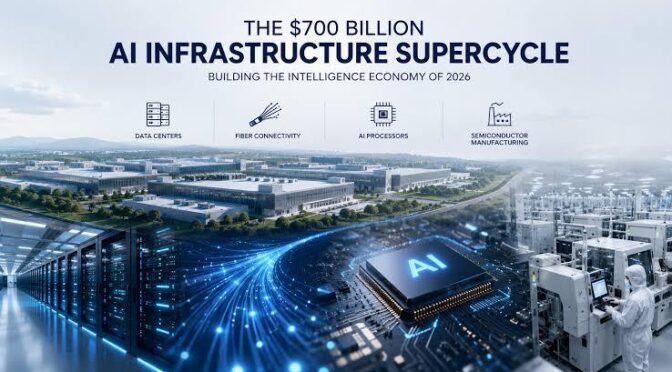
The five largest U.S. cloud and AI infrastructure providers Amazon, Alphabet, Microsoft, Meta, and Oracle have collectively committed to spending between $660 billion and $690 billion on capital expenditure in 2026, nearly double the levels of 2025 . This is not corporate spending as usual. This is a national project, a technological mobilization that rivals the space race and the interstate highway system in its ambition and scale.
This article explores the most critical developments in U.S. technology right now: the AI infrastructure spending frenzy, the semiconductor supply chain battle, the government’s aggressive new role in AI security, and what all of this means for American businesses, investors, and national security.
Part 1: The $700 Billion AI Infrastructure Sprint
Hyperscalers Go All In
The numbers are almost incomprehensible. Let us break them down company by company:
- Amazon leads the pack with a projected $200 billion in capex for 2026. Most of this is directed toward data centers, though logistics and other business segments also receive investment. CEO Andy Jassy has defended this massive spending by noting that AI capacity is being monetized as quickly as it is installed. AWS reached a $142 billion annualized revenue run rate with growth accelerating to 24% year-over-year — a three-year high .
- Alphabet is planning $175–185 billion in capital expenditure. This figure is notable because it has been revised upward three times from an initial $71–73 billion range for 2025. CEO Sundar Pichai has acknowledged the scale is significant enough to cause concern internally, but pointed to a cloud backlog that surged 55% sequentially to over $240 billion .
- Microsoft is tracking toward $120 billion or more in fiscal 2026, having already spent $37.5 billion in its most recent quarter alone. The company disclosed an $80 billion backlog of Azure orders that cannot be fulfilled due to power constraints — suggesting demand is outpacing even its aggressive build-out pace .
- Meta, not traditionally considered in the same business as the hyperscalers, is planning capex in the $115–135 billion range, including a 1GW data center in Ohio and a facility in Louisiana that could eventually scale to 5GW .
- Oracle’s projected $50 billion represents a 136% increase over 2025, supported by $523 billion in remaining performance obligations .
Layered on top of these individual company plans is the Stargate project, a joint venture between OpenAI, SoftBank, Oracle, and MGX. Announced in January 2025 and backed by the Trump administration, the project targets $500 billion in AI infrastructure investment by 2029, with an initial $100 billion deployment . As of September 2025, roughly 7 GW of capacity had been planned across five sites in Texas, New Mexico, and Ohio.
The Revenue Gap: Is This Sustainable?
The scale of investment naturally raises questions about returns. The pure-play AI vendors OpenAI, Anthropic, Cohere, Mistral, and others — are the primary consumers of this infrastructure. They are growing rapidly but from modest bases relative to the capital being deployed.
OpenAI ended 2025 with approximately $20 billion in annual recurring revenue, a threefold increase from the prior year. Anthropic’s revenue run rate surpassed $9 billion in January 2026, up from roughly $1 billion at the end of 2024 . The entire cohort of pure-play AI vendors likely accounts for less than $35 billion in projected combined 2026 revenue.
However, the hyperscalers are not building exclusively for third-party AI vendors. They are building for their own AI services, enterprise customers running AI workloads on their clouds, and the anticipated growth in AI inference demand as adoption matures. The revenue is coming — but the infrastructure is being built well ahead of it, which introduces execution risk .
Goldman Sachs Weighs In
Goldman Sachs has been closely tracking this phenomenon. In its mid-2026 capital expenditure report, the investment bank noted that AI has “evolved from a tech-sector innovation cycle into a nationwide infrastructure build-out” . The bank estimates that AI-related annualized spending in the U.S. has already reached approximately $650 billion in the first quarter of 2026 and is expected to exceed $800 billion by year-end .
Goldman Sachs breaks AI capital expenditure into four categories:
- Equipment investment — servers, storage devices, semiconductors, power transmission equipment
- Construction investment — data centers, power facilities, energy infrastructure
- Software investment — AI cloud services, enterprise AI applications
- Research and development — hyperscaler and chip company R&D
Notably, Goldman Sachs points out that this massive investment is not translating equally into U.S. GDP growth. Why? Because much of the hardware — GPUs, storage devices, servers — is imported from Asia, particularly from Taiwan and South Korea. While these imports inflate U.S. capital expenditure figures, they are offset in GDP calculations by the import subtraction .
But there is another, more intriguing observation: Goldman Sachs suggests that U.S. GDP statistics may be underestimating the true economic value of AI. The most valuable components — chip design, software services, AI algorithms, cloud services, and intellectual property licensing — are not fully captured in GDP figures. The bank estimates that unmeasured U.S. AI-related intellectual property exports may be worth as much as 60% of the value of imported semiconductors .
Part 2: The Semiconductor Supply Chain — America’s Achilles Heel
Bosch Opens First U.S. Chip Plant
While the hyperscalers are spending billions on AI infrastructure, the semiconductor supply chain that makes it all possible is undergoing its own transformation. In July 2026, German auto component and chip maker Bosch began sample production at its first U.S. semiconductor factory in Roseville, California .
The plant, which Bosch purchased from TSI Semiconductors in 2023 and reconfigured at a total cost of $2 billion, is focused on producing silicon carbide chips. These chips are primarily used in electric vehicles to manage high-voltage electricity, helping move power from the battery to the motor more efficiently while reducing heat and energy losses. But they have another application that is increasingly relevant: powering data centers .
Bosch received $225 million in funding from the Commerce Department’s CHIPS Program Office, created under the 2022 CHIPS and Science Act. The Trump administration has been actively promoting domestic semiconductor manufacturing, with Commerce Secretary Howard Lutnick stating that the administration is “committed to developing a secure supply chain here in the United States that will enable continued innovation and competitive leadership in industries of national and economic security importance” .
Bosch plans to strengthen its U.S. operations through up to $7.5 billion in investments until 2031 .
The Memory Chip Shortage
Memory chips are another critical bottleneck in the AI supply chain, and Commerce Secretary Lutnick has been pressing South Korean memory producers Samsung Electronics and SK Hynix to expand their U.S. production capacity . Speaking at an event hosted by Micron Technology, Lutnick acknowledged that Micron’s CEO might not welcome having rivals expand their U.S. presence, but cited the need to make the American chip supply chain more robust .
This push reflects a fundamental vulnerability: the United States still relies heavily on Asian suppliers for memory chips and advanced semiconductors, even as it builds out AI infrastructure at record pace.
Coherent’s InP Expansion: The Optical Interconnect Story
Here is a piece of the AI puzzle that most people have never heard of: indium phosphide (InP) wafers. These are the substrate materials for lasers, modulators, and photodetectors used in high-speed optical transceivers — the components that connect servers in AI data centers .
In July 2026, Coherent Corporation received a $50 million funding commitment from the CHIPS Act to expand its 6-inch InP wafer fabrication facility in Sherman, Texas. The expansion will quadruple production capacity .
Why does this matter? Because optical interconnects are the hidden bottleneck in AI computing clusters. Silicon is great for many things, but it is not good at generating and detecting the light signals needed for high-bandwidth data communication. For that, you need III-V compound semiconductors like InP.
As Yole Group analyst Lakshman Srinivasan noted, “Regardless of whether ‘pluggable’ or ‘co-packaged optics’ architectures eventually win, the light source must come from InP lasers. Coherent’s move to quadruple 6-inch InP capacity reveals the industry’s real assessment of 1.6T optical module production scaling limits” .
The shift from 3-inch and 4-inch to 6-inch InP wafers mirrors the semiconductor industry’s decades-old transition to larger wafers — more chips per wafer, lower per-device cost, and better economies of scale. Coherent’s first-mover advantage in 6-inch InP production is a significant competitive moat .
However, there is a catch: the capacity expansion at Coherent’s Sherman facility is not expected to come online until 2029 to 2030. This underscores the long lead times involved in semiconductor manufacturing and the potential for supply bottlenecks to constrain AI growth over the next several years .
Part 3: AI Meets National Security The Government Steps In
The Trump Administration’s AI Pivot
When Donald Trump began his second term, he stated he would take a “hands-off approach” to AI regulation. That stance has shifted dramatically in recent months . The administration is now taking an increasingly active role in monitoring AI capabilities and addressing national security risks .
The most significant development came on June 2, 2026, when President Trump signed Executive Order 14409: “Promoting Advanced Artificial Intelligence Innovation and Security” . The order reflects a dual mandate: promote AI innovation while simultaneously hardening national systems against AI-enabled threats.
Key Provisions of Executive Order 14409
1. Accelerated Federal Cyber Defense (30-Day Deadline)
By July 2, 2026, multiple federal agencies were directed to prioritize cyber defense:
- The Committee on National Security Systems must prioritize defense of National Security Systems
- The Secretary of War must prioritize defense of Department of War information systems
- CISA must issue binding operational directives to expedite cyber defense of civilian federal information systems
- These directives must facilitate access to cybersecurity tools and services, including “covered frontier models,” for federal agencies, state and local authorities, and critical infrastructure operators such as “rural hospitals, community banks, and local utilities”
2. AI Cybersecurity Clearinghouse (30-Day Deadline)
By July 2, the Secretary of the Treasury, in consultation with the National Cyber Director, NSA, and CISA, was directed to form a voluntary AI cybersecurity clearinghouse with industry and critical infrastructure operators. This clearinghouse coordinates vulnerability scanning, validates findings, and prioritizes patch distribution .
3. Secure Frontier Model Deployment (60-Day Deadline)
By August 1, 2026, Treasury, NSA, and CISA must:
- Develop a classified benchmarking process to designate “covered frontier models” based on advanced cyber capabilities
- Design a voluntary framework allowing developers to engage the federal government for pre-release access of up to 30 days
- Collaborate with developers to select “trusted partners” for early access to frontier models
Crucially, Section 3(c) explicitly disclaims “any mandatory governmental licensing, preclearance, or permitting requirement” for new AI models . However, as legal analysts note, “Voluntary on paper” may become “table stakes in practice,” with early engagement and trusted partner designation likely translating into preferred placement in federal acquisitions .
4. Criminal Enforcement Prioritization
The Attorney General must prioritize enforcement of identity fraud, Computer Fraud and Abuse Act violations, and wire fraud against anyone using AI to access or damage a computer without authorization including “employing AI agents to unlawfully access data or information that is subsequently used for a criminal or unlawful purpose” .
The AI and Cybersecurity Coordination Group
Building on the executive order, the White House announced on July 14, 2026, the formal establishment of an AI and cybersecurity coordination group between leading AI developers and essential services providers . This group will share information about cybersecurity vulnerabilities identified by advanced AI systems and coordinate responses.
The arrangement includes developers of open-source AI models, with companies like Nvidia, Meta Platforms, and startup Reflection identified as offering open-source options. The group involves the Treasury Department, National Cyber Director’s Office, Department of Defense, and National Security Agency.
This coordination group represents a significant shift from the earlier “hands-off” approach, driven by the recognition that advanced AI systems can identify software vulnerabilities at scale capabilities that could be exploited by bad actors to target financial institutions, hospitals, and energy networks .
The Anthropic Export Control Incident
The tension between AI innovation and national security was vividly illustrated in June 2026, when the U.S. government ordered Anthropic to restrict global access to its most advanced AI tools, Claude Fable 5 and Mythos 5, over national security concerns .
Anthropic complied, suspending access on June 12, but the company pushed back publicly, stating: “Our understanding is that the government believes it has become aware of a method of bypassing, or ‘jailbreaking’ Fable 5. However, we disagree that the finding of a narrow potential jailbreak should be cause for recalling a commercial model deployed to hundreds of millions of people” .
Remarkably, just weeks later, the Department of Commerce lifted the export controls, and Anthropic began restoring access on July 2 . This episode illustrates the rapidly evolving regulatory landscape for frontier AI models and the practical challenges of balancing innovation with security.
Part 4: Investment Implications Where the Money Is Going
Baker Tilly’s Investment Monitor
Baker Tilly’s 2026 U.S. Investment Outcomes Monitor on AI and Digital Infrastructure confirms the structural shift in private capital markets. The report finds that venture capital, private equity, and M&A activity are all being influenced by the same trend: investors are moving from AI hype toward AI deployment, monetization, and the physical infrastructure needed to make it possible .
Key findings include:
- AI venture investment reached record levels in early 2026, driven in part by a single major OpenAI financing round
- Private equity interest has moved beyond software into digital infrastructure, with data center operators representing several of the largest recent tech PE deals
- Power availability is emerging as a key bottleneck for data center development
- M&A is shifting toward infrastructure and platform-scale assets, with median tech buyout sizes increasing sharply since 2023
The Energy Bottleneck
Power was repeatedly and unanimously cited as the most critical and longest lead-time constraint in AI scaling . Securing multi-gigawatt sites for new data centers is becoming nearly impossible, pushing companies toward “behind-the-meter” solutions and a shift to smaller, distributed data centers.
This energy challenge is creating massive opportunities across the supply chain from power transmission equipment to cooling technology to nuclear energy startups. The infrastructure build-out is not just about chips and servers; it’s about the entire ecosystem that supports them.
Conclusion: America’s Technological Transformation
The United States is in the midst of a technological transformation that rivals any in its history. The scale of investment is unprecedented. The coordination between government and industry is intensifying. The supply chain vulnerabilities are being exposed and addressed. And the national security implications are driving a fundamental rethinking of how AI is developed, deployed, and protected.
What does this mean for the average American? In the short term, it means continued economic growth, job creation in manufacturing and construction, and the gradual emergence of AI-powered services that improve daily life. In the medium term, it means a more resilient domestic supply chain, reduced dependence on foreign semiconductor suppliers, and stronger defenses against cyber threats.
The risks are real. The investment gap between infrastructure spending and revenue realization could lead to a correction. The power constraints could throttle AI growth. The regulatory environment could become burdensome. But for now, the momentum is undeniable.
America is building the infrastructure for the AI era not just in code, but in steel, silicon, and power. And that may be the most important technology story of 2026.


