


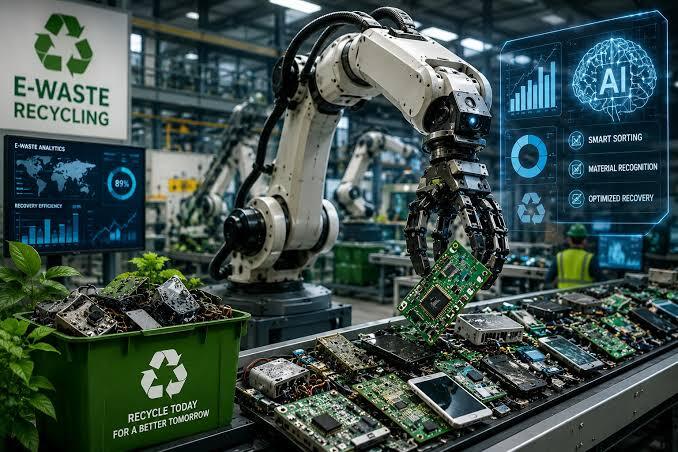


Introduction
Waste management is becoming one of the most important technology and environmental challenges in the United States. Every day, American households, businesses, factories, retailers, and industries generate enormous amounts of discarded materials. These materials include plastic packaging, cardboard, electronic equipment, metals, batteries, textiles, and industrial waste.
For many years, traditional recycling systems depended heavily on people separating materials, mechanical equipment sorting them, and processing facilities turning suitable waste into reusable products. Although this approach remains important, it has limitations. Contaminated packaging, mixed materials, complex plastics, and incorrectly sorted items can make recycling difficult and expensive.
In 2026, new technologies are helping change this situation.
Artificial intelligence, machine vision, robotic sorting, advanced sensors, chemical processing, and automated material recovery systems are creating new opportunities for recycling businesses across the United States. These innovations are designed to identify valuable materials more accurately, improve processing efficiency, and recover resources that might otherwise be sent to landfills.
The concept is closely connected to the circular economy. Instead of treating products as materials that are used once and discarded, a circular economy aims to keep resources in circulation for as long as practical. Recovered materials can become inputs for new packaging, construction products, manufacturing components, and other goods.
Government agencies, research institutions, waste management companies, and technology developers are investing in different approaches to make this possible. The U.S. Department of Energy is supporting research into material recovery and recycling, while companies are introducing smarter sorting equipment and new processing methods.
However, advanced recycling is not a single technology, and not every process produces the same environmental or economic results. Successful recycling depends on collection systems, material quality, energy consumption, processing costs, market demand, and the ability to use recovered materials in new products.
What Is Advanced Recycling Technology?
Advanced recycling technology refers to newer methods and equipment designed to recover, separate, purify, or process materials that traditional recycling systems may struggle to handle.
The term can describe several different technologies, including:
- Artificial intelligence-powered waste identification.
- Robotic sorting and automated material separation.
- Advanced optical and sensor-based sorting.
- Chemical recycling and depolymerization.
- Thermal conversion processes such as pyrolysis.
- Specialized battery and electronic waste recovery.
- Digital tracking and material management software.
Traditional mechanical recycling generally involves collecting, sorting, cleaning, shredding, and processing materials without fundamentally breaking down their chemical building blocks.
Advanced chemical processes can work differently. Certain methods break polymer structures into smaller chemical components, while others dissolve and purify selected polymers. These outputs may be used as feedstock for manufacturing new materials.
The U.S. Environmental Protection Agency explains that advanced recycling can complement mechanical recycling by processing certain plastic materials that are difficult to handle through conventional systems.
The important distinction is that advanced recycling should not automatically be considered better than traditional recycling. The most suitable method depends on the material, contamination level, processing requirements, environmental impact, and final use of the recovered output.
Why the United States Is Investing in Advanced Recycling
Several economic, industrial, and environmental developments are encouraging the United States to improve its recycling infrastructure.
1. Growing Amounts of Plastic Waste
Plastic packaging is widely used in food distribution, consumer products, healthcare, transportation, and manufacturing.
Some plastic products are relatively easy to recycle, while others contain multiple layers, mixed polymers, adhesives, dyes, or food contamination.
These characteristics can make conventional processing difficult.
Advanced sorting and specialized processing methods may help identify and recover selected materials from waste streams that would otherwise be difficult to recycle.
2. Demand for Recycled Manufacturing Materials
Manufacturers need reliable supplies of materials to produce packaging, automotive components, electronics, construction products, and industrial equipment.
Recovered metals, plastics, paper, and other materials can help supply some of these requirements.
For manufacturers, recycling is not only an environmental activity. It can also become part of a broader strategy to improve material security, reduce dependence on certain raw materials, and develop more resilient supply chains.
3. Electronic Waste and Battery Recovery
Electronic devices contain valuable materials, including copper, aluminum, precious metals, and specialized battery materials.
As the use of electronics and electric vehicles expands, recovering these materials becomes increasingly important.
However, electronic waste and batteries require specialized handling. Improper processing can create fire, chemical, and environmental hazards.
Advanced recycling systems can support safer identification, separation, and recovery when operated under suitable technical and regulatory controls.
4. More Efficient Waste Processing
Recycling facilities process large quantities of material, often moving items along conveyor belts at high speeds.
Manual sorting can be expensive and difficult to scale. Automated equipment can help facilities identify specific objects and separate them more consistently.
AI-based systems can also provide information about the composition of incoming waste, allowing managers to understand where valuable materials are being lost.
AI-Powered Waste Sorting: A Major Innovation in 2026
Artificial intelligence is becoming one of the most interesting technologies in modern recycling facilities.
Traditional sorting equipment often relies on a combination of physical separation, magnets, air systems, optical sensors, and manual inspection.
AI adds another layer of intelligence.
Cameras capture images of materials moving along conveyor belts. Machine-learning models analyze these images and identify objects based on their appearance, shape, color, and other visual characteristics.
Depending on the system, AI may help recognize:
- Aluminum cans.
- Plastic bottles.
- Cardboard and paper.
- Different packaging formats.
- Contaminated recyclable materials.
- Items that should not enter particular processing streams.
Some systems can connect their detection software to automated sorting equipment. When the software identifies a target object, the machinery can direct it toward the appropriate collection stream.
Real-Time Waste Analysis
AI can also help facilities understand what is passing through their sorting lines.
Instead of relying entirely on occasional manual inspections, operators can use cameras and software to collect ongoing information about material composition and recovery performance.
This can help answer practical questions:
- How much aluminum is entering the facility?
- Which materials are being incorrectly discarded?
- Where is contamination increasing?
- Which sorting line is losing valuable material?
- How does a change in equipment settings affect output quality?
These insights can help recycling facilities make better operational decisions.
A Real-World Development in New York
In September 2026, industry publication Waste Dive reported that Circular Services was planning a pilot involving Greyparrot’s Analyzer AI at its Sunset Park materials recovery facility in Brooklyn, New York.
The AI system uses cameras and software to monitor material streams. Greyparrot reported that its analysis found approximately 89% of aluminum passing through the facility was recoverable, representing around 91,000 cans per day.
The pilot was intended to evaluate how AI-generated information could improve recovery rates and facility operations.
This example illustrates how recycling technology is moving beyond basic object recognition toward continuous operational analysis.
Robotic Sorting Systems Are Changing Recycling Facilities
Robotics is another important part of the recycling industry’s technological transformation.
Robotic sorting systems can identify objects and use mechanical arms or specialized equipment to remove selected materials from moving conveyor belts.
These systems can support facilities that handle large volumes of mixed recyclable materials.
How Recycling Robots Work
A typical robotic sorting installation may combine:
- Cameras and sensors that observe incoming waste.
- AI software that identifies selected materials.
- Processing systems that calculate object positions.
- Robotic arms or air-based ejectors that separate target items.
- Collection systems that direct materials into separate containers.
Some systems are designed to identify specific packaging types, while others focus on recovering valuable materials or removing unwanted contaminants.
Benefits for Recycling Businesses
Automated sorting can help facilities:
- Process material more consistently.
- Reduce some repetitive manual sorting tasks.
- Improve identification of selected recyclable items.
- Collect more detailed performance data.
- Adjust processing operations based on changing waste streams.
Robots are not a complete replacement for human workers. Facilities still need technicians, maintenance specialists, safety personnel, quality-control teams, and experienced operators.
The strongest results are likely to come from combining human expertise with reliable automated equipment.
Chemical Recycling: Turning Difficult Plastics Into Useful Materials
Chemical recycling is one of the most discussed areas of advanced recycling technology.
Mechanical recycling works well for many clean and properly sorted plastic materials. However, some plastics are difficult to process repeatedly because of contamination, mixed materials, or changes in material properties.
Chemical recycling uses specialized processes to alter or separate plastic polymers and recover useful chemical components.
1. Pyrolysis
Pyrolysis is a thermal process that heats selected materials in an environment with little or no oxygen.
When used for suitable plastic feedstocks, the process can produce liquid and gaseous hydrocarbon products along with solid residues.
Some recovered outputs may be further processed and used as chemical or manufacturing feedstock.
The technology can potentially handle certain mixed plastic streams, but the process requires careful control of feedstock quality, emissions, energy use, and product quality.
It is important to understand that pyrolysis is not the same as conventional mechanical recycling. Its environmental and economic performance depends heavily on how the facility operates and how its outputs are used.
2. Depolymerization
Depolymerization breaks selected polymer materials into smaller chemical building blocks called monomers.
These monomers may then be purified and used to manufacture new polymers.
The method can be suitable for certain materials, including particular types of polyester and polyamide plastics.
For example, specialized processes can break down suitable PET materials into components that can be purified and used in the production of new PET.
3. Solvent-Based Purification
Solvent-based purification uses selected solvents to dissolve particular polymers while separating unwanted additives and contaminants.
Unlike depolymerization, the goal is generally to recover the polymer without breaking its main chemical structure.
This can potentially improve the quality of recovered material, although solvent recovery, chemical management, process energy, and environmental controls remain important considerations.
4. Hydrothermal and Other Thermal Processes
Some advanced recycling approaches use water, heat, pressure, or other controlled conditions to process selected waste materials.
The best method depends on the composition of the incoming material and the quality requirements of the final product.
Research continues into improving these processes and making them more commercially practical.
New US Research Is Improving Plastic Sorting
In October 2026, the Illinois Sustainable Technology Center reported that the U.S. Department of Energy had awarded $2.5 million to a research team developing improved technologies for identifying and sorting difficult-to-recycle plastics.
The project combines advanced sensors with artificial intelligence algorithms to identify different plastic polymers through their chemical characteristics.
The research aims to separate materials that are often difficult to distinguish using conventional sorting methods.
According to the research announcement, the project includes a cost target below $30 per ton for the sorting process.
This is a research and development target, not a confirmed commercial operating cost. Nevertheless, the work demonstrates how sensor technology and AI could help improve the economics of plastic recovery.
Advanced Recycling in American Manufacturing
Recycling technology is closely connected to the future of American manufacturing.
Factories require reliable access to metals, polymers, minerals, and other materials. Recovering usable resources from discarded products can create additional domestic supply sources.
The Department of Energy’s REMADE Institute is supporting research in areas such as material recovery, remanufacturing, and recycling.
In August 2026, the Department of Energy announced that the REMADE Institute had awarded $4.8 million to 10 projects focused on improving materials recovery and strengthening manufacturing supply chains.
The selected projects were intended to help move promising technologies from successful laboratory demonstrations toward commercial deployment.
This matters because recycling is increasingly being considered part of industrial competitiveness.
A stronger domestic recovery system could help manufacturers access materials from discarded products, industrial scrap, and other waste streams.
However, recovered materials must meet the quality, consistency, and price requirements of manufacturers before they can replace conventional inputs at scale.
Companies Driving Advanced Recycling Innovation in the USA
A growing group of companies is working across recycling equipment, waste processing, material recovery, and digital technology.
1. <escape> </escape>TOMRA
<Entity value=”TOMRA” category=”brand” disambig=”sensor-based sorting and recycling technology company”/> develops sensor-based sorting systems used in recycling and resource recovery.
Its technologies include optical sorting and AI-supported systems designed to identify and separate materials.
In 2026, TOMRA announced new AI-based sorting applications and an expanded AI platform ecosystem. The company also highlighted developments in identifying complex materials and improving the quality of recovered streams.
2. <escape> </escape>AMP Robotics
<Entity value=”AMP Robotics” category=”company” disambig=”AI-powered recycling robotics company”/> focuses on artificial intelligence and robotic systems for waste sorting.
Its technology aims to identify recyclable materials and automate selected sorting activities in material recovery facilities.
The broader opportunity is to make recycling operations more data-driven and improve the consistency of material separation.
3. <escape> </escape>Greyparrot
<Entity value=”Greyparrot” category=”company” disambig=”AI-powered waste analytics company”/> develops computer-vision technology that analyzes waste streams.
Its systems can provide information about material composition and sorting performance.
The 2026 pilot reported at Circular Services’ Brooklyn facility illustrates how this type of technology can help operators understand what is being lost during recycling operations.
4. <escape> </escape>Republic Services
<Entity value=”Republic Services” category=”company” disambig=”US waste collection and recycling services company”/> is a major American waste collection and recycling business.
The company has been investing in modern recycling facilities and automated processing equipment.
In October 2026, reporting by CoStar described the growing use of AI and automation in recycling centers, including developments involving Republic Services.
5. <escape> </escape>Waste Management
<Entity value=”WM” category=”company” disambig=”US waste management and recycling services company”/> operates waste collection, disposal, and recycling infrastructure across the United States.
Modern material recovery facilities can combine optical sorters, automated equipment, and digital monitoring to improve the handling of recyclable materials.
6. <escape> </escape>ExxonMobil
<Entity value=”ExxonMobil” category=”company” disambig=”energy and chemical manufacturing company”/> is involved in chemical recycling through its Exxtend technology.
The company has developed processes intended to convert selected plastic waste into feedstocks for chemical manufacturing.
Chemical recycling remains a commercially and environmentally debated area, so performance should be assessed based on verified facility operations, actual recovered output, and lifecycle impacts.
How Advanced Recycling Can Support the Circular Economy
A circular economy aims to keep products and materials useful for longer instead of treating them as disposable resources.
Advanced recycling can contribute to this approach in several ways.
Recovering Valuable Materials
Metals, plastics, paper, and other materials can be recovered and processed for reuse.
This may reduce the need for some virgin raw materials, depending on material quality and manufacturing requirements.
Supporting Product Design Improvements
Manufacturers can use information from recycling facilities to understand which packaging designs are easier to process.
For example, products made from fewer material types may be easier to separate than complex multi-layer packaging.
Improving Resource Efficiency
Better sorting and recovery systems can reduce the amount of potentially valuable material lost during waste processing.
Strengthening Domestic Supply Chains
Recovered materials may support local manufacturing and reduce dependence on some imported raw materials.
The degree of benefit depends on the economics of collection, processing, transportation, and final manufacturing.
Challenges Facing Advanced Recycling Technology
Although the industry is developing quickly, advanced recycling still faces important obstacles.
1. High Investment Costs
Modern sorting facilities require expensive equipment, including cameras, optical sensors, conveyor systems, robotic arms, software, and specialized processing machinery.
Chemical recycling facilities may require additional investment in reactors, purification systems, environmental controls, and energy infrastructure.
These costs can make it difficult for smaller operators to adopt new technologies.
2. Contamination and Material Quality
Recycling systems cannot process every material equally well.
Food residue, chemicals, mixed polymers, labels, adhesives, and other contaminants can reduce the quality of recovered outputs.
Better sorting helps, but collection and product-design improvements are also necessary.
3. Energy Consumption
Some advanced recycling processes require substantial amounts of heat, electricity, or chemical inputs.
The overall environmental benefit depends on the energy source, process efficiency, emissions, and the products made from recovered materials.
A recycling process should be evaluated across its full lifecycle rather than judged only by the amount of waste it receives.
4. Weak or Uncertain Market Demand
A recycling facility needs buyers for the materials it produces.
If demand for recycled plastic or other recovered commodities is weak, facilities may struggle to cover their operating costs.
Sustainable business models require reliable customers, consistent output quality, and competitive pricing.
5. Regulatory Differences
Recycling rules and definitions can differ between states and jurisdictions.
This creates complexity for companies that collect and process waste across multiple regions.
Clear standards and transparent reporting can help businesses understand which technologies and outputs meet applicable requirements.
6. Environmental and Public Health Concerns
Chemical recycling processes require careful management of emissions, wastewater, residues, and chemical inputs.
Some processes may produce fuels or other outputs rather than new materials. These outcomes should not automatically be described as material-to-material recycling.
Independent environmental assessments and transparent reporting are important for evaluating the actual benefits of each technology.
The Future of Advanced Recycling in the United States
The next stage of recycling innovation will likely combine several technologies rather than depend on a single solution.
AI cameras may identify materials, robotic systems may separate selected objects, advanced sensors may distinguish different polymers, and specialized processing facilities may recover usable materials.
Digital systems could also help companies track material flows from collection through processing and manufacturing.
Several developments are worth watching.
More AI-assisted sorting: Machine-learning systems may become increasingly useful for recognizing difficult packaging formats and identifying valuable materials.
Smarter recycling facilities: Real-time analytics could help operators monitor performance, reduce contamination, and adjust equipment settings.
Improved battery recycling: Better separation and material recovery could support the growing market for batteries used in vehicles and energy storage.
More advanced plastic processing: Research into depolymerization, purification, and other methods could create additional options for selected plastic waste streams.
Greater manufacturing integration: Recovered materials may become more closely connected to domestic manufacturing supply chains.
Better recycling data: Digital tracking and transparent reporting could help businesses measure recovery rates and evaluate environmental performance.
Progress will depend on whether these technologies can operate reliably, meet environmental requirements, and produce materials that manufacturers actually want to purchase.
Conclusion
Advanced recycling technology is becoming an important part of the United States’ industrial and environmental innovation landscape in 2026.
Artificial intelligence, robotics, sensor-based sorting, chemical processing, and digital monitoring are creating new opportunities to recover materials that traditional systems may struggle to handle.
Developments such as the Department of Energy’s research funding, REMADE Institute projects, and AI-powered recycling pilots demonstrate the growing interest in improving the country’s material recovery infrastructure.
Companies developing automated sorting equipment and advanced processing systems are also helping transform recycling facilities into more intelligent and data-driven operations.
However, technology is only one part of the solution. Effective recycling also requires better collection systems, product designs that support material recovery, reliable markets for recycled materials, responsible environmental controls, and transparent performance measurement.
The future of recycling in America will not be defined simply by how much waste enters a processing facility. It will depend on how much useful material can be safely and economically recovered and returned to productive use.
As innovation continues, advanced recycling could become an increasingly important contributor to domestic manufacturing, resource efficiency, and the development of a more circular American economy.
Frequently Asked Questions (FAQs)
1. What is advanced recycling technology?
Advanced recycling technology includes modern methods such as AI-powered sorting, robotic separation, chemical recycling, polymer purification, and specialized material recovery systems.
2. How is AI used in recycling?
AI analyzes images and sensor information to identify different materials, monitor waste streams, and help automated equipment separate recyclable objects.
3. What is chemical recycling?
Chemical recycling uses specialized chemical or thermal processes to break down or purify selected materials so their components can be used as manufacturing feedstock.
4. What is the difference between mechanical and chemical recycling?
Mechanical recycling physically processes materials through sorting, cleaning, shredding, and melting. Chemical recycling changes or separates polymer structures through chemical or thermal treatment.
5. Can advanced recycling process all types of plastic?
No. Different technologies are suitable for different plastic types and contamination levels. Some materials remain difficult or uneconomical to process.
6. Which US companies are involved in advanced recycling?
Companies active in recycling technology and services include TOMRA, AMP Robotics, Greyparrot, Republic Services, WM, and ExxonMobil. They operate in different parts of the recycling ecosystem.
7. How does robotic sorting work?
Robotic systems combine cameras, sensors, software, and mechanical equipment to identify and separate selected materials from moving waste streams.
8. Why is battery recycling important?
Batteries contain valuable materials that may be recovered for use in new products. Specialized recycling can also help manage safety and environmental risks associated with discarded batteries.
9. Does advanced recycling reduce landfill waste?
It can help recover selected materials that might otherwise be discarded, but the actual reduction depends on collection quality, processing capacity, facility performance, and market demand.
10. What is the future of recycling technology in the USA?
The industry is likely to see more AI-powered sorting, robotics, advanced sensors, battery recovery, digital tracking, and specialized processing technologies integrated into recycling operations.


