




Introduction
Solar energy technology is becoming an increasingly important part of the American energy industry. From residential rooftops and commercial buildings to massive solar farms, businesses and communities across the United States are exploring new ways to generate electricity from sunlight. Improvements in solar panels, energy storage systems, digital monitoring, and artificial intelligence are changing how solar power is produced, stored, and used.
In 2026, the US solar industry is experiencing both significant opportunities and considerable challenges. Electricity demand is increasing as data centers, electric vehicles, industrial facilities, and digital infrastructure require more power. At the same time, solar developers must navigate changing government policies, equipment supply chains, financing conditions, and electricity grid limitations.
According to the Solar Energy Industries Association (SEIA) and Wood Mackenzie, the United States installed approximately 43.2 gigawatts of new solar capacity during 2025. Solar represented 54% of all new electricity-generating capacity added to the American grid that year. Although annual installations declined compared with 2024, solar remained a leading source of new electricity generation capacity.
These developments demonstrate that solar energy technology is no longer limited to small rooftop systems. It is becoming a major part of discussions about America’s energy security, electricity prices, industrial development, and long-term power supply.
This article explores the latest solar technology trends in the United States, the companies contributing to the industry, the importance of battery storage, the challenges facing solar adoption, and what consumers and businesses should understand about the future of solar energy.
1. The Current State of Solar Energy Technology in the USA
The American solar industry includes several major segments: residential solar installations, commercial and industrial systems, community solar projects, and utility-scale solar farms.
Residential systems allow homeowners to generate electricity using panels installed on their roofs or properties. Commercial systems help businesses reduce their dependence on electricity purchased from the grid. Community solar programs allow participating customers to benefit from electricity generated by shared solar projects, depending on the program’s structure and local regulations.
Utility-scale solar farms operate on a much larger scale. They can supply electricity to utilities, electricity markets, and large commercial customers through power purchase agreements or other arrangements.
Recent industry data illustrates the scale of this market. SEIA and Wood Mackenzie reported that the United States installed approximately 43.2 GWdc of solar capacity in 2025. Their long-term outlook projects that cumulative US solar capacity could reach approximately 769 GWdc by 2036, although the actual outcome will depend on policy, financing, grid connections, equipment costs, and electricity demand.
Solar growth is particularly relevant in states with strong sunlight, available land, expanding populations, and significant electricity demand. Texas, California, Florida, Arizona, and other states continue to play important roles in the broader American solar market.
However, sunlight alone does not determine whether a solar project succeeds. Developers must also consider land availability, transmission infrastructure, local permitting, equipment prices, financing, and the ability to deliver electricity when customers need it.
2. Advanced Solar Panels Are Improving Energy Production
Solar panels convert sunlight into electricity through photovoltaic technology. When sunlight reaches a photovoltaic cell, the cell generates electrical energy that can be used directly, stored in a battery, or exported to the electricity grid.
Modern solar technology focuses on producing more electricity from a given amount of space. This is particularly important for homes with limited roof areas, commercial buildings with high electricity demand, and utility-scale projects where land and installation costs influence profitability.
More efficient photovoltaic cells
Manufacturers continue to develop solar cells that capture sunlight more effectively. Technologies such as passivated emitter and rear contact (PERC), tunnel oxide passivated contact (TOPCon), and heterojunction cells are used in different parts of the solar market.
These technologies improve the way solar cells manage electrical losses and convert sunlight into usable power. TOPCon and heterojunction technologies, in particular, have attracted attention as manufacturers pursue higher module efficiency and better energy production.
Actual performance depends on the specific panel, installation angle, temperature, shading, and operating conditions. A high-efficiency panel does not automatically guarantee the lowest electricity cost, so buyers should compare the complete system rather than looking only at advertised efficiency percentages.
Bifacial solar panels
Bifacial solar panels can generate electricity from sunlight reaching both their front and rear surfaces. They are especially useful in certain large solar installations where reflected light from the ground can contribute to additional production.
Their performance depends on factors such as ground reflectivity, panel height, spacing, and installation design. They may be less advantageous in settings where the rear surface receives little usable light.
Better durability and monitoring
Manufacturers and installation companies are also working to improve panel durability, weather resistance, and long-term performance monitoring.
Modern systems can use digital monitoring tools to identify production changes, detect equipment problems, and compare expected electricity generation with actual output.
For homeowners and businesses, these improvements can make solar systems easier to manage and help maintenance teams identify issues before they become more serious.
3. Battery Storage Is Transforming the Solar Industry
One of the biggest limitations of solar energy is that electricity generation changes throughout the day. Solar panels generally produce the most electricity when sunlight is strongest, while household and commercial electricity demand may continue into the evening.
Battery energy storage helps address this challenge by storing electricity when it is available and releasing it later.
For example, a home equipped with solar panels and a compatible battery may store excess daytime production and use some of that energy after sunset. A utility-scale battery can charge during periods of high solar production and discharge electricity when demand increases or grid conditions become more constrained.
Home battery storage systems
Residential battery systems can provide several benefits, depending on the equipment and local electricity rules:
- Store excess solar electricity for later use.
- Reduce purchases of grid electricity during selected periods.
- Provide backup power during outages when the system supports backup operation.
- Help households manage time-of-use electricity rates.
- Improve the flexibility of home energy management.
However, not every solar installation includes a battery, and a standard grid-connected solar system may shut down during a power outage for safety reasons. Backup operation generally requires suitable equipment, electrical configuration, and sufficient stored energy.
Utility-scale battery projects
Large battery installations are increasingly important to electricity grid operators and energy developers. They can help balance differences between electricity production and consumption, provide certain grid services, and shift energy from one period to another.
The US Energy Information Administration reported in February 2026 that developers planned to add approximately 86 GW of new utility-scale electricity-generating capacity during the year. Solar represented 51% of the planned additions, while battery storage accounted for 28%.
These were planned additions rather than a guarantee of completed projects, but the figures highlight the growing connection between solar deployment and energy storage.
The role of battery chemistry
Lithium-ion batteries are widely used in modern energy storage systems. Lithium iron phosphate (LFP) batteries are one important category, valued for characteristics including thermal stability and long cycle life in appropriate applications.
Other lithium-ion chemistries may offer different energy density, cost, or performance characteristics. Battery selection depends on the intended use, installation requirements, safety design, expected operating conditions, and lifetime economics.
Researchers are also developing alternative battery technologies, including sodium-ion and various solid-state concepts. Their commercial suitability varies, and emerging technologies should not automatically be treated as replacements for established battery systems.
4. Artificial Intelligence Is Making Solar Systems Smarter
Artificial intelligence and data analytics are becoming useful tools across the solar industry. Solar projects generate substantial amounts of operational data, including electricity output, weather conditions, inverter performance, and battery activity.
AI-based software can analyze these data points to support forecasting, maintenance, and energy management.
Solar production forecasting
Weather conditions have a direct effect on solar electricity generation. Cloud cover, temperature, storms, and seasonal changes can influence the amount of energy produced.
Forecasting systems combine weather information, historical generation, and other data to estimate how much electricity a solar installation is likely to produce.
Better forecasts can help utilities plan electricity supply and help battery operators decide when to charge or discharge their systems.
Predictive maintenance
Solar installations contain several components that may require maintenance, including inverters, electrical connections, trackers, and panels.
Monitoring software can identify unusual performance patterns that may indicate equipment faults or reduced output. Maintenance teams can then investigate potential problems instead of relying entirely on fixed inspection schedules.
These systems do not eliminate the need for qualified technicians, but they can help prioritize inspections and reduce avoidable downtime.
Smart energy management
For homes and businesses with solar panels, batteries, and controllable electrical equipment, energy management software can coordinate when electricity is generated, stored, and consumed.
A system may, for example, schedule certain energy-intensive activities for periods when solar production is high. In commercial settings, energy management can also help coordinate battery charging with electricity prices and operational requirements.
As these tools become more sophisticated, solar technology is increasingly connected to software, communications networks, and automated energy controls.
5. Major Companies Shaping Solar Energy in the United States
The American solar market includes panel manufacturers, equipment suppliers, project developers, installers, battery companies, and energy technology providers.
First Solar
First Solar is a US-based solar technology manufacturer known for its thin-film photovoltaic modules. Its cadmium telluride technology differs from the crystalline-silicon technology used by many other panel manufacturers.
The company has invested in US manufacturing capacity and serves utility-scale solar markets. Its technology offers a different set of manufacturing and performance characteristics, making it one of the notable companies in the American solar supply chain.
Enphase Energy
Enphase Energy is known for microinverter technology and residential energy systems. Microinverters convert the direct-current electricity generated by individual solar panels into alternating-current electricity.
This approach can help manage panel-level performance, which may be useful when panels experience different shading or operating conditions. Enphase also offers energy-related products and software designed to work with compatible residential systems.
SolarEdge Technologies
SolarEdge develops solar inverters, power optimizers, and related energy management products. Its technology is used in residential, commercial, and other solar installations.
Power electronics play an important role in solar performance because the electricity produced by panels must be converted and managed to meet the requirements of homes, buildings, batteries, and the grid.
Tesla Energy
Tesla Energy offers energy storage products and solar-related solutions, including the Powerwall home battery. Its products are part of a broader ecosystem focused on electricity storage, energy management, and electric mobility.
For households considering solar and batteries, compatibility between panels, inverters, storage equipment, backup circuits, and local electrical requirements remains essential.
Other important market participants
The wider US solar ecosystem includes companies such as NextEra Energy, which develops and operates large energy projects, and numerous regional installers, engineering firms, manufacturers, and independent power producers.
These companies have different business models. A manufacturer may supply equipment without installing it, while a project developer may arrange financing, construction, grid connections, and electricity sales.
Consumers and businesses should therefore compare companies according to the specific service or technology they need rather than treating every solar company as a direct competitor.
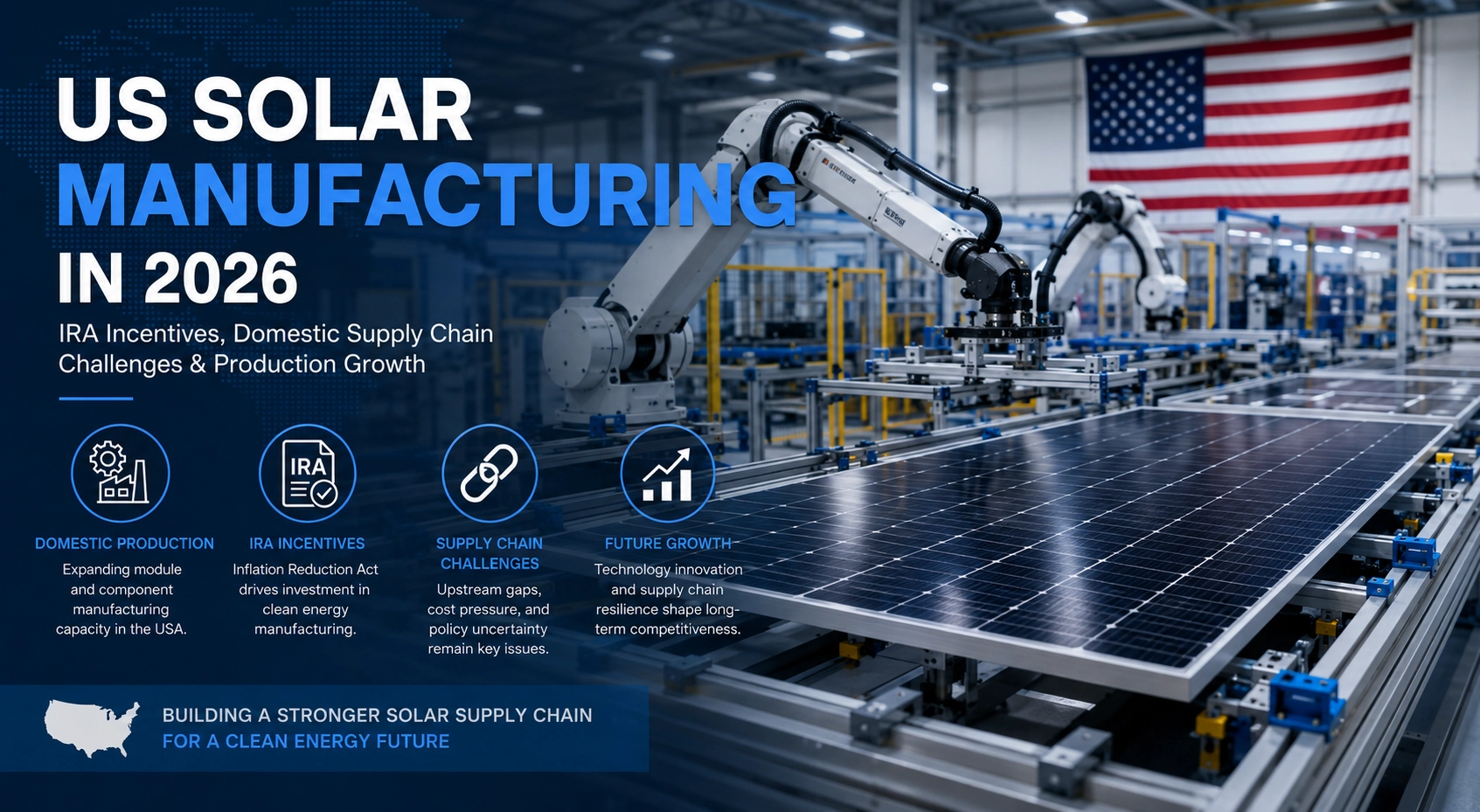
6. US Solar Manufacturing and Domestic Supply Chains
Solar manufacturing has become an important topic in American energy policy. Domestic production can support industrial investment, create manufacturing jobs, and reduce dependence on certain overseas supply chains.
The solar manufacturing process can include producing polysilicon, ingots, wafers, photovoltaic cells, modules, mounting equipment, inverters, and other electrical components.
Building a complete supply chain is challenging because each stage requires specialized equipment, technical expertise, capital investment, and reliable access to materials.
US manufacturing has expanded in several parts of the solar industry, but domestic production does not automatically eliminate dependence on imported components. Supply chains remain influenced by international competition, trade measures, production costs, and demand for equipment.
According to SEIA and Wood Mackenzie, 2025 was a significant year for US solar manufacturing, including developments in domestic wafer capacity. Continued progress will depend on how manufacturers respond to changing market conditions and supply-chain requirements.
For businesses, domestic manufacturing may create opportunities in equipment production, logistics, engineering, quality control, and industrial automation. At the same time, manufacturing facilities must compete on cost, product quality, and dependable delivery.
7. The Impact of Solar Energy on American Electricity Demand
The United States needs additional electricity capacity for several reasons. Data centers, artificial intelligence infrastructure, manufacturing facilities, transportation electrification, and growing residential demand can all contribute to changing power requirements.
Solar energy can be deployed relatively quickly compared with some large infrastructure projects, although development timelines still depend on permitting, equipment availability, financing, and grid interconnection.
Solar power can be particularly attractive when electricity demand is high during daylight hours. However, its output varies with weather and time of day, so a dependable electricity system generally needs a combination of generation sources, storage, transmission, and demand management.
Why data centers matter
Data centers support cloud computing, online services, enterprise software, and AI workloads. Their electricity requirements can be substantial, especially as operators build facilities with higher computing capacity.
Some technology companies are exploring long-term electricity contracts and new energy projects to support their facilities. Solar can contribute to these arrangements, but the electricity supply must still match the timing and reliability requirements of the data center.
Battery storage, grid connections, other generation sources, and carefully structured electricity contracts may all be needed.
Solar and energy independence
Domestic solar generation can reduce the amount of electricity that must be produced using imported fuels in some circumstances. It can also diversify the sources available to the power system.
Nevertheless, solar energy does not make the United States completely energy independent by itself. Equipment supply chains, minerals, grid infrastructure, and other energy sources remain relevant to the wider energy system.
8. Challenges Facing the US Solar Industry in 2026
Despite the industry’s long-term potential, solar energy faces several important challenges.
Changing government incentives
Federal energy policy and tax incentives can significantly influence the financial returns of solar projects. Legislation enacted in 2025 changed several clean-energy tax credit rules and timelines, creating uncertainty for developers, installers, investors, and consumers.
SEIA and Wood Mackenzie have highlighted the effects of policy changes on project schedules and the residential solar market. The precise eligibility of a project depends on the relevant law, dates, ownership structure, and applicable guidance.
Homeowners and businesses should verify current federal, state, and local requirements before assuming that a particular incentive is available.
Grid connection delays
A solar project cannot deliver its full value if it cannot connect to the electricity grid. Developers may face interconnection studies, network upgrades, transmission constraints, permitting requirements, and other delays.
These issues can increase project costs and postpone the date when electricity generation begins.
Improving grid infrastructure and streamlining appropriate administrative processes could help more projects reach operation.
Equipment and financing costs
Solar projects require upfront investment in panels, inverters, electrical systems, labor, and often land or roof preparation.
Interest rates, tariffs, equipment shortages, and supply-chain disruptions can affect project economics. Even when the technology itself is cost-effective, financing and installation expenses may influence whether a project proceeds.
Residential customer concerns
Homeowners may be uncertain about installer reliability, warranties, electricity savings, financing agreements, and battery performance.
Before signing a contract, customers should compare multiple proposals, review expected annual production, understand utility compensation rules, and examine the total financing cost.
A reputable installation company should explain both the potential savings and the limitations of the proposed system.
9. How Businesses and Homeowners Can Benefit From Solar Technology
Solar energy may provide financial and operational benefits, but the results depend on the property, electricity rates, installation cost, and local rules.
For homeowners
Homeowners considering solar should begin by reviewing their electricity bills and identifying their annual energy consumption. A qualified installer can then evaluate roof orientation, shading, structural conditions, and the expected output of a proposed system.
Customers should also understand how their utility credits exported electricity. In some areas, electricity sent to the grid receives a different rate from electricity purchased from the utility.
A battery may be useful when backup power is important or when electricity rates make storing energy financially attractive. However, the additional purchase and installation costs should be evaluated carefully.
For commercial buildings
Businesses may use rooftop solar to offset a portion of their electricity consumption. Warehouses, factories, offices, and retail buildings can have large roof areas suitable for photovoltaic systems.
Commercial projects require careful analysis of energy consumption patterns, roof condition, electrical capacity, lease arrangements, and expected operating costs.
Companies should also consider whether solar generation matches their working hours. A business that uses most of its electricity during sunny daytime periods may have a different financial case from a facility that operates primarily overnight.
For investors and entrepreneurs
The solar industry offers opportunities beyond panel installation. Potential areas include battery integration, electrical engineering, monitoring software, equipment maintenance, recycling, energy consulting, and commercial project development.
However, entering the industry requires an understanding of technical standards, permitting, financing, competition, and applicable regulations.
Entrepreneurs should identify a specific customer problem before investing in equipment or services.
10. The Future of Solar Energy Technology in the USA
The future of American solar energy will depend on technological progress as well as practical factors such as electricity demand, financing, manufacturing capacity, and grid development.
Several trends are likely to remain important over the coming years.
First, solar panels will continue to improve through advances in cell design, materials, and manufacturing processes. These developments may help generate more electricity from limited space and improve project economics.
Second, battery storage is expected to remain an important complement to solar generation. Storage can help move electricity from periods of high production to periods of greater demand, although it introduces additional equipment costs and energy losses.
Third, AI and digital monitoring tools may improve forecasting, maintenance, and energy management. These tools could help operators manage larger portfolios of solar installations more efficiently.
Fourth, domestic manufacturing and supply-chain resilience will remain significant business and policy concerns. Companies will need to balance production costs, equipment quality, trade rules, and reliable access to materials.
Finally, electricity demand from data centers, advanced manufacturing, and other industries could create opportunities for additional solar deployment. Whether those opportunities become completed projects will depend on grid access, permitting, investment decisions, and the economics of individual developments.
SEIA and Wood Mackenzie projected in their 2025 year-in-review report that cumulative US solar capacity could approach 769 GWdc by 2036. This is a forecast, not a guarantee, but it illustrates the scale of the industry’s potential.
Conclusion
Solar energy technology in the USA is evolving through improvements in photovoltaic panels, battery storage, digital monitoring, AI-powered forecasting, and domestic manufacturing. These developments are helping solar become a more flexible component of the American electricity system.
The industry nevertheless faces significant challenges, including changing incentives, supply-chain uncertainty, financing costs, and delays in connecting projects to the grid. Consumers must also evaluate installation quality, electricity tariffs, warranties, and long-term costs before making investment decisions.
For homeowners, solar can offer an additional way to manage electricity expenses when the economics and property conditions are favorable. For businesses, it can support energy planning and diversify electricity procurement. For technology companies and investors, the broader solar ecosystem offers opportunities in manufacturing, storage, software, and infrastructure.
As the United States responds to changing electricity demand, solar power and energy storage are likely to remain important subjects in the national technology and energy conversation. The industry’s future will depend not only on better technology, but also on how effectively businesses, policymakers, utilities, and consumers turn that technology into reliable and economically practical electricity.
Frequently Asked Questions (FAQs)
1. What is the latest solar energy technology in the USA in 2026?
Important technologies include high-efficiency photovoltaic cells, TOPCon solar panels, bifacial modules, battery energy storage, smart inverters, and AI-based performance monitoring. The best option depends on the project’s size, location, budget, and electricity requirements.
2. Is solar energy growing in the United States?
Yes. Solar remains a major source of new electricity-generating capacity. SEIA and Wood Mackenzie reported approximately 43.2 GWdc of new US solar capacity in 2025, despite a decline from the previous year.
3. Which companies are involved in US solar technology?
Notable companies include First Solar, Enphase Energy, SolarEdge Technologies, and Tesla Energy. Large-scale developers and energy companies, including NextEra Energy, also participate in the wider solar market.
4. Can solar panels provide electricity at night?
Solar panels do not generate meaningful electricity without sunlight. A solar installation can provide power at night by drawing electricity from a battery charged earlier or by using electricity from the grid.
5. Are solar batteries worth installing?
Solar batteries may be worthwhile for customers who value backup power, face high evening electricity rates, or receive limited compensation for exporting excess electricity. Their financial value depends on installation costs, utility rules, battery size, and energy usage.
6. Does the US government offer solar tax credits in 2026?
Federal clean-energy tax provisions changed following legislation enacted in 2025. Eligibility depends on the particular credit, project type, ownership arrangement, and applicable deadlines. Check current IRS guidance and state or local programs before relying on any incentive.
7. What are the biggest challenges for solar energy in America?
Major challenges include grid interconnection delays, changing policies, financing costs, equipment supply chains, permitting, and the variable availability of sunlight.
8. What is the future of solar energy technology?
Potential developments include more efficient solar cells, expanded battery storage, smarter energy management, improved manufacturing processes, and greater integration with electricity grids. Actual growth will depend on market conditions, regulations, and infrastructure investment.


