




Introduction
American manufacturing is entering a new phase of industrial modernization. Factories across the United States are looking for better ways to manage energy consumption, control operating costs, improve production efficiency, and reduce dependence on traditional fuel-based heating systems. One technology receiving growing attention in this transformation is the industrial heat pump.
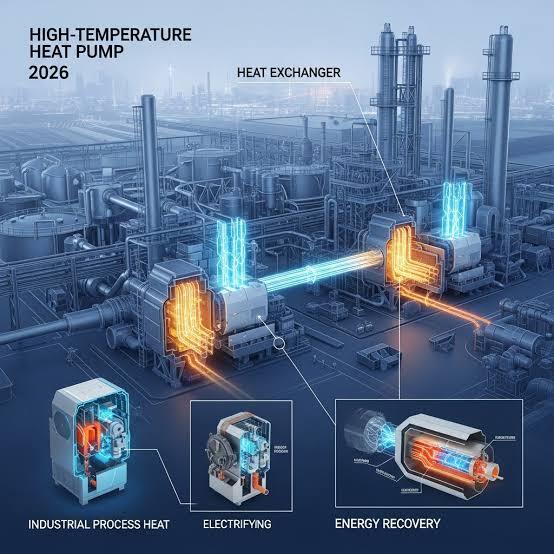
Industrial heat pumps are designed to capture heat from one source and transfer it to another location where it can be reused. Instead of allowing valuable thermal energy to escape through exhaust systems, cooling equipment, or industrial wastewater, manufacturers can recover that energy and use it in production processes.
The technology is particularly interesting because heating is an important part of many manufacturing operations. Food processing facilities, chemical plants, paper mills, beverage manufacturers, pharmaceutical companies, and other industrial businesses require substantial amounts of heat to operate their equipment.
In 2026, industrial heat pump technology is becoming more advanced. Newer systems can deliver higher temperatures, recover lower-grade waste heat, produce useful hot water, and support certain steam-generation applications. American technology developers and established industrial equipment manufacturers are also working to make these systems easier to install and operate.
The opportunity is significant, but industrial heat pumps are not a universal replacement for every boiler or furnace. Their performance depends on temperature requirements, available waste heat, electricity prices, equipment costs, and the design of the manufacturing facility.
1. What Is Industrial Heat Pump Technology?
An industrial heat pump is an energy system that transfers thermal energy from a lower-temperature source to a higher-temperature destination using electricity.
The basic concept is similar to the heat pump used in residential heating and cooling systems. However, industrial versions are engineered for larger facilities, demanding operating conditions, and specific production requirements.
A typical industrial heat pump system includes several important components:
- Evaporator: Absorbs heat from a source such as warm water, exhaust heat, or industrial cooling systems.
- Compressor: Uses electricity to increase the pressure and temperature of the working fluid.
- Condenser: Transfers the recovered heat to water, air, or another process medium.
- Expansion device: Reduces the pressure of the refrigerant before the cycle begins again.
- Control system: Monitors temperature, pressure, energy consumption, and operating performance.
The most important advantage is that a heat pump does not need to generate all its output heat through direct electrical resistance or fuel combustion. It moves existing thermal energy and adds electricity to make that energy useful at a higher temperature.
For example, a manufacturing facility may have warm wastewater that is normally discharged after production. An industrial heat pump could recover some of that energy and use it to preheat incoming process water.
The exact savings depend on the system design, temperature difference, operating hours, and local energy prices.
2. Why American Manufacturers Are Paying Attention in 2026
Energy is a major operating expense for many US manufacturers. Facilities that depend on continuous heating processes can be particularly exposed to changes in natural gas, electricity, and other fuel prices.
Traditional boilers and furnaces remain important industrial technologies, but they can lose useful energy through exhaust gases, distribution systems, and other parts of the production process.
Industrial heat pumps offer a different approach: recover energy that already exists inside a facility and reuse it where practical.
Several factors are increasing interest in this technology.
Rising interest in energy efficiency
Manufacturers are under pressure to improve production efficiency without sacrificing product quality or output. Recovering waste heat can help facilities reduce the amount of new energy required for certain heating processes.
Industrial modernization
Many US factories are upgrading older equipment with automated controls, improved sensors, and more efficient production systems. Heat pumps can become part of these broader modernization projects.
Environmental targets
Companies with emissions-reduction goals are evaluating ways to reduce fuel consumption and improve energy management. Electrifying suitable heating processes can contribute to those efforts, although the overall environmental benefit depends partly on how the electricity is generated.
Better heat recovery opportunities
Modern industrial facilities often have several sources of recoverable heat. Refrigeration systems, cooling water, process equipment, and exhaust streams may contain thermal energy that can be reused with suitable engineering.
The International Energy Agency’s 2026 Heat Pump Monitor identifies industry as an important future growth opportunity, particularly for low- and medium-temperature process heat. It also notes that industrial adoption remains more limited than building applications because installations often require customized integration.
3. How Industrial Heat Pumps Recover Waste Heat
Waste heat recovery is one of the most promising applications of industrial heat pump technology.
During manufacturing, machines and production processes frequently generate heat that is not fully used. This energy may leave through ventilation systems, cooling water, exhaust gases, or wastewater.
Instead of treating all this heat as waste, manufacturers can evaluate whether it can be captured and reused.
Consider a food processing plant that uses refrigeration equipment to keep ingredients and finished products at controlled temperatures. The refrigeration system removes heat from the cooled environment and releases it elsewhere.
An appropriately designed heat pump can recover some of this rejected heat and raise its temperature for use in cleaning, water heating, or other suitable operations.
A similar opportunity exists in beverage production. A facility may need hot water for cleaning tanks, pipes, and processing equipment while simultaneously operating refrigeration systems. Recovering heat from the cooling process can help meet part of the heating demand.
A successful installation requires careful analysis of:
- The temperature of the available waste heat.
- The amount of heat available throughout the day.
- The temperature required by the production process.
- The distance between the heat source and the heat demand.
- The existing piping and equipment configuration.
- The cost of electricity and alternative fuels.
The strongest projects often involve facilities with a consistent heat source and a nearby, predictable demand for hot water or process heat.
4. High-Temperature Heat Pumps Are Expanding Industrial Applications
One of the biggest developments in the sector is the improvement of high-temperature heat pumps.
Earlier industrial systems were mainly suited to lower-temperature applications. Newer designs are expanding the range of temperatures that heat pumps can deliver, making them relevant to a wider selection of manufacturing processes.
Commercially available industrial heat pumps can already support many applications below approximately 160°C, although the actual temperature range varies by equipment and configuration. Higher-temperature technologies are also being developed and demonstrated.
This matters because factories do not all use heat in the same way.
Some operations need warm water for washing or cleaning. Others require hot water for processing, drying, evaporation, or specialized production equipment. Certain facilities also require steam.
High-temperature heat pumps can help address some of these needs, particularly when a suitable source of recoverable heat is available.
However, applications requiring very high temperatures may still need conventional boilers, electric heating equipment, or hybrid systems.
The future is therefore unlikely to involve one technology replacing every industrial heating system. Instead, manufacturers may combine heat pumps with existing equipment to improve efficiency while maintaining production reliability.
5. American Companies and Technology Developers in the Industrial Heat Pump Market
The US industrial heat pump market includes established industrial equipment companies, specialist technology developers, engineering businesses, and research organizations.
Several companies are contributing to the development and commercialization of this technology.
Skyven Technologies
Skyven Technologies is an American company working on industrial heat pump and steam-generation solutions.
Its Arcturus steam-generating heat pump project has attracted attention because it focuses on electrifying industrial steam production. The US Department of Energy’s industrial demonstrations program has described a planned project involving Western New York Energy in Medina, New York.
The broader goal is to demonstrate a process-heat-as-a-service approach that could help manufacturing facilities adopt electrified heat without necessarily managing every part of the equipment investment themselves.
Johnson Controls
Johnson Controls is a major industrial and building systems company with experience in heating, cooling, refrigeration, and energy management.
In 2026, the company announced additional industrial heat pump products and developments. Its FRICK HeatPAC system, introduced in November 2026, is designed to recover heat from ammonia refrigeration systems and reuse it for high-temperature hot water applications in food and beverage facilities.
This is an example of how companies are developing more standardized equipment for industrial applications that previously required extensive custom engineering.
AtmosZero
AtmosZero is another US technology developer working on industrial heat electrification. Its work focuses on steam-generating heat pump technology and solutions intended to help industrial facilities move away from conventional fossil-fuel-based steam production where technically and economically suitable.
Thar Energy
Thar Energy is among the American companies identified in California Energy Commission research examining industrial heat pump development and commercialization.
The wider market includes international manufacturers as well as US-based developers. Competition between these companies may help improve system performance, product availability, and installation options over time.
6. Industries That Can Benefit from Industrial Heat Pumps
Industrial heat pumps are most attractive in manufacturing sectors that have suitable temperature requirements and recoverable heat sources.
Food and beverage manufacturing
Food processing facilities use heat for pasteurization, cleaning, cooking, drying, and hot-water production. At the same time, refrigeration systems are common throughout the industry.
This combination creates opportunities to recover heat from cooling equipment and reuse it in other operations.
Potential applications include:
- Preheating process water.
- Producing hot water for cleaning.
- Supporting selected pasteurization processes.
- Recovering heat from refrigeration systems.
- Reducing demand on conventional boilers.
Chemical manufacturing
Chemical facilities often operate complex heating and cooling processes. Some plants produce waste heat that may be suitable for recovery, while other processes require steady supplies of thermal energy.
Industrial heat pumps may help connect these heating and cooling requirements. However, chemical plants require careful safety reviews, process integration, and equipment selection.
Paper and pulp production
Paper manufacturing involves substantial heating and drying requirements. Certain facilities may be able to recover heat from process water or other waste streams and reuse it for lower-temperature operations.
The suitability of heat pumps depends on the temperature level, moisture conditions, and specific production design.
Pharmaceutical manufacturing
Pharmaceutical facilities use hot water, temperature-controlled production environments, cleaning systems, and specialized process equipment.
Heat pumps may support selected heating requirements while helping companies improve energy management. Any installation must also meet strict process-quality and regulatory requirements.
Textile manufacturing
Textile facilities use heat for washing, dyeing, drying, and finishing. Some operations have recurring hot-water requirements that may be suitable for heat pump integration.
Recovering heat from wastewater or cooling processes can potentially improve overall facility efficiency.
7. The Role of Artificial Intelligence and Smart Controls
Industrial heat pumps are becoming part of a wider digital manufacturing environment.
Modern factories increasingly use sensors, automation platforms, and energy management software to monitor equipment. These tools can also help optimize heat pump performance.
For example, a smart control system can monitor:
- Incoming and outgoing water temperatures.
- Compressor performance.
- Electricity consumption.
- Heat demand across production lines.
- Equipment operating schedules.
- Changes in waste heat availability.
Artificial intelligence and advanced analytics may help identify patterns in energy use and predict when heating demand will increase.
A manufacturing facility could use this information to coordinate its heat pump with refrigeration equipment, storage tanks, production schedules, and backup boilers.
This can make the system more flexible and help reduce unnecessary operation.
However, AI is not required for every installation. A well-designed industrial heat pump can operate with conventional control systems. Digital optimization becomes more valuable when a facility has multiple heat sources, changing production schedules, or complex energy requirements.
8. Industrial Heat Pumps and Thermal Energy Storage
Thermal energy storage can improve the flexibility of industrial heat pump systems.
A heat pump may produce hot water during periods when electricity is relatively inexpensive or when waste heat is readily available. That heat can then be stored in insulated tanks or other suitable thermal storage systems.
The stored energy can be used later when production requires additional heat.
For example, a food processing facility may have different heating requirements during morning, afternoon, and evening production shifts. Thermal storage can help separate the timing of heat production from the timing of heat use.
Potential benefits include:
- Better coordination between energy supply and production demand.
- Reduced pressure on heating equipment during peak periods.
- Greater flexibility in electricity consumption.
- Improved use of recovered heat.
- Support for facilities with variable production schedules.
Thermal storage does not eliminate the need for sufficient heating capacity. It must be sized according to actual production requirements and operating conditions.
9. Environmental Benefits and Energy Efficiency
Industrial heat pumps can reduce fuel consumption when they replace suitable fossil-fuel-based heating applications.
Their environmental performance depends on several factors, including electricity generation, refrigerant selection, equipment efficiency, and the system being replaced.
A major advantage is that heat pumps can deliver more thermal energy than the electrical energy they consume because they transfer heat rather than producing all of it directly.
This performance is commonly described through the coefficient of performance, or COP.
For example, a heat pump with a COP of 3 delivers three units of heat for each unit of electricity consumed under the stated operating conditions. Actual performance varies depending on temperature lift, operating conditions, and equipment design.
The benefits may include:
- Lower natural gas consumption.
- Reduced direct combustion emissions at the facility.
- Improved use of existing waste heat.
- Lower energy demand for suitable processes.
- Potential reductions in local air pollutants associated with fuel combustion.
A complete environmental assessment should also consider electricity-related emissions and refrigerant leakage. A heat pump is not automatically emissions-free simply because it uses electricity.
10. Challenges Facing Industrial Heat Pump Adoption in the USA
Despite the opportunities, several barriers can slow adoption.
High initial investment
Industrial heat pump projects can require expensive equipment, engineering, piping modifications, electrical upgrades, and installation work.
Manufacturers must evaluate the total project cost rather than considering the equipment price alone.
Electricity and natural gas prices
Operating economics depend heavily on the relationship between electricity and fuel prices.
A system may be highly efficient but still struggle to deliver attractive financial savings in a region where electricity is expensive relative to natural gas.
Temperature limitations
Not every industrial process can be served by currently available heat pumps.
Facilities requiring very high-temperature heat may need hybrid systems or other technologies.
Complex factory integration
A heat pump must work with existing production equipment. Retrofitting an older facility can be difficult if there is limited space, unusual piping, inconsistent waste heat, or complicated operating schedules.
Workforce and technical knowledge
Industrial heat pump projects require engineers and technicians who understand refrigeration cycles, industrial heating systems, controls, and manufacturing processes.
As the market expands, training and technical support will become increasingly important.
11. Government Research and Industry Support
Government research and industrial demonstration projects are helping establish the technical and commercial potential of industrial heat pumps.
The US Department of Energy has supported projects involving industrial process heat and electrification. Its industrial demonstrations program has highlighted the Skyven steam-generating heat pump project in New York as an example of technology intended to replace conventional natural-gas-based steam production in suitable facilities.
State-level research is also contributing to market development.
A California Energy Commission report updated in November 2026 examined the development of an advanced high-temperature heat pump designed to recover low-grade industrial waste heat and convert it into useful high-temperature steam.
The report highlights an important opportunity: a substantial amount of industrial energy is lost as waste heat, and recovering even part of that energy could improve the efficiency of manufacturing facilities.
Research, pilot projects, and commercial installations can help manufacturers understand actual operating performance rather than relying only on laboratory results or theoretical estimates.
12. What Manufacturers Should Consider Before Installing an Industrial Heat Pump
A company considering industrial heat pump technology should begin with a detailed energy assessment.
Buying equipment before understanding the facility’s heating and cooling requirements can lead to disappointing results.
A practical evaluation should include the following steps.
Step 1: Identify waste heat sources
Examine refrigeration systems, cooling water, exhaust streams, wastewater, and other processes that may release usable heat.
Step 2: Identify heating requirements
Determine which operations require hot water, process heat, or steam. Record the temperature and quantity needed.
Step 3: Compare temperature levels
A heat pump is generally more efficient when the temperature difference between the heat source and the required output is manageable.
Step 4: Review electricity costs
Compare electricity prices with the cost of natural gas or other existing heating fuels. Include demand charges and other applicable utility costs.
Step 5: Evaluate equipment integration
Check available space, piping, electrical capacity, safety requirements, and how the heat pump will connect to current production systems.
Step 6: Calculate the financial return
Estimate capital costs, operating costs, maintenance, expected energy savings, and the likely payback period.
Step 7: Consider a pilot installation
For complex facilities, testing the technology in one production area may help identify technical problems before a larger investment is made.
13. The Future of Industrial Heat Pump Technology in the United States
The future of industrial heat pumps will likely be shaped by higher output temperatures, improved compressors, advanced refrigerants, better system controls, and more standardized equipment.
One important development will be the expansion of high-temperature applications. As manufacturers gain access to systems capable of supplying higher-temperature heat, the technology may become suitable for more production processes.
Another opportunity is the development of integrated energy systems. Instead of treating heating, cooling, refrigeration, and energy storage as separate operations, factories may coordinate them through connected control platforms.
Industrial heat pumps may also become easier to adopt through service-based business models. Under these arrangements, technology providers or specialist partners may help finance, install, maintain, or operate equipment, reducing the need for manufacturers to manage every part of a project independently.
The market will still depend on practical economics. Manufacturers need reliable equipment, competitive operating costs, qualified installers, and clear evidence that a project can support production requirements.
The International Energy Agency’s 2026 analysis suggests that industrial heat pumps could play a growing role in low- and medium-temperature industrial heating. However, deployment will depend on supportive economics, integration expertise, and suitable policies.
14. Conclusion
Industrial heat pump technology is becoming an important part of the conversation about the future of American manufacturing.
In 2026, advances in high-temperature systems, waste heat recovery, steam generation, and digital controls are creating new opportunities for factories to improve energy efficiency.
Companies such as Skyven Technologies, Johnson Controls, AtmosZero, and Thar Energy illustrate the range of businesses contributing to this developing market. Government research and industrial demonstration projects are also helping evaluate how these systems perform under real manufacturing conditions.
The technology is not suitable for every process, and its financial benefits depend on local energy prices, temperature requirements, installation costs, and available waste heat. Nevertheless, for facilities with consistent heating demand and recoverable thermal energy, industrial heat pumps can offer a practical way to reduce wasted energy and modernize operations.
As American manufacturers continue investing in efficient production systems, industrial heat pumps could become an increasingly important tool for improving competitiveness, managing energy costs, and supporting a more efficient industrial sector.
Frequently Asked Questions (FAQs)
1. What is an industrial heat pump?
An industrial heat pump is an electrically powered system that transfers heat from a lower-temperature source to a higher-temperature application. It can provide hot water, process heat, and certain steam-generation applications.
2. How do industrial heat pumps save energy?
They recover and transfer existing heat rather than generating all their output heat through direct fuel combustion or electrical resistance. Their efficiency depends on operating conditions and the temperature difference between the heat source and destination.
3. Which US industries can use industrial heat pumps?
Food and beverage manufacturing, chemicals, paper and pulp, pharmaceuticals, textiles, and other industries may benefit when their heating requirements match available equipment capabilities.
4. Can industrial heat pumps replace natural gas boilers?
They can replace or reduce the use of natural gas boilers in suitable applications. High-temperature processes may still require conventional boilers, electric heaters, or hybrid heating systems.
5. What is a high-temperature industrial heat pump?
It is a heat pump designed to deliver higher output temperatures for industrial processes. Commercial systems are expanding into applications around and above 100°C, while some higher-temperature technologies remain under development.
6. Are industrial heat pumps suitable for food processing plants?
Yes. They can be useful for hot-water production, cleaning operations, heat recovery from refrigeration systems, and other suitable processes. Each installation needs to meet food safety and production requirements.
7. What is waste heat recovery?
Waste heat recovery means capturing thermal energy that would otherwise be released into the environment and reusing it for another purpose, such as preheating water or supporting production.
8. Do industrial heat pumps use artificial intelligence?
Some modern energy management systems use AI and advanced analytics to monitor equipment and optimize operating schedules. However, AI is optional and is not necessary for every industrial heat pump installation.
9. What are the main challenges of industrial heat pumps?
The main challenges include upfront investment, electricity prices, temperature limitations, factory integration, equipment availability, and the need for trained technical professionals.
10. What is the future of industrial heat pumps in the USA?
The market is expected to develop through improvements in high-temperature performance, waste heat recovery, digital controls, standardized products, and industrial demonstration projects. Adoption will depend on technical suitability and economic performance.


