




Introduction
Semiconductors have become one of the most important technologies in the modern world. These tiny electronic components power smartphones, laptops, electric vehicles, medical equipment, data centers, satellites, and advanced defense systems. Although most people rarely think about the chips inside their devices, nearly every part of the digital economy depends on them.
In 2026, the semiconductor industry in the United States is experiencing a period of significant transformation. The rapid growth of artificial intelligence, increasing demand for computing power, and renewed interest in domestic manufacturing are changing how American companies design, produce, and distribute chips.
According to the Semiconductor Industry Association’s 2026 industry report, US-headquartered semiconductor companies generated approximately $425 billion in sales during 2025, representing 53.4% of global semiconductor market share. The association also reported that worldwide semiconductor sales reached a record $795.6 billion in 2025, with global sales projected to reach $1.5 trillion in 2026. These figures demonstrate the scale of the opportunity facing the industry. Source: Semiconductor Industry Association.
However, the industry faces several challenges, including manufacturing costs, international competition, supply chain risks, workforce shortages, and the enormous expense of developing advanced chips.
This article explores the latest developments in the American semiconductor sector, the companies driving innovation, the growing importance of AI chips, and the trends likely to shape the industry’s future.
What Is the Semiconductor Industry?
The semiconductor industry focuses on developing and manufacturing materials and electronic components that control the flow of electricity. Silicon is one of the most widely used materials because its electrical properties can be carefully controlled to perform complex computing tasks.
Semiconductor chips contain microscopic electronic components called transistors. These components act as switches that process information, perform calculations, store data, and control electronic devices.
Modern chips are considerably more sophisticated than the simple electronic components used in early computers. A single advanced processor can contain billions of transistors and perform enormous numbers of operations every second.
The industry includes several connected activities:
- Chip design: Engineers develop the architecture and electronic circuits used in processors, memory, and other chips.
- Wafer fabrication: Specialized facilities manufacture microscopic circuits on silicon wafers.
- Semiconductor equipment: Companies develop the machines needed to create increasingly complex chips.
- Materials production: Manufacturers supply silicon wafers, specialty chemicals, gases, and other essential materials.
- Packaging and testing: Finished chips are connected, protected, tested, and prepared for use in electronic products.
The United States has a strong position in chip design, semiconductor research, manufacturing equipment, and several other parts of this ecosystem. Maintaining that position requires continued investment across the entire supply chain rather than focusing exclusively on building factories.
Why the US Semiconductor Industry Is Growing in 2026
Several factors are contributing to the industry’s expansion in the United States.
1. Growing Demand for Artificial Intelligence
Artificial intelligence has become one of the biggest drivers of semiconductor demand. AI systems require powerful processors to train models, analyze information, generate responses, recognize images, and complete other computational tasks.
Traditional processors remain important, but many AI workloads rely heavily on graphics processing units, specialized accelerators, and high-performance memory.
Large technology companies are investing in data centers equipped with thousands of chips. These facilities require not only computing processors but also networking components, memory, power-management chips, and storage controllers.
This creates opportunities for semiconductor designers, manufacturers, equipment suppliers, and advanced packaging companies.
AI demand also creates a challenge: companies must develop more powerful chips without allowing electricity consumption, cooling requirements, and operating expenses to grow uncontrollably.
Consequently, energy efficiency has become a major consideration in modern chip design.
2. Investment in Domestic Manufacturing
For many years, the United States has maintained a leading position in semiconductor design while relying on manufacturing facilities across several countries for portions of its chip supply.
The expansion of domestic manufacturing is intended to strengthen supply chain resilience and increase access to strategically important technologies.
The Semiconductor Industry Association reported in July 2026 that semiconductor companies had announced more than $770 billion in private-sector investments across 160 projects in 30 states since 2020. These projects span manufacturing, research, packaging, materials, and related activities. Announced investment does not mean that every project is already operational, but it demonstrates the scale of industry interest in US production. Source: SIA 2026 report.
Building a semiconductor factory is a complex process that can take years. Facilities require specialized equipment, reliable electricity, large quantities of carefully treated water, highly trained workers, and extremely precise environmental controls.
As a result, domestic manufacturing growth will depend on more than financial commitments. Companies must successfully construct, equip, staff, and operate their facilities.
3. National Security and Supply Chain Resilience
Semiconductors are essential to telecommunications, transportation, energy infrastructure, aerospace, and defense systems.
Disruptions in chip manufacturing can affect industries far beyond consumer electronics. A shortage of one specialized component may delay production of vehicles, industrial machinery, or communications equipment.
For this reason, American policymakers and manufacturers increasingly view semiconductor production as an economic and national security priority.
The objective is not necessarily to manufacture every chip domestically. Instead, the United States can strengthen its position by expanding important domestic capabilities, diversifying international suppliers, and reducing excessive dependence on a limited number of production locations.
A resilient supply chain also requires access to materials, manufacturing equipment, skilled labor, and advanced packaging technologies.
Major American Semiconductor Companies to Watch
Several US companies play important roles in the semiconductor ecosystem. Some design processors, while others manufacture chips, develop production equipment, or supply essential components.
NVIDIA
NVIDIA is one of the most influential companies in the AI computing market. Its graphics processing units and related computing platforms are widely used for AI training, scientific computing, and data center applications.
As AI models become more complex, customers require greater computing capacity and faster communication between processors and memory.
NVIDIA’s ecosystem includes hardware, software, networking, and developer tools. This combination helps customers build systems for demanding workloads.
The company’s continued opportunities depend on AI infrastructure spending, competition, supply availability, and customers’ ability to generate returns from their AI investments.
Intel
Intel has a long history in processor design and semiconductor manufacturing. Its products have played a major role in personal computers and enterprise computing.
The company also operates foundry-related businesses focused on manufacturing chips for itself and external customers.
Developing advanced manufacturing processes requires substantial capital, engineering expertise, and consistent production performance. Intel’s progress in manufacturing technology and its ability to attract external customers remain important factors for the wider US semiconductor industry.
Domestic manufacturing can improve supply chain options, but competitiveness still depends on cost, quality, performance, production yields, and delivery schedules.
AMD
Advanced Micro Devices, commonly known as AMD, designs processors and accelerators used in personal computers, gaming systems, and data centers.
The company competes in markets where customers increasingly evaluate performance per dollar and performance per watt.
Its data center products support workloads ranging from cloud computing to AI and scientific research.
Like several other chip designers, AMD relies on external manufacturing partners for the fabrication of its leading-edge processors. This illustrates how US semiconductor leadership is closely connected to international production networks.
Micron Technology
Micron Technology is an important American supplier of memory and storage products.
Memory is essential for AI systems because processors need rapid access to large amounts of data. High-bandwidth memory has become especially important in advanced computing systems where conventional memory arrangements may create performance bottlenecks.
Demand for memory is influenced by AI infrastructure, smartphones, computers, automotive electronics, and enterprise storage.
However, the memory industry is also cyclical. Prices and profitability can change significantly as supply, inventories, and customer demand shift.
GlobalFoundries
GlobalFoundries operates semiconductor manufacturing facilities and supplies chips used in communications, automotive electronics, industrial systems, and other applications.
Not every product requires the newest and smallest manufacturing process. Many essential electronic systems depend on specialized chips made using mature or differentiated technologies.
A notable development reported in October 2026 was a $2 billion agreement involving GlobalFoundries and TSMC to manufacture a silicon interposer component at GlobalFoundries’ New York facility. Silicon interposers help connect processors and memory in advanced packages, making them relevant to high-performance AI hardware. Source: Reuters.
The agreement highlights how advanced packaging and specialized manufacturing can create opportunities for US facilities alongside conventional processor production.
The Importance of the CHIPS Act and Government Policy
Government policy has played a significant role in efforts to strengthen US semiconductor manufacturing.
The CHIPS and Science Act, enacted in 2022, established incentives and funding mechanisms intended to encourage semiconductor production, research, and workforce development in the United States.
Semiconductor projects often require billions of dollars before generating revenue. Companies must consider construction costs, equipment purchases, manufacturing yields, customer demand, and the possibility that technology may advance before a facility reaches full production.
Public incentives can help reduce some of the financial risks associated with domestic investment.
However, incentives alone cannot guarantee long-term success. Manufacturers still need competitive processes, reliable suppliers, experienced engineers, and customers willing to purchase their products.
Policy decisions involving taxation, trade, export controls, research funding, and immigration can also influence the industry’s future.
The challenge for policymakers is to support domestic capabilities while allowing American companies to compete in a highly interconnected global market.
Advanced Packaging: A Major Semiconductor Trend
For many years, semiconductor innovation was often associated primarily with shrinking transistor sizes. Smaller transistors can improve performance and energy efficiency, but continued miniaturization has become increasingly difficult and expensive.
Advanced packaging offers another way to improve computing performance.
Instead of placing every function on one large chip, manufacturers can combine multiple smaller chip components, often called chiplets, within a single package.
Different components can be manufactured using processes suited to their specific functions. Advanced packaging then connects them to operate as one system.
This approach can provide several advantages:
- Higher communication speeds between components.
- More flexible combinations of computing and memory.
- Better use of specialized manufacturing processes.
- Potential improvements in performance and power efficiency.
- Opportunities to increase computing capacity without relying exclusively on smaller transistors.
High-performance AI systems increasingly depend on the coordination of processors, memory, and high-speed interconnects.
As a result, packaging technology is becoming an important area for US research, investment, and manufacturing.
How Semiconductors Are Transforming American Industries
Semiconductors affect nearly every major sector of the US economy.
Automotive and Electric Vehicles
Modern vehicles contain chips for engine management, battery monitoring, driver assistance, infotainment, safety systems, and connectivity.
Electric vehicles require specialized electronics to manage battery performance, charging, temperature, and electric motors.
Advanced driver-assistance systems also rely on processors capable of interpreting information from cameras, radar, and other sensors.
As vehicles become more software-driven, demand for automotive semiconductors is likely to remain an important part of the market.
Healthcare and Medical Technology
Medical equipment depends on chips for imaging, monitoring, laboratory analysis, and data processing.
Semiconductors help power devices such as portable diagnostic equipment, patient monitors, and advanced imaging systems.
AI-based healthcare applications may also require additional computing resources to analyze medical images, support research, and assist with certain clinical workflows.
Nevertheless, medical technology must meet strict requirements for safety, reliability, privacy, and regulatory compliance.
Aerospace and Defense
Aircraft, satellites, radar systems, communications equipment, and defense platforms all rely on semiconductor components.
Some applications require chips designed to operate under extreme temperatures, vibration, radiation, or other challenging conditions.
These specialized requirements make reliability and supply chain traceability particularly important.
Domestic semiconductor capabilities can contribute to supply security, although many aerospace and defense systems still depend on international suppliers for various materials and components.
Telecommunications and Connectivity
Mobile networks, broadband infrastructure, routers, and data transmission equipment all depend on semiconductors.
As networks evolve and data traffic increases, demand continues for efficient processors, radio-frequency components, optical communications technology, and networking chips.
Future developments in 5G, early 6G research, satellite connectivity, and high-speed data centers could create additional opportunities for American semiconductor designers and suppliers.
Challenges Facing the US Semiconductor Industry
Despite its strong market position, the American semiconductor industry faces significant obstacles.
High Manufacturing Costs
Advanced semiconductor factories are among the most expensive industrial facilities to build and operate.
They require specialized equipment, cleanrooms, sophisticated production systems, and carefully controlled manufacturing environments.
Industry submissions have noted that US fabrication facilities have historically faced cost disadvantages compared with facilities in parts of Asia. Incentives can narrow that gap, but companies must still achieve competitive production economics. Source: SIA policy comments.
Skilled Worker Shortages
Semiconductor manufacturing requires engineers, technicians, materials specialists, equipment operators, software developers, and researchers.
As new facilities open, companies need enough qualified workers to operate production lines and maintain complex equipment.
Universities, technical colleges, apprenticeship programs, and industry partnerships can help expand the talent pipeline.
International Competition
The United States competes with semiconductor ecosystems in Taiwan, South Korea, Japan, China, and Europe.
Other governments are investing in manufacturing, research, and workforce development.
American companies must continue innovating while managing costs and responding to changes in international trade policies.
Energy and Water Requirements
Semiconductor factories require reliable electricity and carefully treated water.
Power interruptions can damage production processes, while water shortages may affect factory operations and surrounding communities.
Manufacturers must plan for infrastructure availability, environmental requirements, energy efficiency, and responsible water use.
Uncertainty in AI Spending
AI is creating enormous demand for advanced computing hardware, but building data centers and purchasing chips requires substantial investment.
If AI revenue grows more slowly than expected, some customers could delay infrastructure projects or reduce orders.
Chipmakers therefore need to balance expansion plans against realistic demand forecasts and the risk of excess capacity.
Future Trends in the US Semiconductor Industry
Several developments could influence the industry over the next five to ten years.
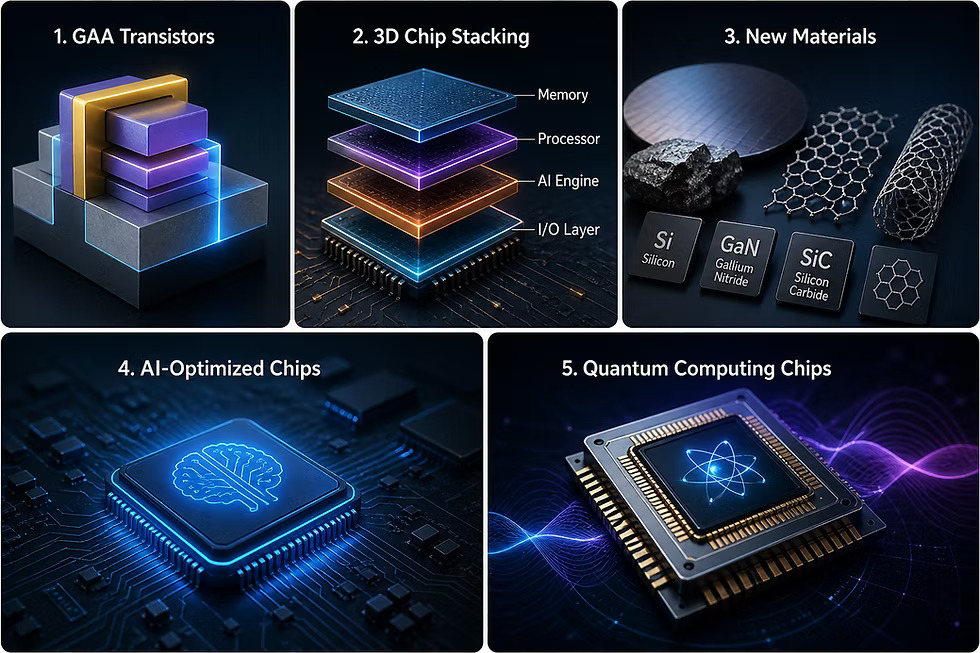
More specialized AI chips: Companies will continue developing processors optimized for particular workloads, including inference, training, networking, and data processing.
Greater emphasis on energy efficiency: As data centers consume more power, performance per watt will become an increasingly important competitive factor.
Expansion of domestic production: Additional factories and supporting facilities may strengthen US manufacturing capabilities, although announced projects will take time to become fully operational.
Growth in advanced packaging: Chiplets, high-bandwidth memory integration, and sophisticated packaging techniques will play a larger role in high-performance computing.
New semiconductor materials: Research into materials such as gallium nitride and silicon carbide may support applications involving power electronics, electric vehicles, renewable energy, and high-frequency communications.
More automation in manufacturing: AI, robotics, and advanced process monitoring may help manufacturers improve quality, reduce waste, and maintain consistent production.
Stronger supply chain diversification: Companies may develop additional suppliers and production options to reduce the impact of disruptions.
These trends will not progress at the same speed, and their commercial success will depend on technical performance, manufacturing costs, customer demand, and the broader economic environment.
Career Opportunities in the American Semiconductor Sector
The expansion of semiconductor research and manufacturing creates opportunities for people with different technical backgrounds.
Potential career paths include:
- Semiconductor process engineer.
- Chip design and verification engineer.
- Electrical and electronics engineer.
- Manufacturing equipment technician.
- Materials science researcher.
- Automation and robotics specialist.
- Semiconductor quality engineer.
- Packaging and testing engineer.
- Manufacturing software developer.
- Supply chain and operations specialist.
Many positions require degrees in electrical engineering, computer engineering, materials science, physics, or related fields. Technical certificates, apprenticeships, and specialized training can also provide entry routes into manufacturing and equipment support.
Students interested in the industry should focus on mathematics, physics, electronics, programming, problem-solving, and practical laboratory experience.
As domestic manufacturing expands, the ability to combine technical knowledge with manufacturing discipline and teamwork will remain valuable.
What the Future Holds for American Semiconductor Leadership
The United States enters late 2026 with a strong position in semiconductor design, research, and industry revenue, alongside significant efforts to expand domestic manufacturing.
Artificial intelligence is creating new demand for processors, memory, networking equipment, and advanced packaging. At the same time, government incentives and private investment are supporting the development of additional manufacturing and research capabilities.
However, investment announcements should not be confused with completed factories or guaranteed commercial success. The industry’s long-term competitiveness will depend on how effectively companies turn research and capital spending into reliable products that customers want to buy.
The United States will also need to maintain strong research programs, train skilled workers, improve manufacturing efficiency, and work with international partners where global supply chains remain essential.
Ultimately, semiconductor leadership is about more than producing a large number of chips. It requires an ecosystem capable of designing advanced technology, manufacturing it reliably, protecting intellectual property, and adapting to changing market needs.
If American companies can combine innovation with competitive manufacturing and resilient supply chains, semiconductors will remain an important foundation of the nation’s technology sector and economic growth.
Frequently Asked Questions (FAQs)
1. Why is the semiconductor industry important in the USA?
The semiconductor industry supports artificial intelligence, cloud computing, automobiles, telecommunications, healthcare, aerospace, and defense. It also contributes to exports, research investment, skilled employment, and national supply chain security.
2. Which companies are major players in the US semiconductor industry?
Major US semiconductor companies include NVIDIA, Intel, AMD, Micron Technology, and GlobalFoundries. Other important participants operate in chip design software, manufacturing equipment, materials, and advanced packaging.
3. How is AI affecting semiconductor demand in 2026?
AI systems require powerful processors, fast memory, networking components, and specialized accelerators. Expanding data centers and AI applications are increasing demand for these technologies, although future demand will depend on investment returns and customer needs.
4. What is the CHIPS Act?
The CHIPS and Science Act is US legislation enacted in 2022 that established support for domestic semiconductor manufacturing, research, and related activities. It aims to strengthen American semiconductor capabilities and improve supply chain resilience.
5. Will the USA manufacture more chips domestically?
The United States is expanding its semiconductor manufacturing ecosystem through new facilities and investments. However, projects require years of planning, construction, equipment installation, and production development, so the impact will emerge gradually.
6. What is advanced semiconductor packaging?
Advanced packaging combines multiple chips or chip components into a single integrated package. It can improve communication between processors and memory, support specialized designs, and increase computing performance.
7. What career opportunities are available in semiconductor manufacturing?
Career opportunities include chip design, process engineering, equipment maintenance, materials science, automation, quality control, packaging, and manufacturing operations. Educational requirements vary by role.
8. What are the biggest challenges facing US chipmakers?
Major challenges include high manufacturing costs, international competition, workforce shortages, energy and water requirements, supply chain dependencies, and uncertainty surrounding demand for expensive AI infrastructure.
Conclusion
The semiconductor industry in the USA in 2026 is at an important point in its development. AI computing, domestic manufacturing investment, advanced packaging, and supply chain resilience are shaping the next stage of growth.
Although significant challenges remain, continued innovation and investment could strengthen the country’s position in this strategically important industry. The companies that combine efficient production, advanced engineering, reliable supply chains, and practical customer solutions will be best positioned to compete in the years ahead.
For businesses, technology professionals, students, and investors researching the American technology sector, semiconductors remain an important industry to watch.


