




Introduction
The electric vehicle industry in the United States is experiencing an important period of change. Automakers are developing new battery technologies, charging networks are expanding, and consumers are comparing electric vehicles with traditional gasoline-powered cars and hybrid models. At the same time, changes in government incentives, vehicle prices, and consumer preferences are influencing the pace of EV adoption.
Electric vehicles, commonly known as EVs, use electric motors powered by rechargeable batteries instead of relying entirely on conventional internal combustion engines. Depending on the model, they may offer lower routine maintenance requirements, quiet operation, and reduced direct emissions during driving.
In 2026, the American EV market is not following a simple path of uninterrupted growth. According to the US Energy Information Administration (EIA), electricity consumption by light-duty electric vehicles increased during the first half of 2026, although growth slowed compared with previous periods. The agency also reported that new EV sales declined following the expiration of federal clean-vehicle tax credits in September 2025. These figures demonstrate why battery technology, charging convenience, vehicle affordability, and public policy remain important factors in the industry’s future.
For consumers and businesses, understanding these developments can help them evaluate the benefits and limitations of electric transportation. For technology companies, the EV market creates opportunities involving battery development, charging equipment, software, energy management, and connected vehicle services.
Understanding Electric Vehicle Technology
Electric vehicles use electrical energy to power one or more electric motors. In a battery-electric vehicle, electricity is stored in a rechargeable battery pack and delivered to the motor through an electrical drive system.
Unlike gasoline-powered vehicles, battery-electric vehicles do not require gasoline for propulsion and have no tailpipe emissions during operation. Their overall environmental impact, however, depends partly on electricity generation, battery manufacturing, vehicle production, and the treatment of batteries at the end of their useful life.
There are several types of electrified vehicles available in the American market.
Battery-electric vehicles (BEVs): These vehicles operate using electric motors and rechargeable batteries. They require an external electricity source for charging.
Plug-in hybrid electric vehicles (PHEVs): These vehicles combine an electric drive system and rechargeable battery with a conventional engine. They can operate electrically for some journeys before using another fuel source.
Hybrid electric vehicles (HEVs): These vehicles combine an electric motor with a combustion engine but generally do not plug into an external power source for charging.
Understanding these differences is important when comparing vehicle prices, driving range, fuel costs, charging requirements, and environmental performance.
Battery-electric vehicles are particularly dependent on battery capacity and charging access. Their practicality can vary considerably depending on how far someone drives, whether they can charge at home, and how frequently they undertake long-distance journeys.
The Current State of the US Electric Vehicle Market
The American electric vehicle market includes established automotive manufacturers, specialist EV companies, battery suppliers, charging-network operators, and software developers.
Companies such as Tesla, General Motors, Ford, Rivian, and Hyundai participate in different segments of the market, while technology suppliers work on batteries, power electronics, vehicle software, and charging equipment.
However, market conditions in 2026 highlight the importance of separating long-term technological development from short-term sales performance.
In its September 30, 2026, analysis, the EIA estimated that US light-duty EV electricity consumption reached nearly 14 billion kilowatt-hours during the first half of 2026. This included electricity consumed by battery-electric and plug-in hybrid vehicles. The agency estimated that consumption was 8% higher than in the second half of 2025, a slower increase than in earlier six-month periods.
The EIA also reported that new EV sales in the first half of 2026 were down 19% compared with the second half of 2025. The expiration of federal clean-vehicle credits was one factor affecting the market.
These figures suggest that electric transportation continues to be used across the country, but consumer purchasing decisions remain sensitive to affordability, incentives, vehicle availability, and charging convenience.
For the latest official data, readers can consult the US Energy Information Administration’s electric vehicle electricity report.
Battery Technology: The Foundation of Electric Vehicles
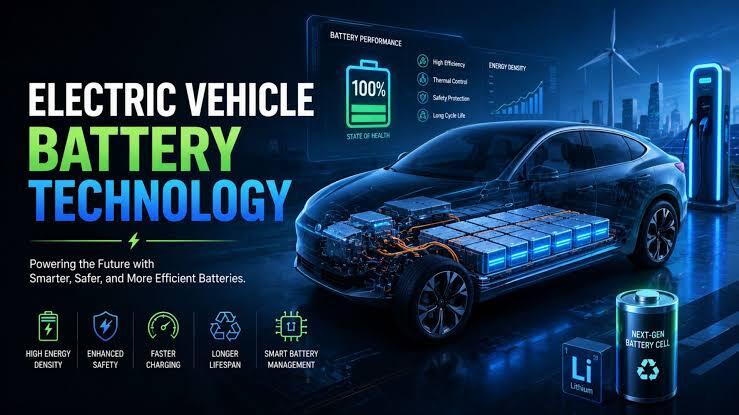
The battery is one of the most important components of an electric vehicle. It influences driving range, charging speed, vehicle weight, production costs, and long-term performance.
Most modern electric cars use lithium-ion battery technology, although manufacturers employ different battery chemistries and pack designs.
Battery development is focused on improving energy density, reducing cost, extending service life, increasing charging performance, and improving safety.
Lithium-Ion Battery Improvements
Lithium-ion batteries remain widely used because they offer a practical balance of energy density, performance, and rechargeability.
Manufacturers continue to refine the materials used in battery cells, the way cells are arranged within packs, and the systems responsible for monitoring battery temperature and charge levels.
Some batteries prioritize energy density, helping vehicles travel farther on a single charge. Others prioritize durability, cost, or performance under particular operating conditions.
For example, lithium iron phosphate batteries are often considered for applications where cost, durability, and thermal characteristics are important. Nickel-rich chemistries may offer advantages in energy density, depending on their specific formulation and design.
There is no single battery chemistry that is ideal for every vehicle. Manufacturers select technologies according to the vehicle’s intended use, cost targets, performance requirements, and supply-chain considerations.
Solid-State Battery Research
Solid-state batteries are attracting attention because they use a solid electrolyte rather than the conventional liquid electrolyte found in many lithium-ion battery designs.
Researchers and manufacturers are investigating whether these batteries can provide higher energy density, improved safety characteristics, or faster charging.
However, important engineering challenges remain, including manufacturing at scale, material durability, production costs, and performance over repeated charging cycles.
Although solid-state battery technology has potential, consumers should be cautious about claims that every upcoming electric vehicle will immediately offer dramatically longer range or extremely short charging times.
Commercial availability and real-world performance depend on successful testing, production capacity, and the specific battery design.
Battery Management Systems
Battery management software monitors important characteristics such as cell voltage, temperature, current, and state of charge.
These systems help maintain safe operating conditions and can limit charging or power delivery when necessary.
More advanced monitoring can also support battery health estimates, maintenance planning, and charging recommendations.
The combination of battery hardware and software is particularly important because a battery pack contains many interconnected cells that must operate within appropriate limits.
EV Charging Infrastructure Across America
Charging infrastructure plays a major role in determining whether electric vehicles are practical for different drivers.
The United States has several types of charging facilities, including home chargers, workplace installations, public charging stations, and high-powered chargers located along major transportation corridors.
According to the International Energy Agency’s Global EV Outlook 2026, the United States had nearly 70,000 public fast and ultra-fast charging points by the end of 2025, following substantial year-over-year growth. Public charging infrastructure continues to develop, although access and reliability differ by region.
The report is available through the International Energy Agency’s electric vehicle charging analysis.
Level 1 Charging
Level 1 charging uses a standard 120-volt household outlet in the United States.
It is generally the slowest charging option and may be suitable for drivers who travel relatively short distances and can leave their vehicles plugged in for extended periods.
Because charging speeds are limited, Level 1 may not meet the needs of every household. Drivers with longer commutes or larger battery packs may need a more powerful charging option.
Level 2 Charging
Level 2 charging generally uses a 240-volt supply and can deliver electricity more quickly than Level 1 charging.
It is commonly used in homes, workplaces, parking facilities, and public charging locations.
For drivers with suitable parking and electrical service, home Level 2 charging can make daily EV ownership more convenient. Installation costs depend on electrical capacity, wiring requirements, equipment selection, and local conditions.
Apartment residents may face additional challenges if their parking spaces do not have dedicated charging facilities.
DC Fast Charging
Direct-current fast charging can supply electricity at much higher power levels than ordinary home charging.
These chargers are especially useful for longer trips, commercial fleets, and drivers who need to recharge during a relatively short stop.
Actual charging speed depends on the charger’s power output, the vehicle’s maximum charging capability, battery temperature, and the battery’s current state of charge.
A vehicle that supports high-powered charging may not maintain its maximum charging rate throughout the entire session. Charging commonly slows as the battery approaches a high state of charge.
This is why manufacturers’ maximum charging claims should not be interpreted as a guarantee of the same charging speed under every condition.
How Charging Networks Are Changing EV Ownership
Public charging networks can help drivers travel beyond the range supported by home charging alone.
Modern charging services increasingly combine hardware with software features such as charger availability information, payment systems, route planning, station status reporting, and remote monitoring.
For drivers, reliable information can be as important as the number of charging stations available. A station that appears on a map but is out of service can create significant inconvenience.
Charging providers therefore need to monitor equipment performance, maintain reliable connections, and make pricing and payment arrangements easy to understand.
Automakers and charging companies also have to address compatibility. Connector standards, charging protocols, vehicle capabilities, and network access can vary.
Before purchasing an electric vehicle, consumers should confirm which connectors it supports and whether their preferred charging networks can serve it directly or through an approved adapter.
The US Department of Energy provides useful background on charging infrastructure through its National EV Charging Network resources.
The Role of Artificial Intelligence in Electric Vehicles
Artificial intelligence and data analysis are becoming increasingly important in vehicle development and operation.
Modern electric vehicles generate information about energy consumption, battery performance, driving conditions, and component status. Software can use this information to support vehicle controls, energy management, and maintenance planning.
Smarter Energy Management
Vehicle control systems can adjust energy use according to driving conditions and the driver’s selected settings.
Navigation software may estimate the amount of battery energy required to reach a destination by considering distance, road conditions, elevation, and other available information.
More sophisticated systems can help drivers identify charging stops before the battery reaches a critically low level.
These estimates are not always exact. Weather, speed, heating and air conditioning, road conditions, and driving style can change actual energy consumption.
Predictive Maintenance
Connected vehicles can report certain faults and operating conditions through onboard diagnostic systems.
Software may identify patterns suggesting that a component needs inspection or that a system is not performing as expected.
For fleet operators, such information can help coordinate service schedules and reduce unexpected vehicle downtime.
However, predictive maintenance systems require reliable data and careful validation. They should complement appropriate inspections rather than replace necessary maintenance procedures.
Software Updates and Connected Services
Some EV manufacturers can deliver software updates that improve selected vehicle functions without requiring a traditional dealership visit for every update.
Depending on the vehicle, updates may affect infotainment, energy management, charging behavior, or driver-assistance features.
These capabilities introduce cybersecurity responsibilities. Manufacturers need secure update processes, appropriate access controls, and procedures for addressing software vulnerabilities.
Consumers should install legitimate updates and follow manufacturer guidance, particularly when an update concerns vehicle safety or charging performance.
EV Battery Recycling and Sustainability
As electric vehicle use expands, battery recycling and end-of-life management are becoming increasingly important.
EV batteries contain valuable materials that may be recovered and reused in suitable applications. Recycling can help reduce demand for newly extracted materials, although the actual environmental and economic benefits depend on collection systems, processing methods, and material recovery rates.
Battery recycling is technically complex. Packs contain multiple materials, and different chemistries require different handling and processing approaches.
Manufacturers and recycling companies are working to improve material recovery, reduce processing costs, and develop more effective systems for handling used batteries.
Not every battery that is removed from a vehicle must be recycled immediately. Some batteries may retain sufficient capacity for less demanding applications, depending on their condition, safety, and suitability.
However, second-life use requires careful testing and appropriate battery management. A damaged or improperly handled battery can present significant safety risks.
The long-term sustainability of EVs depends on the full lifecycle, including manufacturing, electricity generation, vehicle use, and battery recovery.
Challenges Facing the US Electric Vehicle Industry
Despite technological progress, several issues continue to influence EV adoption in America.
Vehicle Affordability
Purchase price remains an important factor for many consumers.
Although operating and maintenance costs can differ favorably from those of gasoline vehicles in some circumstances, buyers must still consider the initial purchase price, financing costs, insurance, depreciation, and home charging expenses.
Federal, state, and utility incentives may affect the overall cost, but eligibility and availability can change.
Because federal clean-vehicle credits ended in September 2025, consumers considering an EV in 2026 should not assume that previously advertised federal credits remain available. Current state and local programs should be checked separately.
Charging Access
Drivers with garages or dedicated parking may find home charging relatively convenient.
People living in apartments, condominiums, or homes without private parking may depend more heavily on public charging.
This can increase travel time and make ownership more complicated, especially where public chargers are limited or unreliable.
Improving access to multifamily charging and dependable public infrastructure remains important for expanding the range of households that can practically use EVs.
Driving Range and Weather
Driving range varies by model, battery capacity, driving conditions, and energy use.
Cold weather can reduce battery efficiency and increase energy consumption for cabin heating. High temperatures may also affect energy management and battery conditioning.
Highway speeds, steep terrain, towing, and heavy loads can reduce range compared with favorable test conditions.
Drivers should therefore evaluate vehicles according to their real travel needs rather than relying exclusively on a manufacturer’s maximum range figure.
Electricity Supply and Grid Planning
Widespread EV charging creates additional electricity demand.
Utilities and communities must plan for the location, timing, and concentration of charging activity. Large charging facilities and commercial fleets may require electrical upgrades.
Smart charging systems can help shift some charging to periods when electricity demand is lower, depending on electricity rates and local grid conditions.
The US Department of Energy discusses these issues in its EVGrid Assist resources.
Battery Supply Chains
Battery production depends on complex supply chains for minerals, processed materials, battery cells, and manufacturing equipment.
Changes in commodity prices, trade policies, production capacity, and international competition can influence battery costs.
Expanding domestic manufacturing and developing alternative battery chemistries may help diversify supply, but these changes require investment and time.
How Consumers Can Evaluate an Electric Vehicle in 2026
Choosing an electric vehicle requires more than comparing advertised range figures.
Consumers should begin by examining their normal driving patterns. Daily commuting, occasional long-distance travel, towing requirements, and access to parking can influence which model is most suitable.
Charging access should be evaluated before the purchase. Drivers should determine whether home charging is possible, whether electrical upgrades are needed, and which public charging networks operate along frequently used routes.
The total cost of ownership is another important consideration. This includes purchase price, financing, insurance, charging costs, maintenance, tires, depreciation, and any applicable incentives.
Buyers should also compare battery warranties, charging capabilities, connector compatibility, and the manufacturer’s service arrangements.
A practical approach is to compare at least several suitable models and use realistic assumptions about annual mileage and local electricity prices.
An EV may be a good choice for one household and less suitable for another. The right decision depends on individual needs rather than general claims about the superiority of one type of vehicle.
The Future of Electric Vehicle Technology in America
The future of the US EV industry will depend on the interaction of technology, economics, consumer preferences, infrastructure, and public policy.
Battery researchers will continue investigating ways to improve energy density, durability, charging performance, and material efficiency. Automakers will have to balance these developments against production costs and the demand for different vehicle categories.
Charging networks are likely to remain a major area of investment and technical development. Reliable public charging, improved access to home and workplace charging, and better interoperability can make electric transportation more convenient.
Connected vehicle software may also become more sophisticated, with improved energy estimates, route planning, diagnostics, and integration with charging services.
Vehicle-to-home and vehicle-to-grid technologies are additional areas of interest. Compatible systems may allow certain EVs to supply stored energy to a home or, under suitable arrangements, provide electricity to the grid. Their practical use depends on vehicle capability, charging equipment, utility rules, and installation costs.
Commercial fleets may adopt electric vehicles where duty cycles, charging access, and operating economics support the transition. However, heavy-duty vehicles and long-distance trucking face different requirements from passenger cars, including battery size, payload, charging power, and route planning.
The industry is therefore likely to develop at different speeds across vehicle categories and regions.
Conclusion
Electric vehicle technology continues to evolve across the United States, creating opportunities in battery research, charging infrastructure, connected software, and energy management.
The industry is also facing practical challenges involving affordability, charging access, battery supply chains, electricity demand, and changing government policies.
Recent US data show that EV electricity consumption continues to grow, even as the pace of growth and new vehicle sales have been affected by changing market conditions. This makes it especially important to evaluate the industry using reliable statistics rather than assuming that adoption always increases at the same rate.
For consumers, the most important factors remain practical: vehicle price, driving range, charging access, reliability, and long-term ownership costs.
For businesses, opportunities may exist in charging services, fleet management, battery recycling, energy optimization, and automotive software. Successful projects will depend on addressing genuine customer needs and building reliable systems.
Electric vehicles are not a universal solution for every transportation requirement, but continued improvements in batteries, charging technology, and vehicle software may expand their usefulness over time.
The long-term direction of the American EV market will depend on how effectively automakers, technology providers, charging operators, utilities, and policymakers respond to these challenges.
Frequently Asked Questions
1. What is the latest trend in electric vehicle technology in the USA?
Major areas of development include battery improvements, public charging infrastructure, connected vehicle software, charging interoperability, and research into next-generation battery chemistries.
2. Are electric vehicles becoming more affordable in 2026?
Affordability varies by vehicle model, manufacturer, financing terms, and local market conditions. Consumers should compare total ownership costs and verify any available incentives rather than assuming every EV is cheaper than a gasoline vehicle.
3. How long does it take to charge an electric vehicle?
Charging time depends on battery size, charger power, vehicle charging capability, temperature, and the battery’s current charge level. Household charging can take several hours, while compatible DC fast chargers may provide substantial additional range in a shorter stop.
4. What is the difference between a hybrid and a fully electric vehicle?
A conventional hybrid uses an electric motor alongside a combustion engine and generally does not plug in. A battery-electric vehicle uses electricity stored in a rechargeable battery for propulsion and must be charged externally.
5. Are public EV charging stations available throughout the United States?
Public charging stations operate across the country, including urban areas and major highway routes. Availability, reliability, charging speed, and network coverage differ by location, so drivers should plan longer trips using current charging information.
6. What are solid-state batteries?
Solid-state batteries use a solid electrolyte and are being researched for potential improvements in energy density, safety, and charging performance. Manufacturing costs, durability, and large-scale production remain important challenges.
7. Can an electric vehicle help reduce emissions?
Battery-electric vehicles have no tailpipe emissions during driving. Their overall emissions depend on electricity generation, manufacturing, battery production, and other lifecycle factors. Their environmental benefits therefore vary by vehicle and energy system.
8. Will electric vehicles replace gasoline cars completely?
The future mix of vehicles is uncertain and depends on costs, technology, infrastructure, policy, and consumer preferences. Battery-electric vehicles, hybrids, plug-in hybrids, and conventional vehicles may continue to serve different needs for some time


