




Introduction
Technology continues to transform the way businesses operate across the United States. From small startups and online retailers to major corporations and financial institutions, American companies are investing in digital solutions to improve productivity, reduce operating costs, and deliver better customer experiences. Among the most important developments in 2026 are artificial intelligence (AI), cloud computing, automation, and advanced data analytics.
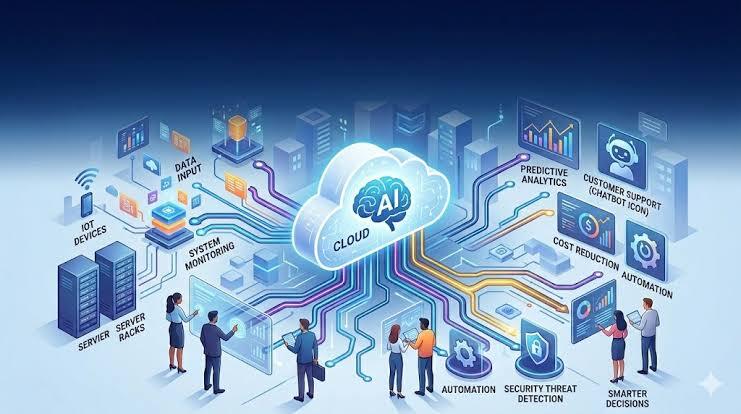
These technologies are no longer limited to large technology companies. Businesses in healthcare, education, transportation, manufacturing, retail, and professional services are increasingly exploring ways to integrate digital tools into their daily operations. Cloud platforms provide the computing power and storage needed to manage growing amounts of information, while AI systems help organizations analyze data, automate repetitive work, and make more informed decisions.
The combination of AI and cloud computing is particularly important because it allows companies to access advanced technology without necessarily building and maintaining expensive infrastructure themselves. Instead of purchasing large amounts of physical equipment, organizations can use cloud-based services and scale their resources according to changing business requirements.
However, adopting these technologies also introduces challenges involving cybersecurity, privacy, employee training, operational expenses, and responsible AI use. Understanding both the opportunities and the limitations is essential for American businesses seeking sustainable digital growth.
This article explores how AI and cloud computing are changing US businesses in 2026, the industries benefiting from these developments, the challenges organizations face, and the technology trends companies should monitor.
What Is Cloud Computing and Why Does It Matter?
Cloud computing allows businesses to access computing resources through internet-connected services rather than relying entirely on computers and servers located at their own facilities.
These resources can include data storage, application hosting, databases, networking, analytics tools, and computing power. Businesses can select services according to their requirements and expand their usage as their operations grow.
For example, an American e-commerce company may use cloud infrastructure to host its website, manage product information, process orders, and analyze customer activity. During busy shopping periods, the company can increase its computing resources and reduce them when demand declines.
This flexibility can be particularly valuable for businesses experiencing seasonal demand or rapid growth.
Cloud computing also supports remote work. Employees can access authorized applications and documents from different locations, helping organizations maintain operations across multiple offices or distributed teams.
Major cloud providers serving the US market include Amazon Web Services, Microsoft Azure, and Google Cloud. Each offers a broad range of infrastructure, data management, security, and AI-related services.
Nevertheless, moving to the cloud does not automatically guarantee lower costs or better security. Businesses must select suitable services, monitor usage, configure access controls, and understand the responsibilities shared between the provider and the customer.
How Artificial Intelligence Is Changing American Companies
Artificial intelligence refers to computer systems designed to perform tasks that commonly require human-like capabilities, such as recognizing patterns, understanding language, generating content, and making predictions from data.
In 2026, businesses are exploring AI applications across many departments, including customer support, marketing, software development, operations, and financial analysis.
One of the biggest advantages of AI is its ability to process large amounts of information quickly. Instead of manually reviewing every record, employees may use AI-powered tools to summarize documents, identify unusual patterns, or organize information into useful categories.
AI can also help employees prepare reports, draft internal communications, and locate information across company documents. These applications can reduce repetitive work and allow staff to concentrate on tasks requiring judgment, creativity, and human interaction.
However, AI-generated information is not always accurate. Companies should establish review procedures for important decisions, especially when outputs could affect customers, employees, finances, or legal obligations.
AI-Powered Customer Support
Customer service is one area where AI and cloud computing can work together effectively.
Cloud-based customer support platforms can manage conversations from websites, email, messaging applications, and other communication channels. AI tools can help classify incoming requests, suggest responses, summarize previous conversations, and direct customers to relevant information.
For example, an online retailer may use an AI assistant to answer common questions about shipping, order status, return policies, and product specifications.
More complicated cases can be transferred to human representatives. This approach can help businesses respond to routine questions faster while allowing support teams to focus on problems that require personal attention.
Companies must still provide clear escalation options, protect customer information, and regularly check whether automated responses are accurate and useful.
AI for Business Data Analysis
Businesses collect information from sales transactions, website visits, customer interactions, supply chains, and internal operations.
AI-assisted analytics can help organizations identify patterns in these datasets. A retailer might use historical sales information to estimate future demand, while a logistics company could examine delivery records to identify recurring delays.
Cloud computing makes these applications easier to deploy because organizations can access scalable storage and processing resources.
However, reliable analysis depends on reliable data. Incomplete records, outdated information, and biased datasets can lead to misleading results. Human review remains important when analytical findings influence major business decisions.
The Growing Role of Cloud-Based AI Services
Developing and operating advanced AI systems can require significant computing power, specialized software, and technical expertise.
Cloud-based AI services help reduce some of these barriers by offering access to computing infrastructure, prebuilt models, development tools, and data-processing capabilities.
A startup in the United States, for instance, may use a cloud platform to develop an AI-powered application without constructing its own data center. The company can begin with a limited deployment and increase its usage if customer demand grows.
Established businesses can also use cloud infrastructure to experiment with AI applications while maintaining existing systems.
Cloud-based AI can support several business functions:
- Automated document processing and information extraction.
- Customer service assistants and conversational interfaces.
- Software development and code analysis.
- Demand forecasting and inventory planning.
- Fraud detection and unusual-activity monitoring.
- Business intelligence and reporting.
- Personalized recommendations and search.
Each application has different technical and operational requirements. Companies should evaluate accuracy, latency, security, integration costs, and the sensitivity of the information involved before choosing a solution.
How US Small Businesses Can Benefit From These Technologies
Small businesses frequently operate with limited budgets and small teams. They may not have dedicated departments for IT infrastructure, data science, or cybersecurity.
Cloud computing can provide access to tools that would otherwise require substantial upfront investment. Subscription-based software, online collaboration platforms, cloud storage, and managed security services allow smaller organizations to adopt digital capabilities gradually.
AI tools can also assist with everyday activities.
A local service company might use AI to draft appointment reminders, organize customer inquiries, or prepare initial marketing content. An online store could use analytics tools to understand which products receive the most attention. A consulting business might use approved AI tools to summarize lengthy documents or structure project notes.
The objective should not be to automate every task. Instead, businesses should identify specific activities that consume time without creating much additional value.
A practical adoption strategy begins with one clearly defined problem. The company can test a suitable tool, measure its results, and expand its use only if the benefits justify the cost.
Small businesses should also review subscription fees, usage-based charges, data handling policies, and employee access permissions. Multiple inexpensive subscriptions can become costly when they overlap or remain unused.
Major US Industries Adopting AI and Cloud Technology
Healthcare
Healthcare organizations use cloud platforms for applications such as scheduling, data management, collaboration, and selected analytics workloads.
AI-assisted systems may help organize medical documentation, summarize information, and support administrative workflows. Some specialized systems are also designed to assist qualified professionals with clinical analysis.
Healthcare applications require particularly careful oversight because medical information is sensitive and mistakes can have serious consequences.
Organizations must consider applicable privacy and security requirements, including HIPAA where relevant, and ensure that tools are appropriate for their intended use.
AI should not replace qualified medical judgment or be treated as a reliable source of clinical decisions without suitable validation and oversight.
Financial Services
Banks, payment companies, insurers, and financial technology businesses process large volumes of transactions and customer information.
Cloud infrastructure can support data processing, digital banking applications, and selected analytical workloads. AI can help identify suspicious transaction patterns, assist with customer support, and support risk analysis.
Financial institutions must also manage regulatory obligations, model risk, data privacy, and operational resilience.
A system that incorrectly flags legitimate activity can inconvenience customers, while a system that misses suspicious behavior can create financial losses. Regular testing and human oversight are therefore essential.
Retail and E-Commerce
Retailers use digital platforms to manage online stores, inventory, marketing, and customer relationships.
AI-assisted recommendation systems can suggest products based on relevant customer activity. Forecasting tools can help businesses estimate demand, while automated support systems can handle routine questions.
Cloud infrastructure also helps online retailers manage changing website traffic and coordinate information across multiple sales channels.
Companies should avoid excessive personalization or unnecessary collection of customer data. Clear privacy practices can help maintain customer trust.
Manufacturing and Logistics
Manufacturers and logistics companies can use cloud-based analytics to examine equipment performance, production schedules, delivery records, and inventory levels.
Predictive maintenance systems attempt to identify warning signs before equipment fails. Route-planning tools can help logistics teams compare delivery options, while demand forecasting can support purchasing and production planning.
These systems depend on accurate operational data and suitable integration with existing equipment.
Businesses should evaluate whether the expected improvements justify implementation costs, staff training, and ongoing maintenance.
Education and Professional Services
Educational institutions and professional service firms are also exploring cloud applications and AI-assisted workflows.
These technologies can support document organization, research, collaboration, administrative communication, and personalized learning activities.
However, organizations should develop clear policies about acceptable AI use, confidential information, copyright, and the verification of generated content.
In educational environments, AI should support learning rather than undermine independent thinking or assessment integrity.
Cybersecurity Challenges in the AI and Cloud Era
As businesses adopt more digital tools, cybersecurity becomes an increasingly important part of technology planning.
Cloud services can provide sophisticated security capabilities, but their effectiveness depends partly on how organizations configure and manage them.
Common risks include stolen passwords, phishing attacks, exposed databases, insecure applications, excessive user permissions, and compromised third-party services.
AI creates additional concerns. Attackers may use AI tools to produce convincing phishing messages, while poorly controlled AI applications can expose confidential information or provide unauthorized access to business data.
Organizations should adopt several practical safeguards.
Use multifactor authentication. Requiring an additional verification step can make stolen passwords less useful to attackers.
Apply least-privilege access. Employees and applications should receive only the permissions needed for their responsibilities.
Maintain reliable backups. Businesses should keep protected backups and periodically test whether they can restore essential information.
Monitor cloud configurations. Storage permissions, network settings, administrative accounts, and security logs should be reviewed regularly.
Train employees. Staff should understand phishing, suspicious links, social engineering, and the appropriate use of AI tools.
Control sensitive information. Companies should identify which data can be shared with external AI services and which information must remain within approved systems.
Prepare an incident response plan. Organizations should know how to isolate affected systems, investigate incidents, communicate appropriately, and restore operations.
Cybersecurity is not a one-time purchase. It requires continuing attention, updated procedures, and clear responsibility across the organization.
Managing Cloud Costs and AI Expenses
Cloud computing can reduce the need for large upfront infrastructure purchases, but ongoing expenses still require careful management.
Businesses may pay for storage, computing time, data transfers, software licenses, AI model usage, security tools, and technical support.
AI applications can introduce additional costs when they process large volumes of documents or generate frequent responses.
A common mistake is to launch a project without estimating its long-term operating expenses. Another is to leave test environments, unused resources, or duplicate subscriptions running indefinitely.
Companies can improve cost management by setting budgets, reviewing billing reports, establishing usage alerts, and removing resources that are no longer needed.
They should also measure business outcomes instead of evaluating a technology solely by its technical performance.
For example, an AI support tool might reduce the time needed to answer routine questions. The company should compare that improvement with implementation costs, review requirements, error rates, and customer satisfaction.
The best solution is not necessarily the most advanced or expensive one. It is the solution that reliably addresses a real business need at an acceptable total cost.
The Importance of Responsible AI Adoption
Responsible AI adoption involves more than installing software and allowing employees to use it.
Businesses should establish policies covering accuracy, privacy, transparency, security, accountability, and human oversight.
Employees should understand when AI-generated material requires verification and which tasks must remain under qualified human supervision.
Companies should also examine whether AI systems produce inconsistent or unfair results for different groups of people.
For higher-risk applications, organizations may need formal testing, documentation, independent review, and stronger controls.
The National Institute of Standards and Technology provides the AI Risk Management Framework, which offers guidance for organizations seeking to identify and manage AI-related risks.
Using a structured approach can help businesses balance innovation with accountability. It also gives employees a clearer understanding of how AI tools should be used in everyday work.
Practical Steps for Businesses Planning Digital Transformation
Organizations do not need to modernize every system at once. A gradual strategy can help them control risk and learn from early results.
Step 1: Identify a Business Problem
Start by determining what needs improvement. Common examples include slow customer responses, inefficient reporting, unreliable backups, or difficulty accessing business information.
Step 2: Review Existing Systems
Examine current software, infrastructure, security arrangements, and data quality. Some problems may be solved through better configuration rather than a complete technology replacement.
Step 3: Compare Suitable Solutions
Evaluate cloud providers and AI tools according to their features, integration requirements, security controls, pricing, and contractual terms.
Step 4: Run a Small Pilot Project
Test the selected solution with a limited group of users or a clearly defined workflow. Avoid moving sensitive information into unapproved systems during experimentation.
Step 5: Measure the Results
Track meaningful indicators such as processing time, error rates, customer satisfaction, operating expenses, and employee productivity.
Step 6: Train Employees
Give staff practical guidance on using the tools, verifying outputs, protecting information, and reporting problems.
Step 7: Expand Carefully
Increase adoption only when the pilot demonstrates measurable benefits and the organization has suitable safeguards in place.
This approach helps businesses avoid unnecessary spending and build confidence before committing to larger deployments.
Future Technology Trends for US Businesses
Several developments are likely to influence how American businesses approach technology over the coming years.
More Specialized AI Applications
Rather than relying exclusively on general-purpose assistants, companies may increasingly explore AI systems designed for specific industries and workflows.
Specialized tools can be more useful when they have access to appropriate business information and are carefully evaluated for their intended purpose.
Greater Focus on AI Governance
As AI becomes integrated into important operations, businesses will need clearer policies for evaluating models, managing data, documenting decisions, and monitoring performance.
Governance will be particularly important for organizations working with sensitive information or high-impact decisions.
Hybrid and Multicloud Strategies
Some businesses will continue combining public cloud services with private infrastructure or systems maintained at their own facilities.
These arrangements can help address particular security, performance, regulatory, or legacy-system requirements. However, they may also increase operational complexity.
Edge Computing and Real-Time Processing
Edge computing processes information closer to where it is generated, such as in factories, vehicles, retail locations, or connected devices.
This can reduce delays for certain applications and limit the need to transmit every piece of raw data to a distant cloud server.
Increased Attention to Digital Resilience
Organizations are likely to place greater emphasis on backup systems, disaster recovery, vendor risk, incident response, and the ability to continue operating during disruptions.
Digital resilience is becoming an important consideration alongside performance and cost.
These developments will not affect every company equally. Businesses should prioritize technologies that address their own operational requirements instead of adopting trends simply because they attract attention.
Conclusion
AI and cloud computing are changing the way businesses across the United States develop products, manage information, communicate with customers, and organize daily operations.
Cloud platforms provide flexible infrastructure and access to digital services, while AI can help employees analyze information, automate repetitive tasks, and improve selected workflows.
Small businesses can benefit from these capabilities just as larger organizations can, provided they choose tools that match their budgets and operational needs.
At the same time, successful adoption requires careful attention to cybersecurity, privacy, data quality, employee training, and ongoing costs. AI outputs must be evaluated appropriately, and sensitive applications should include suitable human oversight.
For American businesses in 2026, the most effective technology strategy is not simply to use more AI or move everything to the cloud. It is to solve specific problems, measure meaningful results, protect important information, and expand successful projects responsibly.
Companies that combine practical planning with continuous learning will be better positioned to adapt as digital technology continues to evolve.
Ultimately, AI and cloud computing are tools rather than automatic guarantees of success. Their value depends on how thoughtfully organizations integrate them into their business strategies and how effectively they use them to serve employees, customers, and long-term organizational goals.
Frequently Asked Questions
1. How are AI and cloud computing helping US businesses in 2026?
They can help businesses automate repetitive tasks, manage data, scale digital services, improve customer support, and analyze operational information. Results depend on the quality of implementation and the suitability of each tool.
2. Which US industries benefit from cloud computing and AI?
Healthcare, financial services, retail, manufacturing, logistics, education, and professional services all have potential applications. The specific benefits vary according to each industry’s requirements and regulatory environment.
3. Is cloud computing affordable for small businesses?
Cloud computing can reduce upfront hardware costs because many services use subscription-based or usage-based pricing. However, businesses must monitor ongoing expenses and avoid paying for unused resources.
4. Is AI safe for business use?
AI can be useful when organizations select appropriate tools, protect confidential data, verify important outputs, and establish clear oversight procedures. No AI system should be assumed to be completely accurate or secure.
5. What should a company consider before adopting AI?
A company should identify its business objectives, evaluate data quality, compare costs, review privacy and security requirements, test the proposed solution, and train employees before expanding its use.
6. What is the future of cloud computing in the United States?
Cloud computing is likely to remain important for digital applications, data analytics, AI services, collaboration, and business infrastructure. Organizations will continue balancing scalability and innovation with security, cost, and operational resilience.


